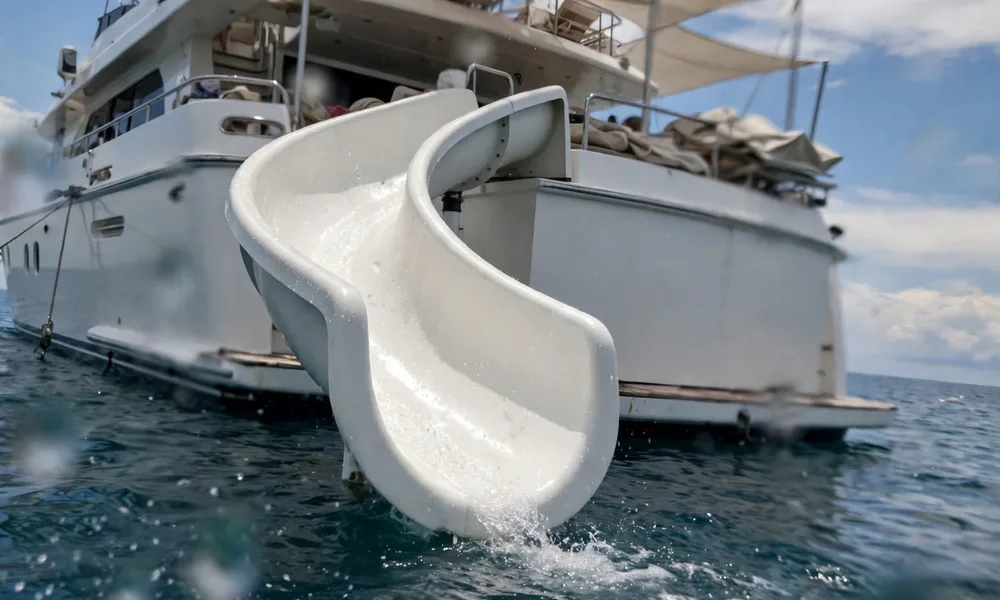
The broker’s spec sheet listed the slide in a single line, between the tender and the jet skis, as if it were a piece of deck furniture. Length in metres, a drop in metres, a flow rate in litres per minute, and a weight limit that looked borrowed from a lift. Nobody on the viewing party asked what any of it meant, because a slide looks too simple to need explaining.
A luxury yacht water slide is a fixed fibreglass flume that carries riders from a high deck down to the sea beside the hull, with a pump keeping a thin film of water running down its surface. Every number on the sheet matters more at sea than it would in a water park, because the slide hangs off a moving boat, weighs over a tonne high up, and ends in open water. This is a plain translation of the figures that matter, and the ones that are mostly decoration.

1. Length and drop, and why height is the first number
The first numbers on the sheet are the slide length and the drop, and on a luxury yacht the flume usually runs between 8 and 15 metres long, with a drop of 6 to 10 metres from the starting deck to the water. The drop is the figure that sets the ride, because a rider falling 8 metres gathers real speed, and the flume must be long enough to turn that fall into a curve rather than a plunge.
The length to check is the riding length, the distance a rider actually travels along the flume, not the straight-line distance from the top to the sea. A slide that curves in a lazy S can be 12 metres of flume in only 7 metres of deck space, and that extra curve is what keeps the ride smooth. The pool the slide usually lands beside has its own numbers in luxury yacht pool specs explained.
2. Flume diameter and curve, and the speed inside the tube
Flume diameter is measured across the inside of the slide, and on a yacht it usually falls between 60 and 90 centimetres. That sounds generous until a grown adult sits in it, because shoulders and knees fill most of the width, and a flume narrower than 70 centimetres feels tight for anyone broad. The diameter also sets the water depth inside, since a wider flume spreads the same flow thinner.
The curve is measured by its radius, and a gentle radius of several metres keeps a rider pressed into the flume instead of bouncing off the walls. A tight bend at speed is where riders bruise elbows and where the fibreglass takes the hardest knocks, so a sheet that quotes a small radius is warning you about a fast, rough ride. Speed at the exit is usually between 20 and 30 kilometres per hour, which is why the run-out into the sea is kept clear of the hull.
3. Water flow rate, and the thin film that makes it slide
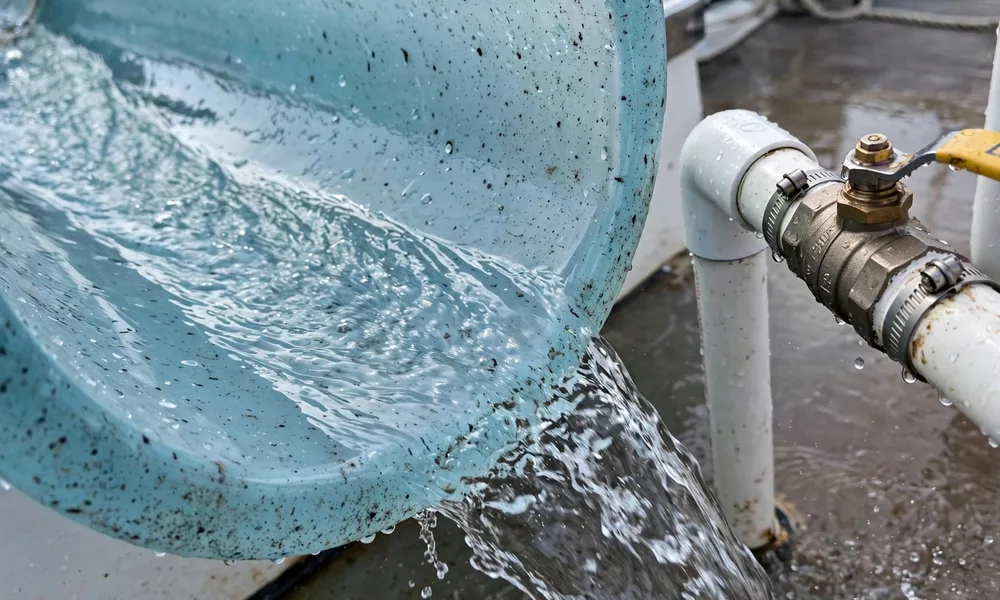
Flow rate is measured in litres per minute, and a yacht slide pump usually delivers between 150 and 400 litres per minute down the flume. The water is not a river the rider floats on, but a thin film a few millimetres deep that separates skin and swimsuit from the fibreglass, and without it the ride would be slow, hot and rough.
The figure to check next to flow is the pump power, because the pump must lift that water from the sea or the yacht’s tanks all the way to the top of the slide, a height of 6 to 10 metres, while the yacht rolls. The deck the slide starts from is measured in luxury yacht sun deck specs explained.
4. Load rating and rider weight, and the frame underneath
Load rating is the maximum rider weight the slide is built for, usually between 100 and 120 kilograms, and it is a structural figure, not a suggestion. The flume is held by a steel frame bolted to the deck, and every rider’s weight presses down and outward on the curve at speed, loading the frame in a way a static test never quite captures.
The number to check beside the rider limit is the frame’s own rating, because the frame also carries the weight of the flume, the water inside it, and the wind load on a structure that stands proud of the deck like a sail. A slide rated for 120 kilograms but bolted to a light frame will flex at the joints, and flex is what cracks fibreglass over a season. The beach area the slide serves is covered in luxury yacht beach club specs explained.
5. Weight and stowage, and what the yacht carries for fun
Total weight is measured in kilograms, and a yacht slide with its frame usually weighs between 800 and 1,500 kilograms, all of it carried high up on the yacht, where weight affects stability most. That is roughly the weight of a small car, hung off the side of the sun deck, and the yacht’s designers must allow for it before the slide is ever fitted.
Stowage is the number most sheets hide, because many slides are built to be unbolted and taken apart for winter or for a long ocean passage, when a tall flume in a storm is a liability. Ask how many sections the flume splits into, how long the crew need to remove it, and where the sections are stored, because a slide that cannot be stowed is a slide the yacht must carry through weather it was never designed for.
6. The numbers at a glance, the price, and the rare fact
| Figure | Typical range | What it means |
|---|---|---|
| Flume length | 8 to 15 metres | Riding length, not straight-line distance |
| Drop | 6 to 10 metres | Sets the speed of the ride |
| Flume diameter | 60 to 90 centimetres | Under 70 feels tight for adults |
| Flow rate | 150 to 400 litres per minute | Thin film, not a river |
| Rider limit | 100 to 120 kilograms | Structural figure, not a suggestion |
| Total weight | 800 to 1,500 kilograms | Carried high up, affects stability |
As a typical and indicative range, a custom water slide for a luxury yacht usually costs roughly 150,000 to 500,000 dollars fitted, depending on length, curve, finish and the steel frame, before the cost of the pump, the plumbing and the deck reinforcement underneath it. A short, straight slide on a smaller yacht sits at the low end, while a long, curved flume in a colour matched to the hull sits at the high end.
The rare fact is that a yacht slide is almost never used while the yacht is under way, not because it is unsafe at speed, but because the exit point moves. In a swell the sea rises and falls by a metre or more beside the hull, so a rider leaving the flume can meet water that is suddenly higher or lower than the designer planned, and the crew wait for anchor before they open the slide. Read the drop, the diameter and the flow rate before the length, and the slide will tell you the truth about itself.