Pick up a phone in a dark room and the screen does not glow like a lamp behind glass. The picture seems to sit on the surface itself, black where it should be black, colour so deep it looks wet. There is no backlight fighting its way through. Each tiny dot of the picture makes its own light, and when a dot is told to be black, it simply switches off.
That is the trick of an OLED panel, and it is a trick made of chemistry as much as electronics. The screen in your hand is a sandwich only a fraction of a millimetre thick, built from glass, silicon, metals and layers of carbon-based molecules that glow when electricity passes through them. Every one of those layers solves a problem: how to make light without heat, how to keep water out, and how to bend without breaking.
Here is what those materials are, and why each one earned its place.

The Materials Behind the OLED Display Panel
1. Glass, the foundation everything else stands on
Almost every rigid OLED panel starts life as a sheet of glass, and it is not ordinary window glass. Display makers use a special alkali-free glass, usually a borosilicate type, made almost perfectly flat and smooth. It must stay stable while it is heated again and again during manufacturing, and it must not release sodium or other ions that would poison the electronics built on top of it. The journey from that bare sheet to a finished screen is described in how an OLED display panel is made, from the first coating to the final test. Flexible panels swap the glass for a bendable polyimide plastic film, but the job is the same.
2. The transistor backplane, silicon that switches each pixel
On top of the substrate sits the backplane, a grid of millions of tiny thin-film transistors that switch each pixel on and off. Most phone panels use low-temperature polysilicon, known as LTPS, because its transistors switch fast enough for high refresh rates. Larger television panels often use IGZO, a transparent oxide of indium, gallium, zinc and oxygen. Either way, the transistors are silicon layers only nanometres thick, patterned by the same photolithography used for computer chips. If one transistor fails, its pixel can stick on or off forever, which is why the backplane is made in clean rooms.
3. The organic layers, molecules that make their own light
The heart of the panel is a stack of organic layers, carbon-based compounds laid down in films thinner than a human hair. One layer carries positive charge, another carries negative charge, and between them sits the emissive layer, where the two meet and release their energy as light. Red, green and blue sub-pixels use different molecules, and the blue one has always been hardest to make: it needs more energy to glow and wears out fastest, which is one reason screens shift colour as they age. Brightness, pixel density and more are laid out in the OLED display panel specs explained, and they show how much of a panel’s performance is decided by chemistry. These materials are so sensitive to air that they are deposited in vacuum chambers, where a single breath of humid air can ruin a batch.
4. The electrodes, a window and a mirror
Electricity has to reach the organic layers, and the two electrodes that do the job could hardly be more different. The front electrode must be transparent, so the light can escape, and it is usually made from indium tin oxide, a ceramic that conducts electricity while letting light through. The rear electrode is a mirror, a thin film of metal, often a magnesium and silver alloy, that reflects stray light back towards the viewer and completes the circuit. The indium is one of the rarest materials in the panel, mined in small quantities as a by-product of zinc production. Where the electrodes meet the organic layers, the whole stack is only a few hundred nanometres thick, thinner than a soap bubble wall.
5. Encapsulation, the seal that keeps water out
The organic layers have one great enemy: water. A tiny amount of moisture, or even oxygen, can react with the glowing molecules and leave a growing black spot on the screen. So the panel is sealed with thin-film encapsulation, alternating layers of inorganic material such as silicon nitride or aluminium oxide with soft organic layers that smooth over any pinholes. The seal may be only a few micrometres thick, yet it must block water vapour for years while the panel flexes and heats in daily use. Rival displays solve the same problem differently, and the materials behind a micro-LED display show how an inorganic screen avoids the moisture problem altogether, at the cost of far harder manufacturing.
6. The polariser, cover glass and glue that finish the job
The last layers are the ones you actually touch. A circular polariser sits above the electrodes to stop ambient light reflecting off the metal mirror inside, which is what keeps the blacks black in bright sunlight. Above that is an optically clear adhesive, a transparent glue that bonds the stack without bubbles or yellowing, and finally a cover glass, chemically strengthened so its surface resists scratches and drops. The cover glass is the thickest layer in the panel, and a cracked cover can sometimes be swapped, but damage reaching the organic layers is usually the end of the screen.
OLED Display Panel Materials
| Material | Where it is used | Why it is chosen |
|---|---|---|
| Alkali-free borosilicate glass | Substrate | Flat, stable when heated, keeps ions away from electronics |
| LTPS silicon or IGZO | Transistor backplane | Fast switching, low leakage, patterned like a computer chip |
| Organic emissive molecules | Light-emitting layers | Glow when powered, no backlight needed, rich colour |
| Indium tin oxide | Transparent front electrode | Conducts electricity while letting light through |
| Magnesium-silver alloy | Rear electrode | Reflects light forward and completes the circuit |
| Silicon nitride and aluminium oxide | Thin-film encapsulation | Blocks water and oxygen in layers only micrometres thick |
| Chemically strengthened cover glass | Outer surface | Scratch and drop resistant, protects everything below |
What Does an OLED Panel Cost?
A replacement phone OLED panel is estimated at roughly $100 to $300 including labour, depending on the model and whether the panel is an original part, while a large television panel can be estimated at several hundred dollars or more on its own. Manufacturing is expensive because yield matters: one dust particle can scrap a whole panel.
A Rare Fact
The first practical OLED device was built in 1987 by two researchers at Kodak, Ching Tang and Steven Van Slyke, who made a thin organic film glow green with only a small battery. Their device was dim by modern standards and would have died within hours in open air, but the idea was the same one in every phone screen today: organic molecules turning electricity directly into light.
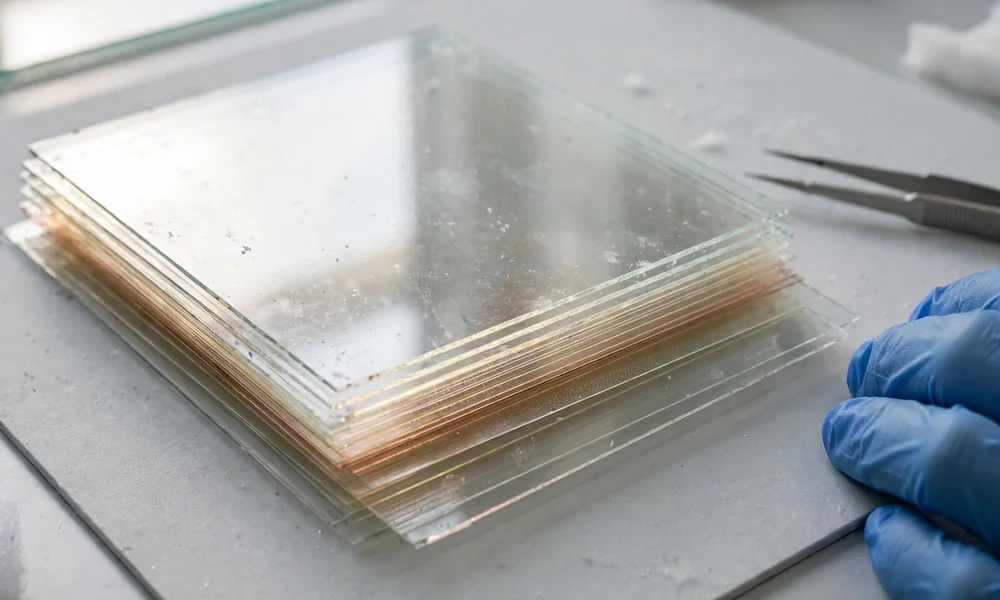

An OLED panel looks like a single sheet of glass with a picture on it, but it is a stack of compromises, each material covering a weakness in the one next to it. The glass gives stability, the silicon gives control, the organic molecules give light, and the encapsulation gives them all a chance to survive.