There is a car in Modena that starts life not as an engine or a body, but as a single bathtub-shaped shell of woven black fibre, so light that two people can lift it and so strong that it can carry a 720-horsepower engine, two passengers and a crash at motorway speed without folding. It is the monocoque of the Pagani Huayra, and everything else on the car — the engine, the suspension, the bodywork — bolts to it. If the monocoque is wrong, nothing else can be right.
A monocoque is a chassis that is also the body: instead of a separate frame with panels hung on it, the shell itself carries the loads. Pagani’s version, called the Carbo-Titanium HP62, is made from carbon fibre woven with titanium threads, cured in an autoclave under heat and pressure. The spec sheet for such a structure reads differently from an engine’s — stiffness, weight, crash loads and fibre counts instead of horsepower — but those numbers decide how the car drives, how safe it is, and why it costs what it does.

Weight and Construction
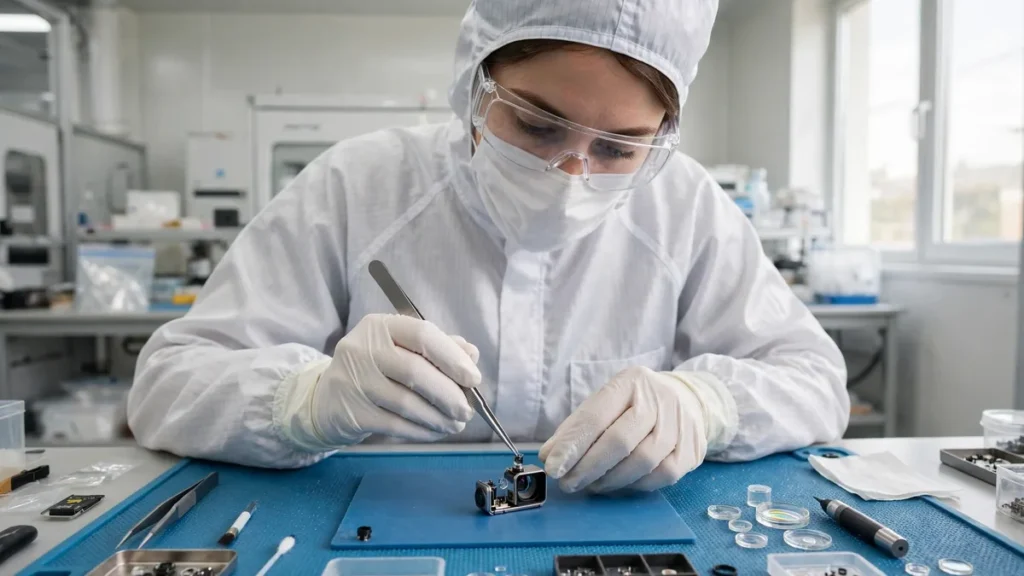
The Huayra’s monocoque weighs roughly 120 to 140 kilograms (estimate) — about the same as two adult passengers — yet it forms the entire central structure of a car that weighs around 1,350 kilograms dry. The shell is laid up by hand from hundreds of pieces of carbon fibre cloth, each cut to a pattern and placed in a specific direction, because carbon fibre is enormously strong along the thread and weak across it. The layup is the engineering: the fibres must point along the loads, and a misplaced layer is a weak spot. To understand the build in sequence, see how the Pagani Huayra monocoque is made.
Carbo-Titanium: What the HP62 Name Means
Pagani’s material is not plain carbon fibre. The HP62 in Carbo-Titanium HP62 refers to a weave that combines carbon fibre threads with titanium wire, giving the structure extra toughness — the ability to absorb energy without shattering — compared with pure carbon fibre. Titanium is also woven into the resin in some areas, and the result is a shell that bends slightly and holds together under impact instead of cracking cleanly. The “62” marks the generation of the material, refined over years of testing.
Torsional Stiffness
The headline structural number is torsional stiffness: how much the shell resists twisting when one corner of the car is pushed up and the opposite corner down, as happens over a bump mid-corner. It is measured in newton-metres per degree, and a good carbon monocoque reaches tens of thousands — the Huayra’s figure is in the region of 30,000 Nm per degree (estimate), several times stiffer than a steel sports car chassis of a generation ago. Stiffness matters because the suspension can only do its job if the body it is bolted to does not flex: a twisting chassis changes the wheel angles, blurs the steering feel, and wastes grip.
Crash Structure and Safety
A monocoque is also the safety cell, and its crash specs are written in forces and distances rather than speeds. The front and rear of the Huayra carry crash structures — sacrificial sections designed to crush progressively and absorb energy — while the central tub is designed to stay intact. The tub must also pass the same crash tests as any road car, which is a remarkable demand for a structure you can lift with two people. The materials in the Huayra monocoque explain how the fibre layup is tuned differently in the crash zones and in the passenger cell, so that one part gives way and the other does not.

Mounting Points and Integration
One of the hardest specs to appreciate is the number and precision of the mounting points built into the tub. The engine, gearbox, suspension arms, steering rack, seats, pedals and fuel tank all bolt directly to the monocoque, and each mounting point is a metal insert bonded into the carbon during layup. The inserts must be positioned to a fraction of a millimetre, because there is no adjustment afterwards — you cannot drill a new hole in a cured carbon tub without weakening it. This integration is why the monocoque is built first and everything else is designed around it, rather than the other way round.
Dimensions and Packaging
The tub’s dimensions decide the whole car: a wheelbase of 2,795 mm, a cabin wide enough for two adults and narrow enough to keep the frontal area small, and a floor so low that the driving position is almost on the ground. The fuel tank sits behind the seats inside the tub’s protection, and the engine sits behind that, so the monocoque must carry a twin-turbo V12 weighing over 200 kilograms cantilevered off its rear. Packaging is a spec in itself, and in a car this low every centimetre of headroom is fought over. The result is a cabin that feels intimate rather than cramped, because the structure was shaped around people rather than around a parts bin.
Curing and Quality Control
Once laid up, the monocoque is cured in an autoclave — a giant oven that applies heat and pressure at the same time, squeezing out air bubbles and forcing the resin into every fibre. The cure cycle runs for hours at temperatures above 100 °C and pressures of several atmospheres, and a single failed cycle can scrap weeks of hand work. After curing, the tub is inspected with ultrasound and X-ray, because a void or a delamination hidden inside the laminate is invisible from the outside. For the full sequence, how the Pagani Huayra monocoque works as a structure shows why that inspection matters on the road.

The Specs at a Glance
| Material | Carbo-Titanium HP62, carbon fibre with titanium weave |
| Monocoque weight | Roughly 120–140 kg (estimate) |
| Torsional stiffness | Around 30,000 Nm per degree (estimate) |
| Car dry weight | Around 1,350 kg |
| Wheelbase | 2,795 mm |
| Engine carried | Twin-turbo V12, over 200 kg, rear mounted |
| Curing | Autoclave, heat and pressure, hours per cycle |
What Does It Cost?
The Huayra itself cost around $1.4 million when new (estimate), and later versions and one-off commissions have sold for several million dollars (estimate). The monocoque is a meaningful share of that price, not because of the raw material — carbon fibre and titanium are expensive but not that expensive — but because of the labour: hundreds of hours of hand layup, a long autoclave cycle, and inspection that rejects anything less than perfect. That is the economics of a car made in the dozens: the tooling and the craft are spread across very few units.
A Rare Fact
Horacio Pagani began his career building racing cars from carbon fibre in Argentina before moving to Italy, and he was so convinced of the material that he bought his first autoclave second-hand and taught himself the curing process. The Huayra’s monocoque still carries that handmade character: each tub is laid up by a small team, and the weave is visible in places where most makers would hide it under paint — Pagani treats the carbon itself as decoration.