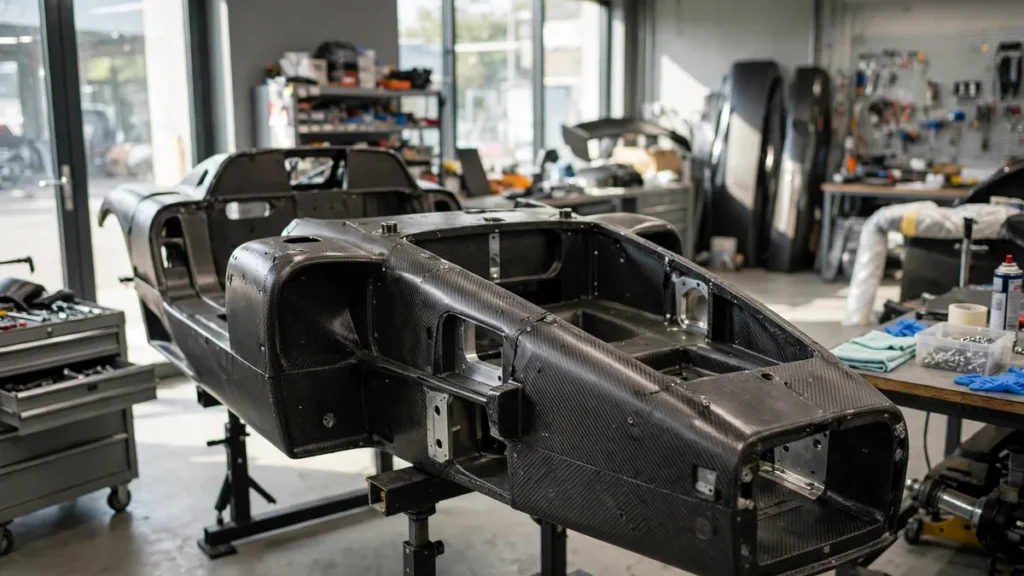
There is a moment in every hypercar factory when the car is nothing but a dark, hollow shell on a stand, open at the top like a canoe. No engine, no wheels, no bodywork, just a single rigid tub of woven black fibre with a few metal inserts glinting inside it. It looks almost too light to be real, and yet this shell is the whole car in the only sense that matters. Everything else — the engine, the suspension, the body — simply bolts on to it. In the Pagani Huayra, that shell is called the monocoque, and it is one of the most obsessively engineered structures ever fitted to a road car.
A monocoque works by making the body itself the chassis. Instead of a separate frame with panels hung on it, the tub carries every load the car will ever see: the weight of the engine, the push of the suspension, the twist of cornering and the violence of a crash. The Huayra’s tub is made from Carbo-Titanium, a weave of carbon fibre and titanium thread, and it weighs barely more than a grown man. This is how it works, from the first sheet of fibre to a car cornering at full force.

How the Pagani Huayra Monocoque Works
Step 1: The tub becomes the chassis
The monocoque is a single rigid shell that forms the passenger cell and the structural spine of the car at once. There is no separate ladder frame underneath, so every force the car meets travels through the walls of the tub itself. That design saves weight, because one structure does two jobs, and it makes the car enormously stiff, because a closed shell resists twisting far better than a frame made of separate rails. When the driver turns the wheel, the tub barely flexes at all, which means the suspension can do its job precisely instead of fighting a bending chassis.
Step 2: Carbo-Titanium gives it its strength
The tub is laid up from sheets of carbon fibre woven together with fine titanium thread, a material Pagani calls Carbo-Titanium. Carbon fibre is stiff and light but brittle on its own, while titanium adds ductility, so the combination resists cracking and holds together better in an impact. Layers are stacked in different directions, some running lengthwise to resist bending, others diagonally to resist twisting, and the weave itself is part of the engineering. The same woven material defines the look and strength of the car’s structure, and its behaviour under load is laid out in the carbon fibre weave that makes it possible.

Step 3: Heat and pressure cure the shell
Once the layers are laid into a mould, the whole assembly is sealed in a vacuum bag and cured in an autoclave, a giant oven that applies heat and pressure at the same time. The heat hardens the resin that binds the fibres together, while the pressure squeezes out air and excess resin, leaving a dense, void-free shell. The cure cycle takes hours and follows a precise temperature curve, because a shell cured too fast can trap bubbles that become weak spots. When the mould opens, the tub emerges as a single piece, already close to its final shape, with mounting points and metal inserts cured in place.
Step 4: Subframes bolt on front and rear
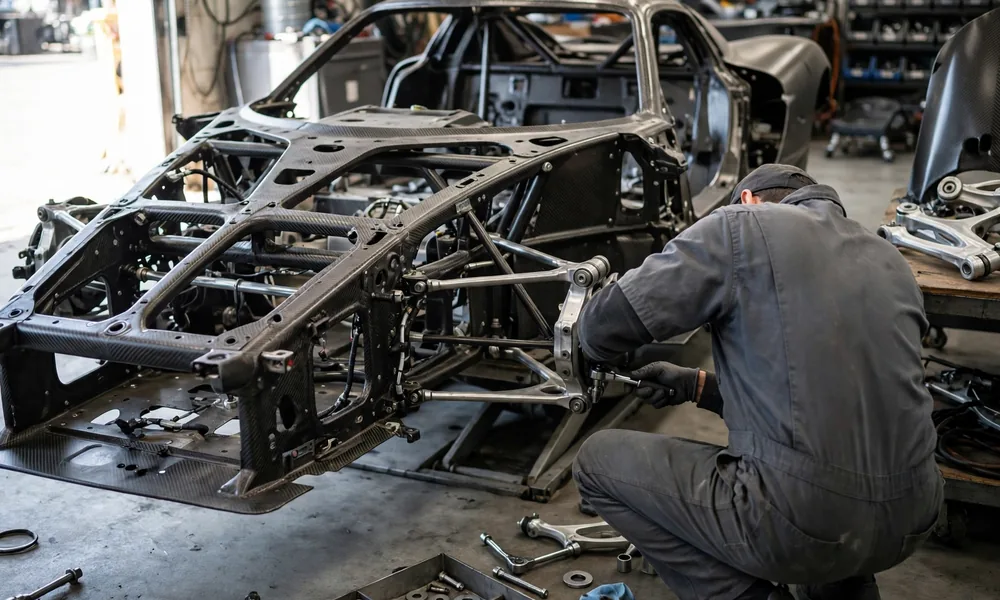
The monocoque itself only covers the middle of the car, so tubular steel subframes bolt to its front and rear to carry the engine, the gearbox and the crash structures. The front subframe holds the steering rack and the front suspension, while the rear cradles the twin-turbo V12 and the gearbox. Bolting these parts on, rather than bonding them, means they can be replaced after a crash without scrapping the tub. The joints between tub and subframe are among the most carefully engineered points on the car, because every load from the wheels and the engine passes through them.
Step 5: Suspension loads flow through the tub
Each wheel is connected to the tub by double wishbones, and every bump, braking force and cornering load travels up those wishbones and into the shell. The tub spreads those loads across its whole surface instead of letting them concentrate at one point, which is why its walls are thicker around the suspension mounts and thinner where little force arrives. Pushrod suspension keeps the heavy dampers tucked inside the bodywork, low down and close to the centre, so the car stays balanced. The way those loads are handled is inseparable from the braking forces the car must also absorb, which is where the carbon ceramic brakes earn their place on a car this fast.
Step 6: Stiffness and safety work together
The finished tub is so stiff that it barely twists under full cornering load, and that stiffness is also what protects the occupants. In a crash, the front and rear subframes are designed to fold and absorb energy, while the central tub stays intact around the cabin, a survival cell in the truest sense. The doors carry their own reinforcement, the roof structure resists crushing, and the fuel tank sits inside the tub, shielded by the same walls that carry the suspension. Power reaches the road through a seven-speed automated manual gearbox mounted behind the engine, and the whole drivetrain is hung off the rear of the tub, as the dual-clutch gearbox layout of other hypercars shows in a different form. The monocoque does not just hold the car together; it decides how the car feels, how it crashes and how long it lasts.
Pagani Huayra Monocoque at a Glance
| Specification | Detail |
|---|---|
| Material | Carbo-Titanium, carbon fibre woven with titanium thread |
| Structure type | Central monocoque with bolted steel front and rear subframes |
| Tub weight | Approximately 100 to 120 kilograms for the bare shell |
| Engine | 6.0-litre twin-turbo V12, around 730 horsepower |
| Torque | Approximately 1,000 Nm from the twin-turbo V12 |
| Car dry weight | Around 1,350 kilograms |
| Top speed | Approximately 370 kilometres per hour |
| Main advantage | Extreme stiffness at very low weight, precise handling |
| Main drawback | Enormous cost, slow hand-built production, costly repairs |
What Does It Cost?
A Huayra monocoque is not a part you can buy off a shelf, and its price is buried inside the price of the whole car. As rough estimates, a new Huayra cost around 2 to 3 million dollars depending on specification, while a replacement tub after serious damage would run into the hundreds of thousands of dollars before labour. Those figures are estimates, not quotes.
A Rare Fact
Pagani’s founder Horacio Pagani was so convinced by carbon fibre that he bought an autoclave with borrowed money in the 1980s, when almost nobody in the car world believed in the material. Years later, the Huayra’s Carbo-Titanium tub became one of the first composite structures of its kind to pass full crash testing for a road car, proving that a shell woven from fibre and titanium thread could protect its occupants as well as steel.
The Huayra monocoque works because it refuses to be two things. It is not a frame with a body on top, and it is not a shell that merely looks fast. It is one structure doing every job at once, and that is why a car built around it feels the way it does: light, rigid and utterly single-minded.