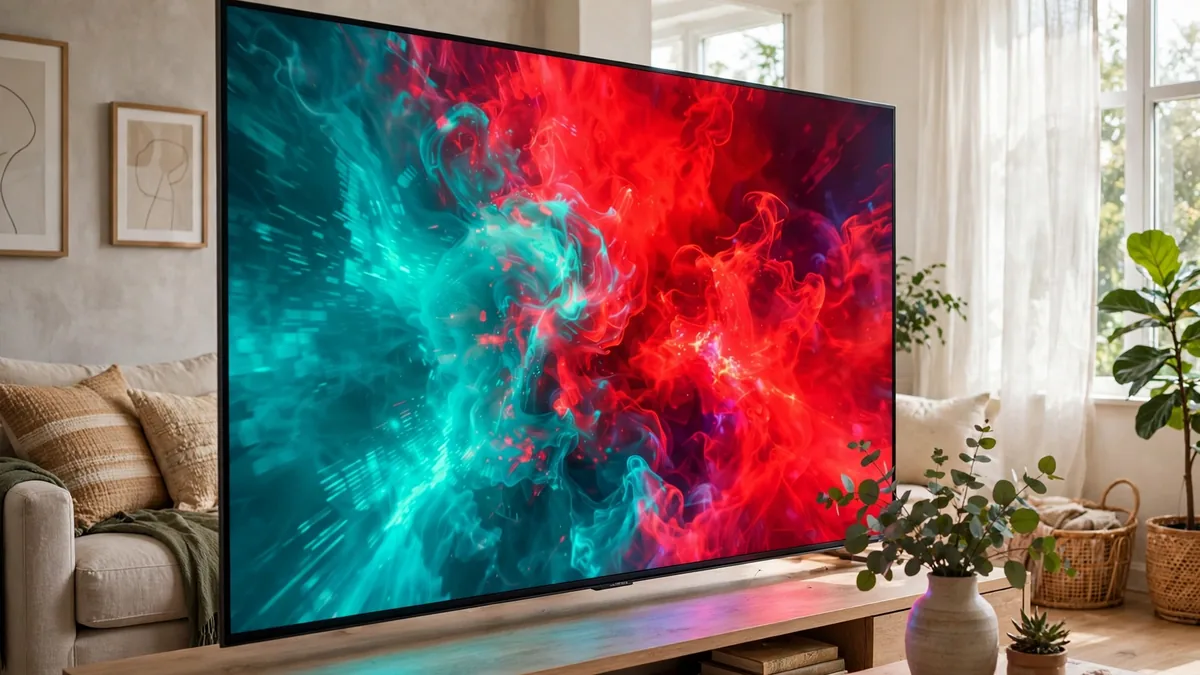
Hold a quantum dot television up to the light and it looks like any other screen. Switch it on, and the reds are redder than any television you have owned — a deep, pure crimson that older screens could only approximate. It is a film, thinner than a hair, filled with crystals so small that a million of them would fit on a pinhead, each one glowing with a colour fixed by its size alone.
Those crystals are quantum dots, and they are the reason this display exists. Change a dot’s diameter by a single nanometre and its colour shifts; make it a fraction bigger and red becomes orange. This is the story of those materials.
The Materials Behind the Quantum Dot Display
The headline materials are the quantum dots themselves — nanocrystals of cadmium selenide or indium phosphide, each a few nanometres across — suspended in a polymer film. Around them sit the blue backlight, usually gallium nitride LEDs, the glass substrate, the colour filters, and the barrier films that seal the dots away from air and moisture. The display’s electronics are indium tin oxide, a transparent conductor, and the whole stack is bonded with optical adhesives that must stay perfectly clear for years.
Step 1: Growing the quantum dots
A quantum dot is made, not found. Chemists grow them in a flask of hot solvent, injecting precursors that burst into thousands of identical crystals at once — a process closer to cooking than to machining. The trick is stopping the growth at exactly the right size: a dot about 2 nanometres across glows blue, 4 nanometres glows green, and 6 nanometres glows red, because the crystal is so small that an electron inside it can only hold certain energies. The best dots are then wrapped in a shell of zinc sulfide, a protective coat a few atoms thick that keeps the core from oxidising and boosts its brightness.
Step 2: Choosing cadmium or indium
The first quantum dots were cadmium selenide, and they are still the brightest and the easiest to make in exactly the right size. But cadmium is toxic, and European rules limit how much can go into a television, so most manufacturers have switched to indium phosphide — safer, but harder to grow evenly, and historically a little dimmer. The choice is a trade-off between colour purity, brightness, cost and regulation, and the indium phosphide dots have improved so fast that the gap has nearly closed. The quantum dot display manufacturing process is built around whichever dot the maker chose, because the dot decides everything downstream.
Step 3: Making the quantum dot film
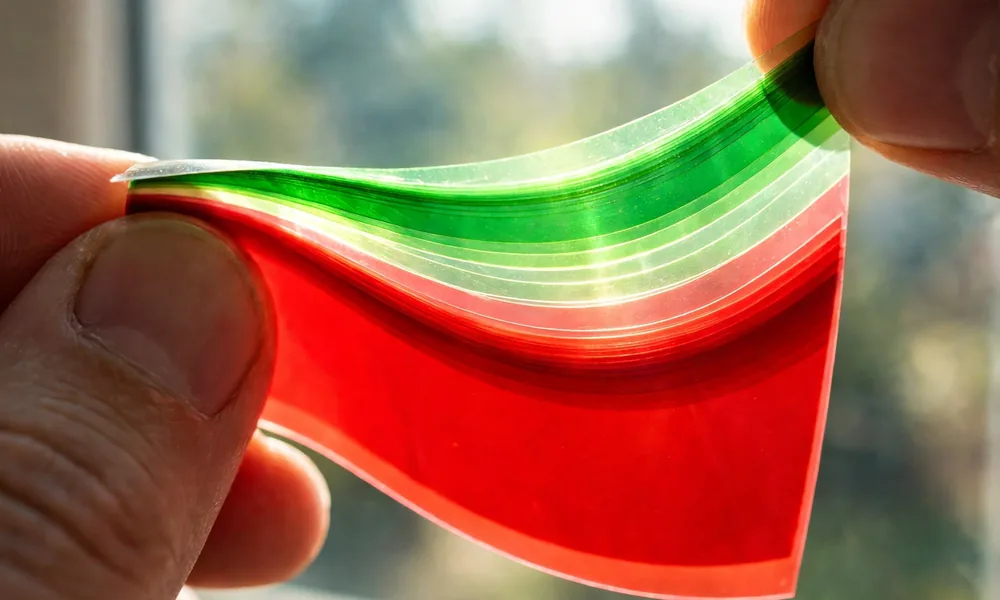
The dots are mixed into a polymer resin and spread into a film thinner than a human hair, sandwiched between two barrier layers. The film sits in front of the backlight, and its job is simple to describe and hard to do: absorb blue light and re-emit it as pure red and green, so the screen can make white from three exact colours instead of a muddy approximation. The polymer must be optically clear, must not yellow with age, and must hold the dots evenly spaced — clumps of dots glow dimmer and shift colour, like a crowd shouting over each other. The film is made in a clean room, because a single speck of dust in it becomes a visible blemish on a 65-inch screen.
Step 4: The blue backlight
Behind the film sits the backlight, and it is blue for a reason. Blue light carries the most energy, so a blue LED can excite the dots to glow red or green, while some blue passes straight through to complete the picture. The LEDs are gallium nitride, the same semiconductor that lights modern homes, grown as thin films on sapphire or silicon carbide wafers. Hundreds of them sit behind the screen in a grid, and on premium sets each zone can dim independently, so a star field can be black around a single bright star. The whole backlight is a balancing act between brightness, power and evenness.
Step 5: Glass, conductors and colour filters
The dots and the backlight sit between sheets of glass, and the glass is a material in its own right. Display glass is made without the soda and lime of window glass, so it stays flat and does not warp when it is heated during manufacturing. On the glass sits a film of indium tin oxide, a strange material that is both transparent and electrically conductive, carrying the signals that switch each pixel. Colour filters — resins dyed red, green and blue — sit over the pixels to sharpen the colours further, and polariser films control the light’s direction.
Step 6: Sealing out air and moisture
Quantum dots are fragile in a way that surprises people: oxygen and water vapour slowly attack them, dulling their glow and shifting their colour. So the film is sealed between barrier layers — alternating films of polymer and aluminium oxide, sometimes dozens of layers thick — that slow the ingress of air to almost nothing. The edges are sealed with a special adhesive, and the whole panel is laminated in a vacuum so no air is trapped inside. It is the same kind of sealing problem faced by the quantum dot display production line, where humidity is the enemy from the first step to the last.
Step 7: Testing the colour
Every finished panel is measured, not just looked at. A spectroradiometer reads the exact wavelength of its red, green and blue, and the panel is graded on how much of the colour gamut it can reproduce — the best reach nearly the full range the human eye can see. The test also checks brightness uniformity, because a screen that is brighter in the middle than at the edges is a failed screen, however pure its colours. The numbers behind that grading are the same ones explained in the quantum dot display specifications, where colour gamut and peak brightness are the figures that matter most.
Quantum Dot Display at a Glance
| Specification | Detail |
|---|---|
| Quantum dots | Cadmium selenide or indium phosphide nanocrystals |
| Dot size | About 2 to 6 nanometres, size sets the colour |
| Dot shell | Zinc sulfide protective coating |
| Backlight | Gallium nitride blue LEDs, zoned dimming |
| Film | Polymer film with barrier layers against air |
| Conductors | Indium tin oxide on display glass |
| Colour gamut | Near the full range the eye can see |
What Does It Cost?
A 55-inch quantum dot television typically sells for around $600 to $1,200 (estimate), with premium 65-inch and 75-inch models at $1,500 to $3,000 (estimate). The quantum dot film itself is a small part of the cost — the panel, the backlight and the electronics dominate — but the dots are what justify the premium over an ordinary LED set.
A Rare Fact
A quantum dot’s colour comes from quantum confinement — the electron inside the crystal is trapped in such a tiny space that it can only occupy certain energy levels, like a guitar string that can only play certain notes. Make the crystal bigger and the notes drop in pitch, shifting the light from blue toward red.