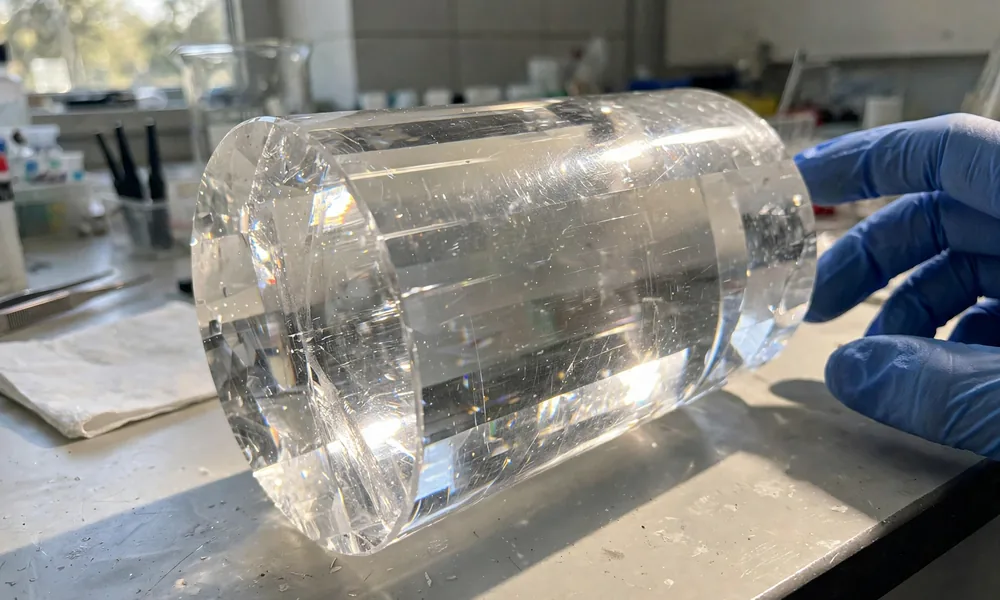
Drop a phone face down on concrete and you expect the worst. Pick it up, and very often the screen is fine, with nothing worse than a smudge. If the cover is sapphire glass, that is not luck. Sapphire is one of the hardest transparent materials ever put on a consumer product, second only to diamond, and it is not glass at all. It is a crystal, grown in a furnace at more than two thousand degrees, then sliced and polished into something you can see through.
Real sapphire glass is aluminium oxide, the same chemistry as the blue gemstone, without the colour. It is grown, not mined, in boules the size of a rolling pin, and every step after that is about keeping it flawless. A single scratch or bubble can ruin a sheet worth hundreds of pounds, so the materials and the machines around it are chosen with unusual care.
Here is what those materials are, and why each one earned its place.

The Crystal Behind Sapphire Glass
1. Aluminium oxide, the crystal itself
Sapphire glass is aluminium oxide, Al2O3, a compound of aluminium and oxygen. It is the same mineral as ruby and sapphire, and its hardness comes from the way its atoms lock together in a tight hexagonal crystal lattice. On the Mohs scale it scores 9, against 7 for quartz and around 6 for ordinary glass, which is why keys, sand and coins cannot scratch it. The raw material is high-purity alumina powder, refined until it is almost entirely free of iron and other impurities, because even a trace of colour would tint the finished crystal.
2. The growth furnace, molybdenum and tungsten at white heat
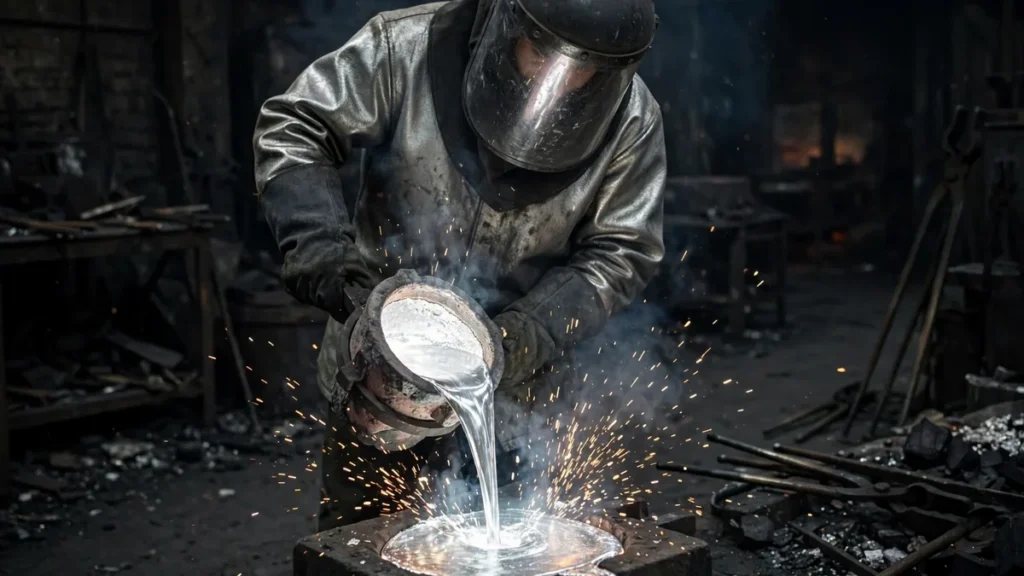
Growing sapphire means melting alumina at about 2,050 degrees Celsius, and the furnace that does it is built from materials that can survive that heat. The crucible is usually molybdenum or tungsten, metals with melting points far above the alumina itself, and the heating elements and insulation are made from graphite and refractory ceramics. The crystal is grown by the Kyropoulos or Czochralski method, pulling a seed crystal slowly from the melt so the atoms stack in perfect order over days. One power cut or vibration at the wrong moment can crack the boule, and a cracked boule is scrap.
3. Diamond tools, the only thing that cuts it
Once grown, the boule has to be sliced into wafers, and the only material hard enough to cut sapphire is diamond. Diamond-coated wire saws and diamond grinding wheels slice the crystal slowly, a few millimetres an hour, with water or oil cooling the cut so the heat does not crack the wafer. The cutting is deliberately slow, because sapphire is brittle as well as hard, and a fast cut chips the edge. After slicing, each wafer is lapped and polished with diamond slurry, progressing from coarse to fine until the surface is flat to within a fraction of a wavelength of light.
4. Anti-reflective coatings, the invisible layer
A bare sapphire surface reflects more light than ordinary glass, which is why a sapphire watch crystal can look milky in bright sun. To fix that, the surface is coated with thin layers of metal oxides, usually magnesium fluoride or silicon dioxide, laid down a few atoms at a time by vapour deposition. The coating is measured in nanometres, far thinner than a human hair, and it is designed so reflected light cancels itself out. A good coating makes the crystal disappear; a bad one peels, and peeling is the most common complaint about sapphire covers.
5. The substrate and the bond, what holds it in place
Sapphire is rarely used on its own. On a phone it is usually a thin cover bonded to a glass substrate, or a small lens over a camera, because a full sapphire screen would be thick, heavy and ruinously expensive. The bond is a clear optical adhesive, cured with ultraviolet light, that has to match the refractive index of the sapphire so the join is invisible. The adhesive must stay clear for years, resist yellowing in sunlight, and flex slightly as the phone warms and cools. In a watch, the crystal is held by a gasket and a bezel, usually stainless steel or titanium, and the seal has to keep water out at depth. The materials of a foldable display solve a similar problem in the opposite way, bending where sapphire refuses to bend.
6. Edge treatments, where sapphire is weakest
For all its hardness, sapphire is brittle, and its weak point is the edge. A sharp corner concentrates force, and a drop on a corner can shatter a crystal that would survive a flat impact. So the edges are ground and polished into a smooth bevel, and the crystal is set slightly below the metal bezel so the bezel takes the first hit. Some covers are chemically strengthened or laminated to a tougher glass, trading a little hardness for a little give. The bevel is also why a sapphire watch crystal feels different under the finger: the edge is rounded, cool and smooth, where ordinary glass feels sharp.
| Material | Where it is used | Why it was chosen |
|---|---|---|
| Aluminium oxide | The crystal itself | Hardness 9 on the Mohs scale, perfectly clear |
| Molybdenum and tungsten | Growth crucibles | Survive 2,050 degrees without melting |
| Diamond abrasives | Slicing and polishing | The only material hard enough to cut sapphire |
| Metal oxide coatings | Anti-reflective layers | Cut reflections without changing the colour |
| Optical adhesive | Bonding to glass | Invisible join, resists yellowing and flex |
| Stainless steel or titanium | Bezel and case | Protects the brittle edge from impact |
What Does Sapphire Glass Cost?
Sapphire is one of the most expensive transparent materials in everyday products, and the cost is in the growth and the polishing, not the raw material. A sapphire watch crystal is estimated at roughly $30 to $150, depending on the size and the shape, against a few pounds for a mineral glass crystal. A full sapphire phone screen has been estimated at roughly $30 to $50 per unit in volume, several times the cost of toughened glass, which is why manufacturers use sapphire only for small parts such as camera covers and fingerprint sensors. A replacement sapphire crystal for a luxury watch is estimated at roughly $200 to $600 fitted.
A Rare Fact
Sapphire glass first reached the public through the military, not through watches. During the Second World War, synthetic sapphire was grown for use in gunsights and aircraft instruments, because it would not scratch or fog in the field. The first sapphire watch crystals appeared in the 1960s, and they were so expensive that only a handful of brands used them. Today the same crystal sits on supermarket scanners and on the windows of the International Space Station, where its resistance to scratching and radiation matters more than its price.

Sapphire glass is a contradiction: a crystal harder than steel, grown in a furnace hotter than lava, and yet fragile enough to shatter on a corner. Aluminium oxide gives it the hardness, molybdenum and tungsten make the growth possible, diamond does the cutting, and a whisper of coating makes it disappear. The same pursuit of a perfect, hard surface runs through other optics too, from the waveguide inside AR glasses to the tiny motor that focuses a camera.