When a ship drops anchor in a storm, the crew is trusting a chain they can barely see. The anchor itself gets the credit, but the chain does most of the work — its weight is what keeps the pull on the anchor horizontal, and its spec sheet is what decides whether it holds or parts.
An anchor chain is not a generic piece of hardware. Each link is forged, welded, tested, and graded, and the numbers on its spec sheet — grade, diameter, proof load, breaking load, weight per metre — are the difference between a ship that rides out the weather and one that drags towards the rocks.
This guide explains the key numbers on a ship anchor chain spec sheet in plain English: what chain grade really means, why diameter is measured the way it is, how proof load and breaking load differ, and which figures are worth comparing when you are judging a chain’s strength.

What Ship Anchor Chain Specs Really Mean
1. Chain grade: the steel’s strength, stamped on every link
Chain grade is the strength class of the steel, and for ships it is usually Grade U1, U2, or U3 under classification society rules. U1 is mild steel, U2 is higher-strength steel, and U3 is extra-high-strength steel, with minimum tensile strengths of roughly 400, 500, and 690 megapascals respectively. The anchor at the end of the chain works as part of the same system, as explained in how a yacht anchor system works.
2. Link diameter: measured where it counts
Link diameter is the diameter of the steel bar the link is made from, usually quoted in millimetres, and it is measured at the crown of the link where wear is least — not at the contact points where links rub each other. A large container ship may use chain of 100 millimetres or more, while a small coastal vessel may use 30 millimetres or less. Chain is replaced when wear reduces the diameter by more than about 10 percent, because strength falls faster than diameter.
3. Proof load: the test every chain must pass
Proof load is the load applied to every length of chain in the factory test, and it is typically around 70 percent of the breaking load. Each shot of chain — a standard length of 27.5 metres — is pulled to its proof load and held, and any link that stretches, cracks, or deforms fails the whole length.
4. Breaking load: the number the chain must never reach
Breaking load is the load at which the chain is expected to part, and it is roughly one and a half times the proof load. It is measured by pulling sample links to destruction in a test machine, and it is the ultimate strength of the chain rather than a safe working figure. If a chain ever reaches its breaking load at sea, something has already gone badly wrong.
5. Weight per metre: the holding power you can calculate
Weight per metre is the mass of one metre of chain, and it is the figure that determines how the chain lies on the seabed. A heavy chain forms a catenary curve, a sagging line from the ship to the anchor, and that curve absorbs gusts and waves before they reach the anchor. The hull the chain is attached to is built to take these loads, and its numbers are covered in ferry hull specs explained.
6. Stud link versus studless: the bar across the middle
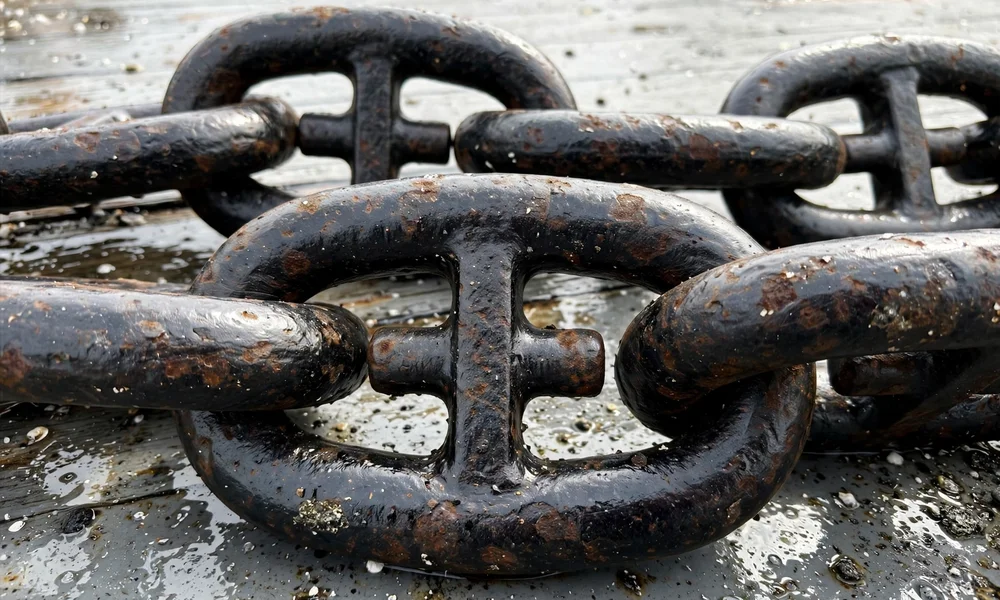
Stud link chain has a steel bar, the stud, pressed across the middle of each link, while studless chain has none. The stud stops the link from collapsing under load and prevents the chain from kinking and tangling in the locker, which is why stud link chain is the standard for ships’ anchors. Studless chain is lighter and more flexible, and it is used for mooring lines and offshore work where the chain runs over fairleads rather than through a windlass.
7. Length and marking: knowing how much chain is out
Chain length is measured in shackles or shots of 27.5 metres, and a ship typically carries 10 to 14 shots on each anchor — roughly 300 to 400 metres. Each shot is marked with paint and with a detachable link so the crew can tell how much chain is out by counting the marks as it runs through the windlass. The largest ships carry the heaviest chain of all, and their hulls are covered in container ship hull specs explained.
Ship Anchor Chain Specs
| Specification | Typical range |
|---|---|
| Chain grade | U1 mild, U2 high-strength, U3 extra-high-strength steel |
| Link diameter | 30 mm small vessels, 100 mm or more on large ships |
| Proof load | About 70 percent of breaking load, tested on every shot |
| Breaking load | Roughly 1.5 times proof load, several hundred tonnes |
| Weight per metre | 20 to over 100 kg per metre by diameter |
| Link type | Stud link for anchors, studless for mooring |
| Shot length | 27.5 metres per shot, 10 to 14 shots per anchor |
| Wear limit | Replace when diameter is reduced by about 10 percent |
What Does Ship Anchor Chain Cost?
Ship anchor chain is estimated at roughly $2,000 to $6,000 per tonne for Grade U2 and U3 stud link chain, depending on diameter, grade, and certification. A full outfit for a large ship — two anchors and around 700 metres of chain — is estimated at $150,000 to $500,000 or more, with the chain itself accounting for most of that figure. All prices are estimates only and vary widely by chain diameter, steel grade, and the ship’s classification society. Chain is bought by weight, and a big ship’s chain outfit can weigh more than 100 tonnes.
A Rare Fact
The word shackle as a unit of chain length comes from the detachable link that joins one shot of chain to the next, and the coloured paint marks on the chain are an old tradition that predates electronic chain counters. The bitter end itself — the inboard end of the chain — is fastened to the ship with a weak link designed to break before the chain locker is torn out, so that in the worst case the crew can slip the anchor entirely rather than lose the ship. The phrase “to the bitter end” comes from this fitting, and it originally meant holding on until the very last link of chain.

The spec sheet is the honest version of the anchor. Grade tells you how strong the steel is, diameter tells you how much wear it can afford, proof load tells you what it has already survived in the factory, and weight per metre tells you how it will behave on the seabed. A chain that reads well on paper and is properly marked, measured, and maintained is the reason a ship can sleep at anchor in weather that would drag a lesser outfit onto the rocks.


