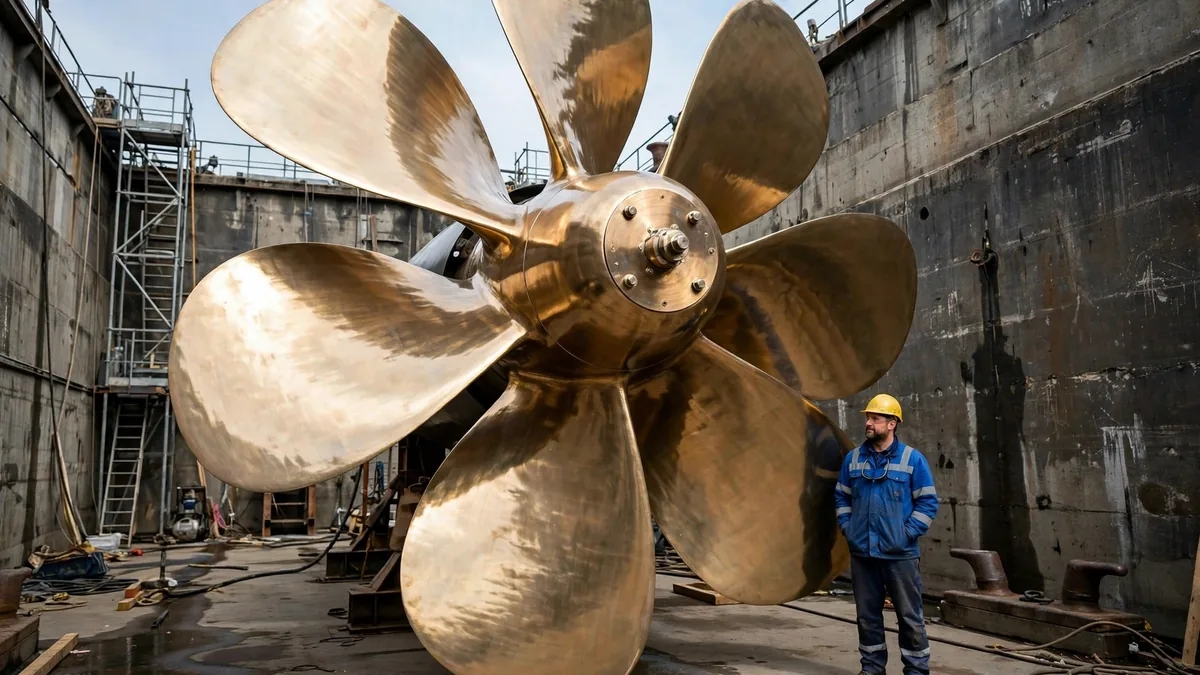
Stand in a dry dock beside a large ship and the propeller stops you first. It is taller than you, wider than a car, hanging in the open air like a bronze flower, each blade curved and polished to a shine that seems wrong for something that spends its life underwater. Run a hand along the leading edge and it is sharp enough to cut paper. That edge turns engine power into thrust, hour after hour, in the most corrosive environment on the planet.
A propeller lives a hard life. It spins in salt water full of sand and debris, it cavitates, which means tiny bubbles collapse against its surface like small explosions, and it carries the whole weight of the ship’s propulsion on a single shaft. The metal decides whether it lasts twenty years or two, and the choice has changed little in a century, because the sea punishes every shortcut.
Here is what those materials are, and why each one earned its place.
The Materials Behind the Ship Propeller
1. Nickel-aluminium bronze, the metal that rules the sea
Almost every large ship propeller today is nickel-aluminium bronze: copper, aluminium, nickel, iron and manganese. It is the standard because it does three things at once: it resists salt-water corrosion, it carries huge loads without bending, and it resists cavitation erosion better than any other affordable metal. The aluminium forms a thin protective oxide layer that heals itself when damaged, while the nickel adds toughness. A propeller can be twenty tonnes of this metal, cast in one piece; the full story is told in how a ship propeller works.
2. Stainless steel, the choice for smaller and faster boats
Smaller propellers, and those on fast ferries and naval craft, are often stainless steel, usually duplex or martensitic grade. Stainless is thinner and sharper than bronze for the same strength, so the blades can be finer, and finer blades are more efficient at high speed. The trade-off is cost and repairability: stainless is harder to cast and weld, and a damaged stainless blade often has to go back to a specialist shop, while a bronze blade can be repaired in a shipyard. Stainless is also heavier for a given size, which matters on a shaft already carrying a lot of weight.
3. Manganese bronze, the old workhorse that still sails
Before nickel-aluminium bronze took over, most propellers were manganese bronze, really a brass: copper and zinc with manganese, iron and aluminium added. It is cheaper and easier to cast, and thousands of older ships still run on manganese bronze propellers, some decades old. Its weakness is dezincification: in salt water the zinc slowly leaches out, leaving a porous, pinkish copper sponge that is weak and brittle. A propeller that looks sound outside can be crumbling inside, which is why surveyors tap-test older bronze propellers and new builds have moved on. Manganese bronze shows a material can be good enough for years before its flaw appears.
4. Composite blades, the new challenger
The newest propellers are not metal at all. Composite blades, made from carbon or glass fibre in epoxy resin, are lighter than bronze, do not corrode, and can be shaped into curves that are hard to cast in metal. Their great trick is flexibility: a composite blade can twist slightly under load, changing its pitch automatically as the ship speeds up, which makes it more efficient across a range of speeds. The catch is damage: a composite blade that strikes a log or a container does not dent, it delaminates, and the damage can be hard to see and expensive to repair. Navies are adopting them first, because a composite propeller is quieter, and quiet matters when you do not want to be heard.
5. Steel shaft, hub and key, the parts the propeller hangs from
The propeller gets the attention, but it hangs on a steel shaft, hub and key, and those parts have their own material story. The shaft is usually high-strength alloy steel, often stainless-clad where it passes through the stern tube, because it carries the propeller’s weight, thrust and torque all at once. The hub is cast with the propeller or shrunk onto the shaft, and the key locking them together is a small steel bar taking an enormous shear load. If it fails, the propeller spins free and the ship goes nowhere, so the key is inspected every time the propeller comes off. Submarines take this further, and how a submarine propeller is made shows how much secrecy and precision goes into a propeller that must be silent as well as strong.
6. Coatings and cathodic protection, the defence against the sea itself
Even the best bronze needs help. Propellers are coated with antifouling paint that stops barnacles and weed growing on the blades, because a fouled propeller can lose a tenth of its efficiency in a few months. More important is cathodic protection: zinc anodes bolted near the propeller, which corrode first and sacrifice themselves so the propeller does not. They are checked and replaced at every dry docking, and a ship whose anodes are gone will start losing its propeller to corrosion within months.
Ship Propeller Materials
| Material | Where it is used | Why it is chosen |
|---|---|---|
| Nickel-aluminium bronze | Large propeller blades and hub | Corrosion resistant, strong, resists cavitation |
| Stainless steel | Smaller and high-speed propellers | Thin, sharp blades, very tough under impact |
| Manganese bronze | Older propellers still in service | Cheap and easy to cast, but can lose zinc over time |
| Carbon or glass composite | Modern and naval propeller blades | Light, quiet, changes pitch |
| High-strength alloy steel | Shaft, hub and key | Carries thrust, torque, weight |
| Antifouling paint and zinc anodes | Blade surfaces and stern | Stops fouling, sacrifices itself for the propeller |
What Does a Ship Propeller Cost?
A ship propeller is priced by the tonne. A nickel-aluminium bronze propeller for a mid-size cargo ship is estimated at roughly $200,000 to $500,000, while a large container ship propeller can be estimated at roughly $1 million to $2 million, before fitting in dry dock. A small yacht propeller is a different world: the yacht propeller specs explained put a typical bronze yacht propeller in the low thousands of dollars. The real cost is downtime: a ship in dry dock for a propeller change earns nothing, which is why owners pay for the best alloy and anodes rather than gamble on a cheap repair at sea.
A Rare Fact
Some of the largest ship propellers are cast in pieces and bolted together in the dry dock, because no foundry has a mould big enough for the whole thing. The largest single-piece propellers weigh over a hundred tonnes, shipped flat on a barge, because no road or rail can carry them. Fitting one means flooding the dry dock in stages, so the ship settles onto the blocks without the propeller touching the ground.
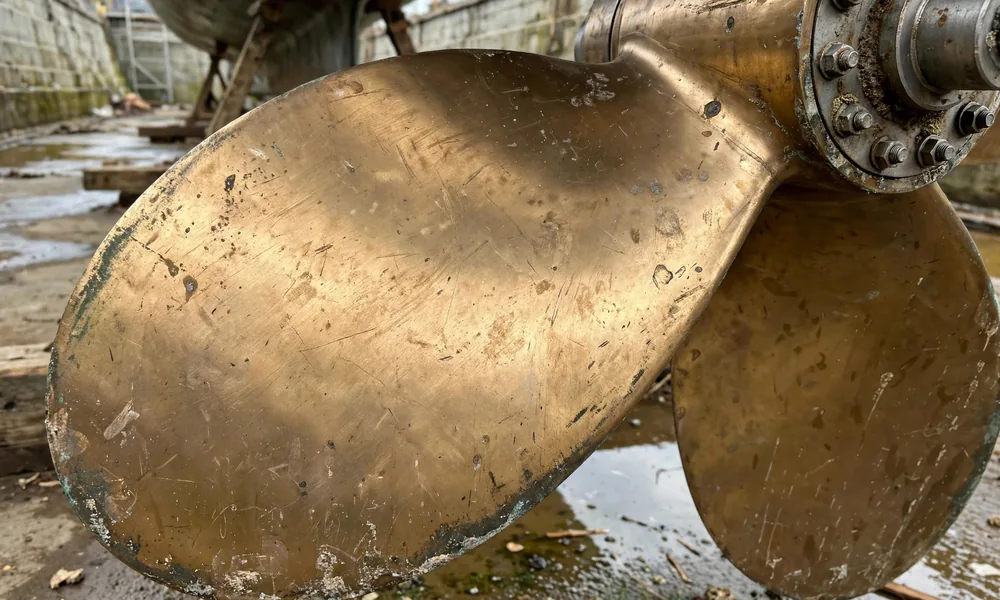

A ship propeller looks like sculpture out of the water, but it is a working tool, its materials chosen for a life the eye never sees. The bronze resists the sea, the steel carries the load, the coatings keep the growth off, and the zinc dies so the propeller can live. Take one away and the ship slows, shakes, or stops, and the sea takes back what it was owed.