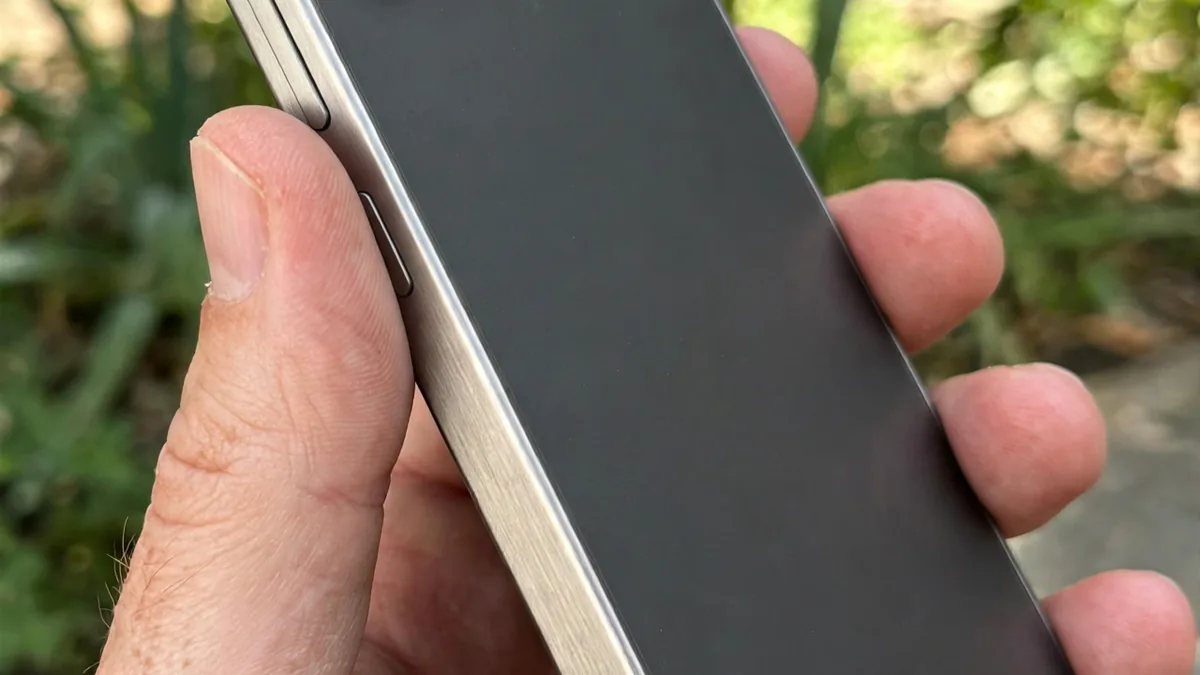
Pick up a flagship phone and the first thing your fingers meet is not glass or plastic. It is metal — cool, smooth, and surprisingly light for how solid it feels. Run a fingernail along the edge and you will feel the difference between a phone built from aluminium and one built from titanium: the titanium frame is harder, stiffer, and finished to a texture that no other phone material can quite match.
Titanium is the metal of jet engines and spacecraft, and putting it into a phone frame was once unthinkable.
This guide explains the key numbers on a smartphone titanium frame spec sheet in plain English: what Grade 5 titanium actually means, how thick the frame really is, how much weight it saves, and which figures tell you whether the titanium is doing real work or is just a marketing label.
Smartphone Titanium Frame Specs Explained
1. Alloy grade: what Grade 5 titanium means
Phone frames use Grade 5 titanium, also known as Ti-6Al-4V — an alloy of titanium with 6 percent aluminium and 4 percent vanadium. The alloy is the standard choice for aerospace, where it holds up turbine blades and airframe parts, and it is specified because pure titanium is too soft for a phone frame. Grade 5 has a tensile strength of around 900 megapascals, roughly double that of the 7000-series aluminium used in most other phones, and it keeps that strength at high temperatures. The way the frame is shaped from this alloy is covered in how a smartphone titanium frame is made.
2. Frame thickness: how thin the metal really is
A smartphone titanium frame is typically 2 to 3 millimetres thick at the band that wraps around the phone, with the total phone thickness around 8 millimetres including the glass front and back. Two millimetres sounds insubstantial, but titanium’s stiffness means that a thin band is enough to protect the glass and carry the phone’s structural loads. The thickness is a compromise: thicker would be stronger but heavier and harder to hold, thinner would flex and let the glass crack.
3. Weight: what titanium actually saves
Titanium is about 45 percent lighter than steel for the same strength, but only about 60 percent heavier than aluminium — so the weight saving over an aluminium frame is modest, typically 10 to 20 grams on a phone that weighs 200 grams or so. The saving comes not from titanium being feather-light, but from needing less of it: because it is stronger, the frame can be thinner and still protect the phone. A flagship titanium phone typically weighs around 187 to 221 grams, and the frame itself accounts for roughly 30 to 40 grams of that. The materials behind that stiffness are explained in the materials engineering of the smartphone titanium frame.
4. Hardness and scratch resistance: why it feels different
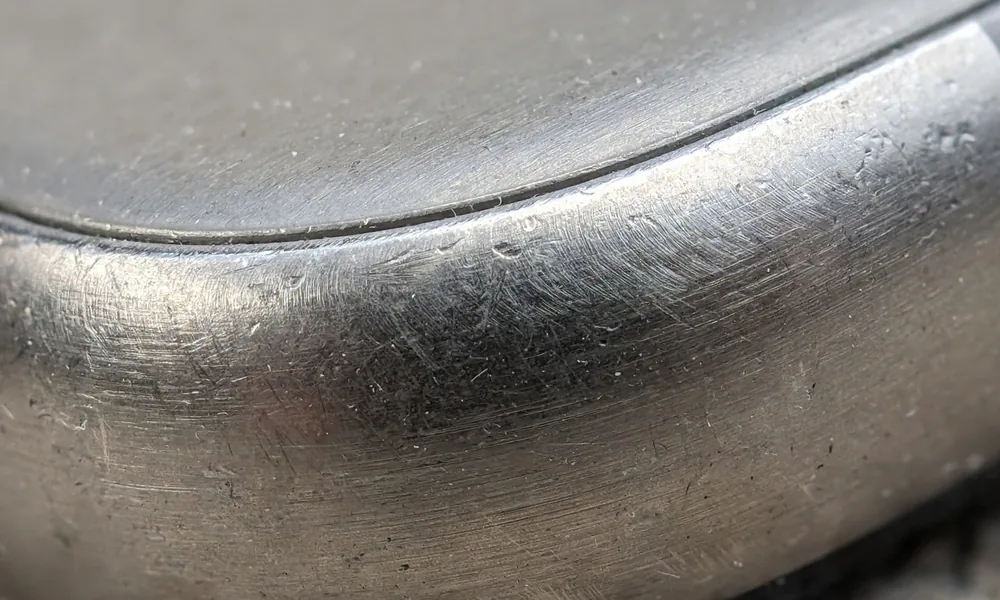
Titanium’s hardness is measured on the Vickers scale, where Grade 5 scores around 340 HV — roughly double the hardness of the aluminium used in phone frames. In practice that means the frame resists scratches and dents far better than aluminium, and it keeps its finish longer. There is a trade-off, though: titanium is harder to machine, and the tools that cut it wear out faster, which is one reason titanium phones cost more.
5. Corrosion resistance: the metal that does not rust
Titanium forms a thin oxide layer the moment it meets air, and that layer protects it from almost everything a phone will encounter: sweat, salt water, rain, and sunscreen. Unlike steel, titanium does not rust; unlike aluminium, it does not pit or corrode in salty conditions. The oxide layer is self-healing — scratch it, and a new layer forms in seconds — which is why titanium is used in marine hardware and medical implants as well as phones. The spec sheet rarely gives this a number, but it is one of the main reasons manufacturers chose the metal at all.
6. Thermal conductivity: why it stays cool
Titanium conducts heat at roughly 7 watts per metre-kelvin, far less than aluminium’s 200 — which means a titanium frame moves heat away from the processor much more slowly. That is a genuine engineering trade-off, and phone makers solve it by bonding the titanium band to an aluminium inner frame that does the thermal work, while the titanium provides the strength and the finish. The two metals are joined with adhesives and mechanical interlocks, and the combination is the real structure of the phone: titanium outside for protection, aluminium inside for heat.
7. Cost and machining time: why titanium phones cost more
Machining a titanium frame takes far longer than machining an aluminium one — the metal is harder on cutting tools, the speeds are slower, and the finishing steps are more numerous. A titanium phone frame can take several times as long to machine as an aluminium frame, and the raw material itself costs many times more per kilogram. That cost is the subject of why the smartphone titanium frame is so expensive, and it is the main reason titanium appears only on flagship phones.
Smartphone Titanium Frame Specs
| Specification | Typical range |
|---|---|
| Alloy grade | Grade 5 (Ti-6Al-4V) |
| Tensile strength | Around 900 MPa |
| Frame thickness | 2 to 3 mm |
| Hardness | Around 340 HV (Vickers) |
| Phone weight | 187 to 221 g |
| Frame weight | 30 to 40 g |
| Thermal conductivity | Around 7 W/m·K |
| Density | 4.43 g/cm³ |
What Does a Smartphone Titanium Frame Cost?
The titanium frame is estimated to add roughly $30 to $80 to the manufacturing cost of a flagship phone compared with an aluminium frame, and the finished phone typically sells for an estimated $1,100 to $1,600. A replacement frame fitted by the manufacturer is estimated at $200 to $500 depending on the model. All prices are estimates only and vary widely by model, region, and market.
A Rare Fact
Titanium was named after the Titans of Greek mythology, but it was almost not used at all. When it was first isolated in the 1940s, it was so difficult to produce that it cost more than gold, and the first practical use was in military aircraft, where its strength and lightness were worth any price. The metal that now wraps a phone once held together the SR-71 Blackbird, the fastest aircraft ever flown, whose skin was made largely of titanium because no other metal could survive the heat of flying at three times the speed of sound. Your phone’s frame and a spy plane’s skin are, chemically, the same alloy.
The titanium frame is easy to dismiss as a luxury detail, but its numbers tell a different story. Grade 5 strength, double the hardness of aluminium, immunity to corrosion, and a weight saving bought by needing less metal — those are engineering answers, not fashion choices. The next time you pick up a flagship phone, the cool, stiff band under your fingers is the spec sheet you can feel. The frame is the first thing you touch and the last thing to fail.


