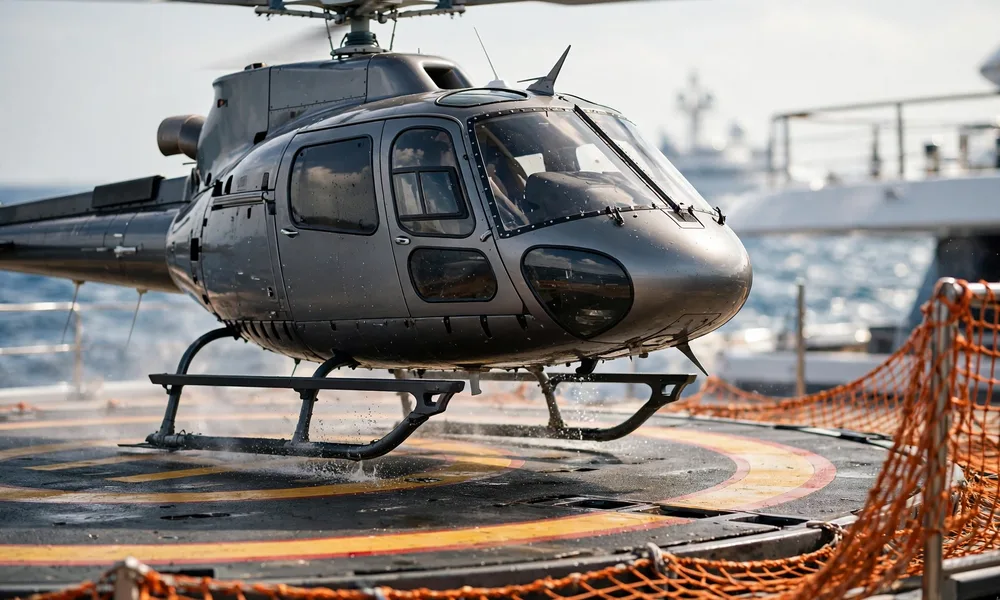
From the bridge of the superyacht, the helicopter looks too big for the boat. It comes in low over the water, rotors hammering, and settles towards a painted circle on the foredeck that is barely wider than the rotor disc itself. Below it, the deck is moving — the yacht is rolling gently at anchor — and the pilot has one chance to put the skids down on the mark. The margin for error is measured in metres, and the deck beneath the helicopter is engineered to a standard most yacht owners never see.
A superyacht helicopter deck, or helideck, is not a flat patch of deck with a painted H on it. It is a certified landing area with a rated load, a firefighting system, lighting, tie-downs and a safety net, built to rules written for offshore oil platforms and adapted for yachts. The helicopter it serves can weigh ten tonnes or more, and its rotor wash can strip paint and throw loose objects across the deck. Every number on the helideck specification exists because something, somewhere, went wrong without it.
Not every superyacht can carry a helicopter, and not every deck that can take one is certified for regular use. The difference between a touch-and-go deck and a fully certified helideck is a long list of specifications, and the way the deck actually works in practice is explained in how a superyacht helideck works. A helideck is also one of the most expensive features a yacht can carry — the reasons why are laid out in why a superyacht helipad costs more than a house. Here is what the numbers mean.

The Specs, Explained
1. The D-value: the size that decides everything
The single most important helideck number is the D-value — the overall length of the largest helicopter the deck is designed to take, rotors turning, from tail tip to nose. A light helicopter like an Airbus H125 has a D-value of about 12.9 metres, a medium one like an Airbus H155 about 14.3 metres. The deck must be at least as wide as the D-value, and the landing circle must be at least 0.83 times the D-value across. If the owner wants a bigger helicopter later, the deck cannot simply be repainted; it has to be rebuilt.
2. Load rating: the weight the deck must hold
A helideck is rated for the maximum take-off weight of the helicopter it serves, and the number is a hard limit, not a guideline. A light helicopter weighs about 2.5 tonnes at take-off, a medium one about 5 tonnes, and a heavy one such as a Sikorsky S-92 more than 12 tonnes. The deck structure must hold that weight plus a safety margin for a hard landing, while the yacht is rolling. The rating is painted on the deck, and the pilot checks it before every landing — a heavier helicopter risks punching through the deck into the cabin below.
3. Tie-downs and safety netting
Once the helicopter is down, it has to stay down. The deck is fitted with tie-down points — steel rings set flush into the deck — and the helicopter is lashed to them with straps rated to hold it against rotor wash and the yacht’s motion. Around the edge, a safety net about 1.5 metres wide catches anything — or anyone — that goes over the side. It is one of those details that looks like decoration until the day it is needed.
4. Lighting, markings and night operations
A certified helideck must be usable at night, and that means lighting. The landing circle is outlined in lights, the deck edge is marked, and a green perimeter light shows the pilot where the safe area ends. The letter H is painted in the centre of the circle, sized to the D-value, and the deck has floodlights that illuminate the area without blinding the pilot. Helicopters landing at night also need a lit windsock, so the pilot can read the wind over the deck before committing to the approach. Without the lighting specification, the deck is a daytime-only feature.
5. Firefighting: foam, water and rescue
The most feared helideck accident is a fuel fire, so the firefighting specification is strict. A certified deck carries foam monitors — fixed nozzles that can flood the landing area with foam in seconds — plus hand-held extinguishers and a water supply rated to keep flowing for at least ten minutes. The crew must be trained and drilled, with fire suits and breathing apparatus kept beside the deck, because a helicopter fire on a yacht at sea has no fire brigade to call. The foam system alone can cost more than a family car.
6. Certification: the rules behind the deck
Most yacht helidecks are built to CAP 437, the United Kingdom’s standard for offshore helicopter landing areas, which sets out the deck size, load rating, lighting, firefighting and obstacle rules. The deck is surveyed, the yacht’s flag state approves it, and the certification is renewed with regular inspections. A deck that is not certified can still be used for occasional landings with special permission. For an owner, the certificate is the difference between a helideck and a very expensive sunbathing platform. Yachts that carry a helicopter also carry the boats and tenders that support it, including the superyacht tender that ferries guests when the helicopter is not flying.
Superyacht Helicopter Deck Specs
| Specification | Typical range |
|---|---|
| D-value, light helicopter | About 12 to 13 metres |
| D-value, medium helicopter | About 14 to 15 metres |
| Deck diameter | At least the D-value, often 15 to 22 metres |
| Touchdown circle diameter | At least 0.83 times the D-value |
| Maximum helicopter weight | About 2.5 to 12 tonnes, by rating |
| Safety net width | About 1.5 metres around the deck edge |
| Deck load safety margin | Rated above maximum take-off weight |
| Firefighting water supply | At least 10 minutes of continuous flow |
| Night lighting | Perimeter, circle and floodlighting required |
| Certification standard | Typically CAP 437, flag-state approved |
| Tie-down points | Multiple flush steel rings, load-rated |
What Does a Superyacht Helicopter Deck Cost?
Adding a certified helideck to a superyacht is estimated to add roughly $2 million to $5 million to the build cost, including the strengthened deck, the firefighting system, the lighting and the certification work. The helicopter itself is separate — a light helicopter is estimated at $3 million to $5 million, a medium one at $8 million to $15 million — plus crew, maintenance and insurance. Prices are estimates only.
A Rare Fact
A few of the world’s largest yachts carry not one but two helicopters, with a hangar below the deck where the second machine is stored, serviced and lifted up on an elevator when it is needed. The hangar has to be tall enough for the helicopter with its rotors folded, ventilated for fuel fumes, and fireproofed like a garage full of petrol. It is, in effect, a small aircraft hangar built into the middle of a ship — and it is one of the reasons the biggest yachts need crews of fifty or more.

Next time you see a superyacht with a painted circle on its deck, remember that the circle is a promise: a size, a weight, a fire system and a certificate, all standing behind a landing that lasts about thirty seconds.