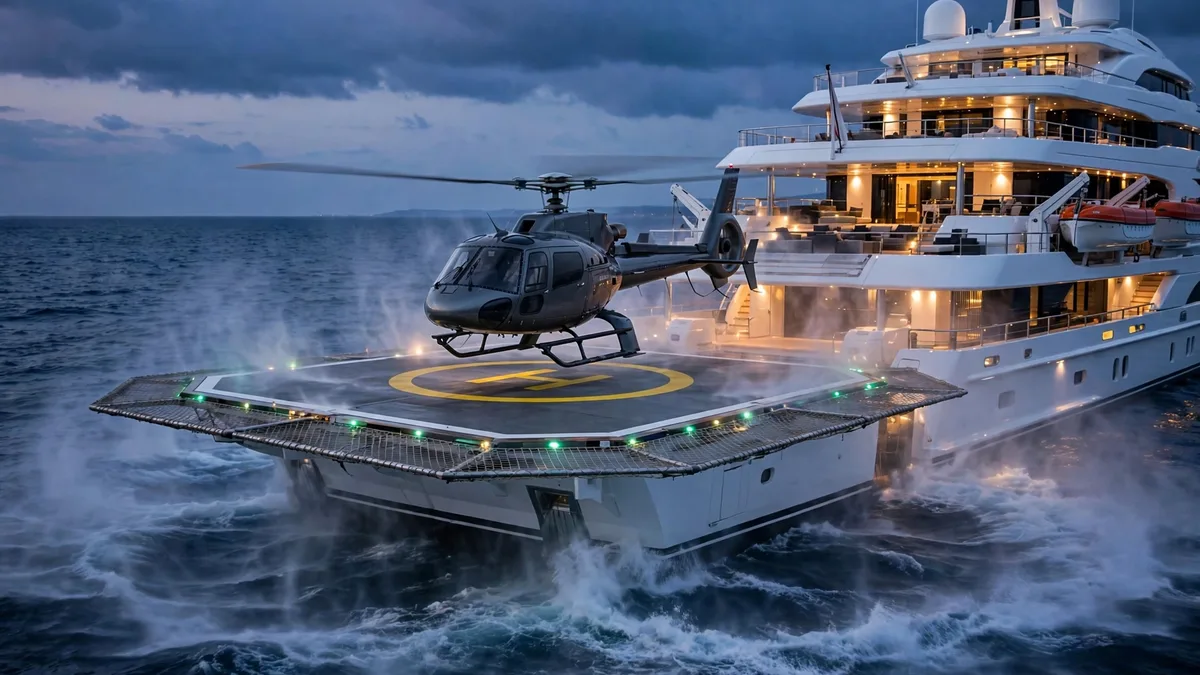
The helicopter comes in low over the water at dusk, its rotor wash flattening the sea into a white ring. Below it, a superyacht the length of a football field holds steady, and on its upper deck a circle of lights marks the landing spot. The pilot sets down gently, the engines spool down, and the owner steps off onto a deck that cost more to build than most houses. A helicopter deck on a superyacht looks like a flat patch of deck with a painted circle. In reality it is one of the most expensive structures on the entire vessel.
A superyacht helicopter deck, or helideck, must do what an airport runway does, but on a ship that moves, rolls and pitches, surrounded by salt water, with a fuel store, a hangar and a crew of specialists nearby. It must be strong enough for a heavy helicopter, safe enough for night landings, and finished to the standard of a luxury yacht. That combination is why it costs so much.
Why It Costs So Much
1. It must hold a helicopter on a moving ship
A helicopter deck is a structural platform, not a cosmetic one. It must support the full weight of a helicopter, often several tonnes, plus the dynamic load of a landing, which can be far higher than the static weight. The deck sits high on the yacht, often on the superstructure, so its weight affects the ship’s stability, and its structure must be tied into the hull with heavy steel or aluminium framing. Engineers model the loads, the ship’s motion and the worst-case landing, then build in a large safety margin. A deck that flexes or cracks is not a maintenance issue; it is a safety failure.
2. Fire is the constant fear
A helicopter carries aviation fuel, hot engines and spinning rotors, and a fire on a helideck is one of the most dangerous emergencies at sea. The deck therefore has its own firefighting system, with foam monitors, hydrants, drainage that captures spilled fuel, and a surface that will not burn. The deck drainage is designed so fuel cannot run into the yacht below, and the fire system must work even if the ship loses power. All of this equipment is marine-grade, tested and certified, and it must be inspected and maintained for the life of the yacht.
3. Certification rules every detail
Helidecks are governed by strict rules from classification societies and aviation authorities, covering the size of the landing area, the lighting, the markings, the safety netting, the tie-down points and the approach paths. The deck must be large enough for the helicopter with a margin on every side, and obstacles such as masts, antennas and funnels must be kept clear of the approach. Meeting those rules often means reshaping the yacht’s superstructure, moving equipment, or enlarging the deck, all of which costs money. The certification process itself, with surveys and flight trials, adds to the bill.
4. Lighting and landing aids for night operations
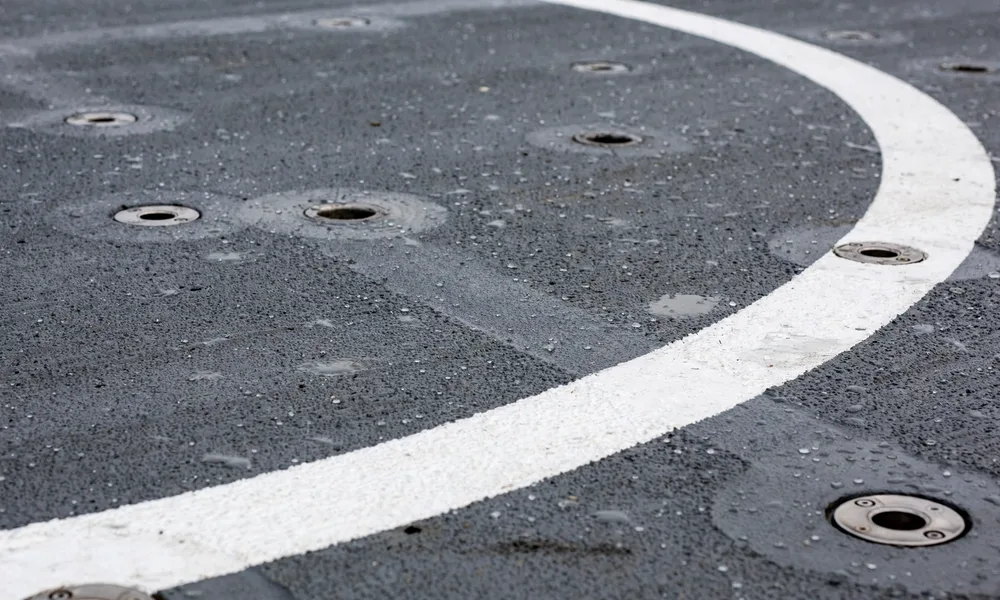
A helideck that can only be used in daylight is of limited value to an owner who wants to fly at night. Night-capable decks need perimeter lighting, floodlights, a lit windsock, glide-slope indicators and sometimes a full instrument approach system. The lights must be visible to the pilot without blinding him, they must be flush with the deck so they are not a trip hazard, and they must survive salt, vibration and being walked on. The electrical system behind them is redundant, so a single failure cannot darken the deck during a landing.
5. The hangar, fuel and crew behind the deck
The deck itself is only the visible part. Below or beside it, a serious helideck installation includes a hangar to store the helicopter, a fuel system with filtration and bonding, and accommodation for the pilot and engineer. The hangar needs doors that open at sea, a crane or tow system to move the helicopter, and its own fire protection. The fuel system must be certified for aviation fuel and kept scrupulously clean. Together, the hangar and support systems can cost as much as the deck itself, and they take up space that could otherwise be guest cabins.
6. Finishing it to superyacht standard
Finally, the deck must look like part of a superyacht, not an oil rig. The surface is usually a specialist non-slip coating in a colour chosen by the owner, the markings are painted to aviation standards, and the surrounding bulwarks, nets and lighting are finished to match the yacht. When the helicopter is away, the deck often doubles as a sunbathing area, a party space or a touch-and-go pad, so it must be beautiful as well as functional. That dual role, working helipad and luxury terrace, is what pushes the cost beyond that of any ordinary industrial platform.

Specifications
| Specification | Detail |
|---|---|
| Typical deck size | 15 to 25 metres across, depending on helicopter |
| Helicopter weight handled | Often 3 to 8 tonnes, sometimes more |
| Deck material | Steel or aluminium structure with non-slip coating |
| Fire system | Foam monitors, hydrants and fuel drainage |
| Lighting | Perimeter lights, floodlights and glide-slope aids |
| Safety features | Safety nets, tie-down points, lit windsock |
| Support systems | Hangar, aviation fuel store, crew accommodation |
| Certification | Classification society and aviation authority approval |
Price
There is no standard price for a superyacht helideck, because it is always part of a custom yacht build, and figures are estimates. Industry guides suggest that adding a full helideck, with hangar, fuel system and certification, to a large superyacht can add several million dollars to the build cost, and the helicopter itself, often several million more, is a separate purchase. Running costs are also high, with a pilot, engineer, fuel, maintenance and insurance. Owners pay it because a helicopter turns a yacht into a vessel that can reach anywhere, landing guests on a remote island or flying them to an airport in minutes.
Rare Fact
Some of the largest superyachts carry not one but two helicopters, with a hangar for one and a deck that can handle the other. The hangar doors are designed to open in rough weather, and the helicopter is lashed down inside with a system strong enough to hold it through a storm. A few yachts even have a helideck that can be raised or lowered, so the deck can be stowed when not in use and the space below used for something else.
A superyacht helideck is expensive because it is three things at once: a structural platform, an airport and a piece of luxury furniture. It must be strong, safe, certified and beautiful, and it must do all of that on a ship that never stops moving. The painted circle on the deck hides a small fortune in steel, foam, lighting and engineering, and the owners who pay for it consider it worth every penny for the freedom it buys.
The steel beneath it is built as described in how a superyacht steel hull is made, the deck finishing follows the craft in how a yacht teak deck is made, and the hull it all sits on is explained in superyacht hull construction.


