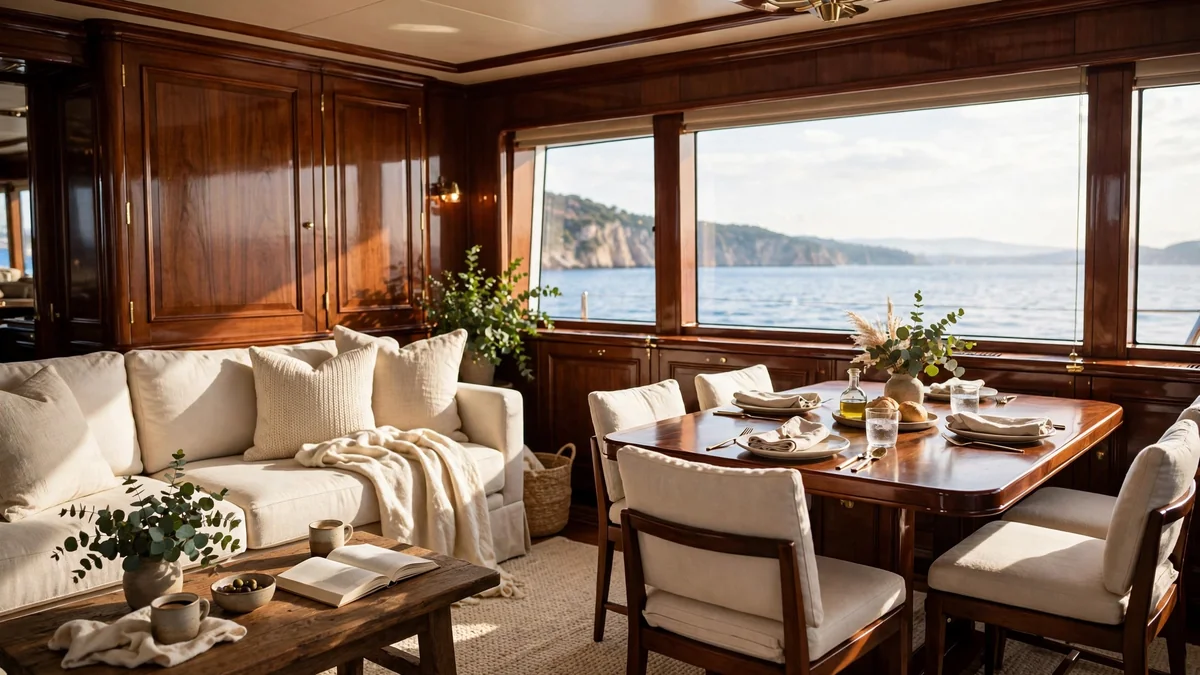
Step aboard a superyacht and the first thing you notice is not the size of it, or the sea through the windows, or even the softness of the carpet underfoot. It is the wood. Warm, dark, polished to a mirror shine, it runs along the walls, wraps around the dining table, climbs the staircase and frames every doorway, and it looks as though it grew there. It did not. Every panel was cut, bent, glued, sanded and varnished by hand, by joiners who spent years learning to make wood behave like furniture in a house that moves, rolls, and lives in salt air.
Superyacht interior joinery is the most demanding woodwork in the world. A cabinet in a house sits still in dry air. A cabinet on a yacht flexes with the hull, breathes in humid sea air, dries out under air conditioning, and has to look perfect after a decade of all of it. The joinery is the yacht’s soul, and it is built from materials that most people never hear of.
Here is what those materials are, and why a yacht’s interior is put together nothing like a house.
The Materials Behind the Machine
1. Teak, walnut and the chosen timbers
The visible wood on a yacht is usually a small group of species chosen for stability and beauty. Teak is the classic, oily and dense, naturally resistant to water and rot, which is why it has been a boat wood for centuries. American black walnut gives the deep brown panels seen in most modern salons, while oak, maple and Santos rosewood appear as contrasts. The timber is kiln-dried far more thoroughly than house timber, down to a moisture content of around 8 percent, and then left to acclimatise in the yard so it will not shrink or swell once installed.
2. Veneers and book-matching
Most of what you see is not solid wood at all. It is veneer, a slice of timber less than a millimetre thick, glued onto a stable substrate. Veneer lets a single beautiful log cover an entire room, and it lets the joiner do something solid wood cannot: book-matching. Slices from the same log are opened like the pages of a book, so the grain mirrors itself across a panel, creating the symmetrical patterns you see on bulkheads and cabinet doors. A whole salon can be veneered from one tree, which is why the grain flows from wall to wall without a break. How the joinery is built in the yard is shown in our guide to how superyacht interior joinery is made.
3. Marine plywood and honeycomb cores
Behind the veneer sits the real structure, and it is engineered for lightness. For large panels, joiners use a sandwich core: thin plywood skins bonded to a honeycomb of aluminium or Nomex, a material also used in aircraft. The result is a panel that is stiff and flat but weighs a fraction of solid timber, which matters on a yacht where every kilogram above the waterline makes the boat roll more. The numbers behind the panels are broken down in our guide to superyacht interior joinery specs.
4. Glues and adhesives
Glue is the most important material in the whole interior, and it is also the most invisible. Yacht joiners use epoxy resins and polyurethane adhesives that cure into a waterproof, flexible bond, chosen because they can absorb the movement of the hull without cracking. The adhesives are applied in climate-controlled workshops, because temperature and humidity change how they cure, and a joint glued on a damp day can fail years later. Veneers are bonded with urea-formaldehyde or modern PUR hot-melt adhesives in heated presses, squeezing the layers together until the bond is stronger than the wood itself.
5. Varnish, lacquer and the mirror finish
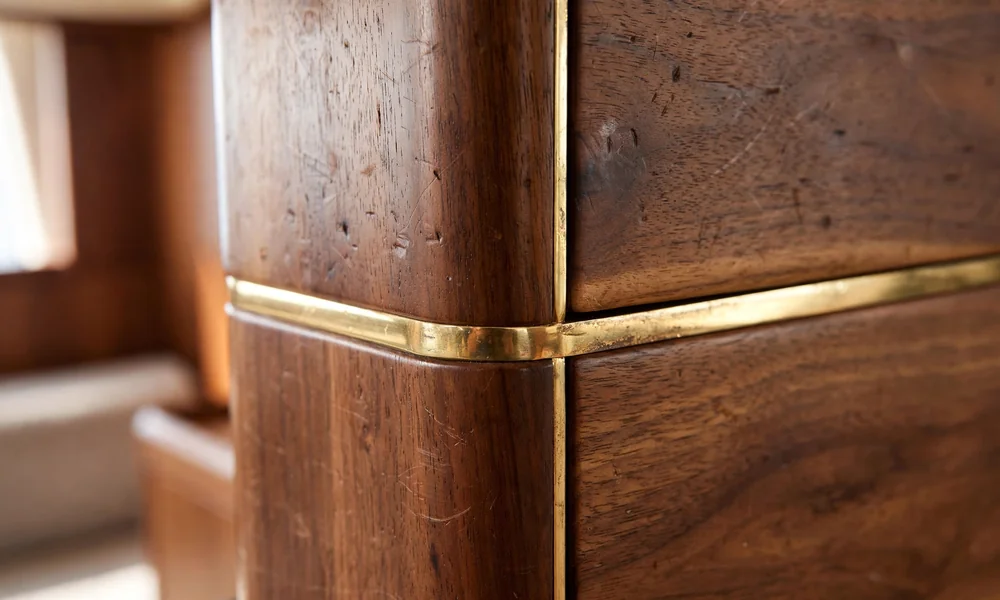
The deep shine on yacht wood is not wax. It is a two-part polyurethane varnish or a polyester lacquer, built up in as many as a dozen coats, each one sanded flat before the next is applied. The finish has to resist ultraviolet light from the sun through the windows, salt in the air, spilled drinks, and cleaning products, and it has to stay flexible enough to move with the wood beneath it. A single dining table can take a week of finishing alone, and the result is a surface so flat and clear that it reflects the room like glass.
6. Brass, stainless steel and inlay materials
The details that make yacht joinery feel luxurious are often not wood at all. Brass inlay strips, stainless steel hinges and handles, mother-of-pearl, and occasionally stone or leather are set into the timber as accents. Brass is chosen because it does not rust in salt air, and it is usually lacquered to stop it tarnishing. The hinges are marine-grade stainless steel, 316 grade, which resists the pitting that ordinary stainless steel suffers near the sea. Leather panels are vegetable-tanned and sealed, and stone inlays are sealed with epoxy so they do not stain. How the finished interior lives and works at sea is covered in our guide to how superyacht interior joinery works.
7. Soundproofing, insulation and fire safety
Behind the beautiful panels is a layer of materials you will never see but will always feel. Acoustic insulation, usually mineral wool or a dense foam, sits behind bulkheads to keep engine noise and voices from travelling between cabins. Fire-retardant treatments are applied to the wood and the fabrics, because a fire at sea is the worst thing that can happen on a yacht, and the materials must meet strict marine fire standards. A superyacht interior is not just furniture. It is a climate system, a sound system and a fire barrier, all hidden behind a few millimetres of walnut.
Key Specs at a Glance
| Part | Typical material | Why it is used |
|---|---|---|
| Visible timber | Teak, walnut, oak, rosewood | Stable, beautiful, salt-resistant |
| Surface | Book-matched veneer, under 1 mm | One log covers a whole room |
| Structure | Marine plywood, honeycomb core | Stiff, flat, light, sound-damping |
| Adhesives | Epoxy and polyurethane resins | Waterproof, flexible, permanent |
| Finish | Two-part polyurethane, up to 12 coats | UV, salt and scratch resistance |
| Metalwork | Brass inlay, 316 stainless steel | No rust in salt air |
| Timber moisture | About 8 percent | Prevents shrinking and cracking |
What It Costs
Interior joinery is one of the most expensive parts of building a superyacht. On a large yacht, the interior fit-out can cost several million dollars, with the joinery alone often running into the millions (estimates, costs vary enormously by yacht size, materials and yard). The cost is not the wood. It is the time: a master joiner may spend weeks on a single cabinet, and a large yacht can take thousands of joinery hours before it is finished.
A Rare Fact
Here is something few guests ever realise: the wood in a superyacht salon is often thinner than the cover of a paperback book. The veneer you admire is less than a millimetre thick, glued to a core that weighs almost nothing, and yet it is expected to look perfect for a decade while the yacht crosses oceans, bakes in the tropics and freezes in northern winters. The next time you run your hand along a yacht’s polished panelling, remember that you are touching the thinnest, most carefully chosen layer of a tree, held in place by chemistry, and finished by hand, one coat at a time.