The owner steps out of the main salon at anchor off the Amalfi coast, crosses a teak deck warmed by the morning sun, and slips into a pool. The water is clear and warm, the horizon is all around, and the nearest shoreline is a kilometre away. It is a swimming pool, but also a small miracle of engineering: a tank of fresh water, held steady and clean, on a vessel that never stops moving.
A pool on land sits still and does its job with gravity on its side. A pool on a superyacht fights the sea every minute it is full. The water sloshes, the hull flexes, and every litre weighs a kilogram that must be carried, filtered, heated, and kept off the expensive joinery. The spec sheet is where all of those battles are quantified.
This guide explains the numbers on a superyacht swimming pool spec sheet in plain English: what length, depth, and volume mean on a moving ship, how the water stays clean and warm, and which figures separate a real pool from a plunge tub.

The Numbers That Matter on a Superyacht Pool
1. Length and width: the swim test
Length decides whether the pool is for swimming or for standing in: superyacht pools typically run 3 to 7 metres long, with the largest reaching 10 metres or more. A pool shorter than 3 metres is a plunge pool, a place to cool off, though a counter-current jet lets owners swim in place. Length is measured inside the walls.
2. Depth: shallower than you think
Depth is typically 1 to 1.4 metres, much shallower than a land pool. Every extra centimetre adds tonnes of water high in the vessel, where it affects stability, and a deep pool sloshes harder in a seaway. Most pools have a flat bottom at around 1.2 metres, deep enough to swim in and shallow enough for a child to stand. Diving is out of the question.
3. Volume: the weight the yacht carries
Volume is measured in litres, and a typical superyacht pool holds 5,000 to 25,000 litres, with the largest holding more than 40,000. Because a litre of water weighs a kilogram, the volume is also the weight the yacht carries high above the waterline, counted in the stability calculations like any other load. The pool is filled from the yacht’s own fresh water, made on board by a watermaker — see the superyacht watermaker specs guide.
4. Water treatment: clean without the chlorine smell
Water treatment keeps the pool safe, and most superyacht pools combine filtration, ultraviolet light, and a small dose of chlorine or bromine. The filter is rated in cubic metres per hour, and the whole volume is typically turned over every 2 to 4 hours. Ultraviolet light kills bacteria without chemicals, which is why a yacht pool rarely smells of chlorine — most important at anchor in warm water, where bacteria grow fastest.
5. Heating: warm water on a cold sea
Heating is measured in kilowatts, and a superyacht pool heater is typically rated at 20 to 60 kW, fed by the yacht’s hot-water system or a heat exchanger from the generators. The target is 26 to 30 degrees Celsius, and holding it overnight in a cool climate takes hours, which is why pools are often covered when not in use. A cover also stops evaporation, the biggest source of heat loss.
6. Anti-slosh design: the invisible engineering
Anti-slosh design stops the water from surging side to side when the yacht rolls, and it is the most yacht-specific number on the sheet. Some pools use a reduced free surface — a cover or raised rim — while others use baffles or a movable floor that rises to deck level, turning the pool into extra deck space. The sheet may quote the maximum roll angle the pool tolerates while full, typically 5 to 10 degrees, and the drain time in heavy weather, usually under 15 minutes. The yacht’s steadying structure is covered in the superyacht mast specs guide, and her propulsion in the yacht propeller specs guide.
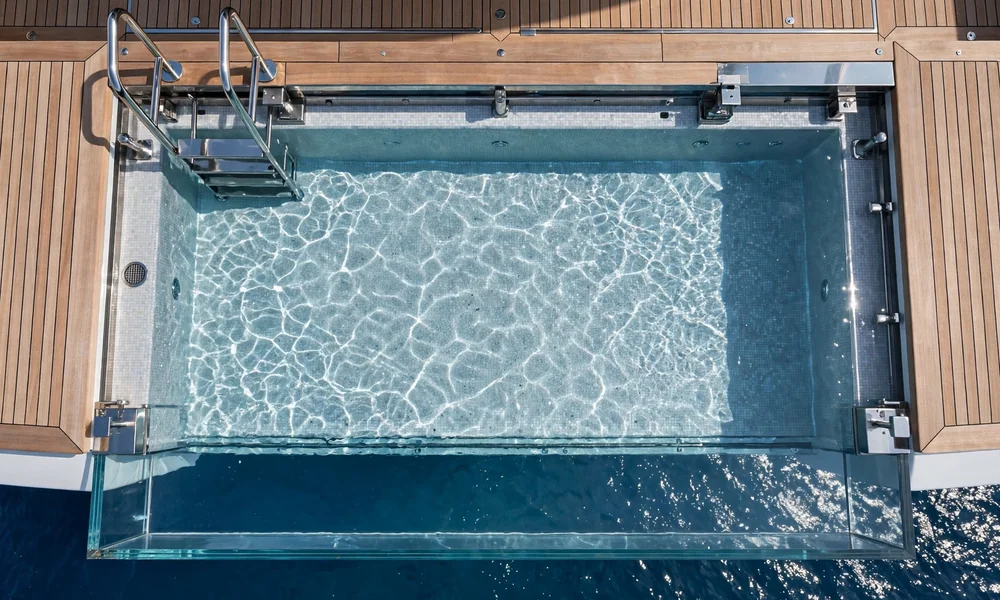
Superyacht Swimming Pool Specs
| Specification | Typical range |
|---|---|
| Length | 3 to 7 m, 10+ m on the largest yachts |
| Width | 2 to 4 m |
| Depth | 1 to 1.4 m |
| Volume | 5,000 to 25,000 litres |
| Water temperature | 26 to 30 °C |
| Heater rating | 20 to 60 kW |
| Filter turnover | Full volume every 2 to 4 hours |
| Time to heat from cold | 6 to 12 hours |
| Time to drain | Under 15 minutes |
How a Superyacht Pool Is Built
A yacht pool is a watertight tank built into a moving hull, and every step is about keeping the water in and the sea out.
Step 1: The tank is welded into the hull. The shell is formed from marine-grade stainless steel or aluminium and welded into the yacht’s structure during the build, so it moves with the hull.
Step 2: The shell is sealed and tiled. The inside is coated with a waterproof membrane and finished in mosaic tiles or smooth resin, chosen to survive salt air, sun, and hull flex without cracking.
Step 3: The plant room is fitted below. Pumps, filters, heaters, and ultraviolet units go in a machinery space beneath or beside the pool, with pipework to circulate, heat, and drain the water quickly.
Step 4: The anti-slosh system is installed. Baffles, a movable floor, or a rigid cover control the water’s movement in a seaway and let the crew drain the pool fast when the weather turns.
Step 5: The pool is filled and balanced. Fresh water from the watermaker fills the tank, and the crew balances the chemistry — pH, chlorine or bromine, and alkalinity — until the water is clear and safe.
Step 6: The pool is tested at sea. Before handover, the yacht is taken out with the pool full, and the crew watches how the water behaves in a roll, how fast it drains, and whether a drop reaches the joinery below.
What Does a Superyacht Swimming Pool Cost?
A superyacht swimming pool is estimated at roughly $200,000 to $1 million to build into a new yacht, and $500,000 to $2 million or more for a large pool with a movable floor and a glass edge. The machinery, waterproofing, and stability engineering cost far more than the structure itself. Running costs are estimated at $10,000 to $50,000 a year. All prices are estimates only and vary widely by size, finish, and the yacht’s build.
A Rare Fact
The first swimming pool on a yacht was not built for swimming at all. In the early 1900s, the great steam yachts carried small tiled seawater tanks used as baths, because a bath was hard to arrange on a rolling ship. The first recognisable pools appeared on ocean liners — the Titanic’s pool, opened in 1912, was heated seawater, and first-class passengers paid extra to use it. It was not until the 1980s, when superyachts grew past 50 metres, that a full-length pool became normal. The pool on a modern superyacht is the descendant of a rich man’s bathtub.

The spec sheet is the honest version of the brochure photograph. Length tells you whether you can swim, depth tells you how much weight the yacht is carrying, and the anti-slosh figures tell you whether the pool can stay full when the sea gets up. A superyacht pool is a small piece of land built on a ship, and its numbers decide whether it feels like luxury or a liability.