The folding electric bike is sold with a photograph, not a specification. A neat little package beside a desk, or tucked into the boot of a small car, or carried onto a train. It looks like the answer to city cycling’s problems: no garage, no rack, no theft, no stairs. Fold it, carry it, forget it. It is a lovely picture. For most buyers, it is also a mistake.
This is not an argument against electric bikes. The ordinary e-bike is one of the best machines of the last twenty years. The argument is against the fold itself, because the fold is not free. It charges you three times: in weight, in ride quality, and in durability. You pay more for a bike heavier to carry, worse to ride, and quicker to wear out than the full-size bike it replaces. For a small number of riders, that trade is worth it. For most buyers, it is not.

It folds. It does not get lighter.
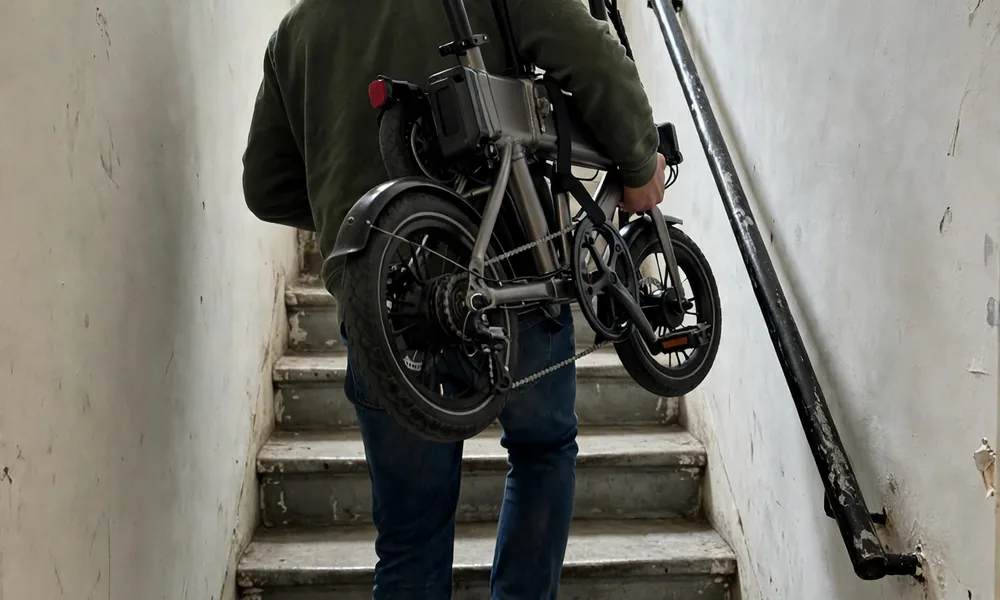
The first surprise is the weight, and it matters most, because the whole point of folding a bike is moving it by hand. A folding e-bike is smaller when folded, but it is not lighter. The hinge, the clamp, the reinforced joints, the motor and the battery all add metal, and the result typically weighs 45 to 65 pounds. The Lectric XP4, a best-selling folder in America, is listed at 62 pounds without its battery and 69 pounds with it fitted: 31 kilograms to lift into a car boot or carry up a flight of stairs, twice a day.
The folding mechanism alone adds roughly two to five pounds over a comparable rigid frame, and the fat tyres many budget folders wear add more. A full-size commuter e-bike with narrow tyres can weigh 39 to 46 pounds, so the folder you bought to carry easily can be 20 pounds heavier than the bike you refused to carry. A full-size bike is long, and you can roll it on its back wheel. A folded bike is a compact, dense block with no good grip. Our guide to how lightweight e-bike frames are engineered shows how much care goes into keeping a proper e-bike light, and a folder throws much of that care away. Amtrak’s 50-pound limit for e-bikes on board rules out most popular folders entirely.
The hinge is a weak point you pay to maintain
A normal bicycle frame is two triangles, and a triangle is close to the strongest shape you can build from straight tubes. A folding frame breaks that geometry on purpose. The main spar is split by a hinge, the down tube is interrupted, and the seat tube often cantilevers from a joint instead of resting on a full triangle. Every pedal stroke twists the front half of the bike against the rear half, and that force is concentrated exactly where the frame folds. The hinge is not a detail on a folding bike. It is the frame.
Riders feel the compromise before they can name it: the bike feels soft under power, the brake drags as the rotor moves against the caliper, and the chain skips as the bottom bracket flexes. A hinge that creaks on every bump is moving more than it should. This is the engineering behind how a folding e-bike frame is made: honest work, spent fighting a problem the designer created by cutting the frame in half.
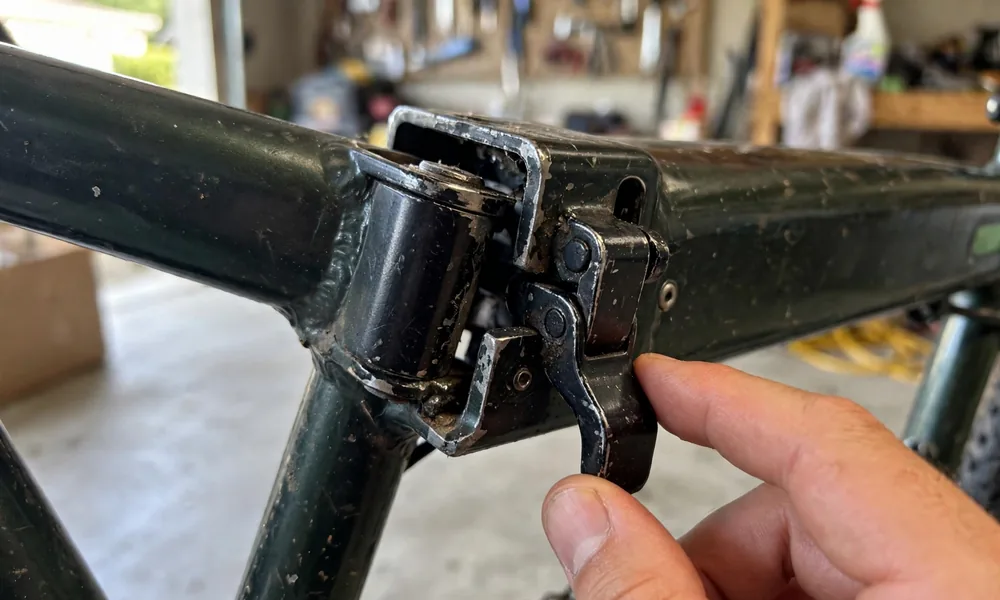
Every fold is also a small act of wear. The latch, cable routing and clamp faces all take a little damage each time the bike is folded and unfolded, twice a day, five days a week. A cheap latch survives a few hundred cycles. A serious one lasts thousands. You will not see the difference on day one. You will feel it in month eight, when the hinge clicks on every bump and the clamp needs adjusting every week. A rigid frame has no moving parts in its structure, so nothing wears out in this way. A folding frame needs regular inspection, and eventually parts a normal bike never needs.
Small wheels, small battery, small ambitions
Then there is the ride. Most folding e-bikes run on 16-inch or 20-inch wheels, because small wheels are what make the folded package small. Small wheels roll over potholes and broken tarmac worse than large ones, and the shorter wheelbase makes the steering quicker and twitchier, especially at speed or in a crosswind. A full-size bike with 27.5-inch or 700c wheels is calmer and more forgiving. The folder is livelier, which is a polite word for nervous, and on a wet, potholed commute, nervous is not what you want underneath you.
The battery is usually smaller too, because there is less frame to hide it in. Many folders carry 250 to 400 watt-hour batteries, against 500 watt-hours or more on a full-size commuter, and their real-world range is often 20 to 40 miles rather than the 60 or 80 on the box. The payload limit is lower as well: many folders are rated for 220 to 250 pounds of rider and luggage, against 300 pounds or more for a full-size bike. Our guide to e-bike battery specs, decoded shows how much of a bike’s usefulness the battery decides, and the folder’s battery is smaller by design.
And the folder costs more: typically 300 to 500 dollars more than a comparable full-size bike, because the hinge, the reinforced joints and the folding stem are expensive to make well. So the buyer pays a premium for a smaller battery, smaller wheels, a lower payload, a heavier bike, and a frame that needs more maintenance. That is a strange deal, and it only makes sense if the folding is worth all of it.
The strongest objection, answered honestly
The honest objection is that some people genuinely need a folding bike, and they do. If you live in a small flat with no ground-floor storage, if you keep a boat or a motorhome, or if you commute by train every day and the bike must fit in a luggage rack, then a folder is not a luxury. It is the only bike that fits your life. The premium folders prove the idea can work: a Brompton Electric folds smaller than anything else, and a Tern Vektron rides better than most folders have any right to.
But notice what those riders have in common: the fold is the point of the bike, not a feature they might use. The problem is the much larger group who buy a folder for a life they do not live. They imagine carrying it onto trains, but they drive; storing it under a desk, but they have a garage. They fold it twice, decide it is a faff, and leave it unfolded in the hallway: simply a heavy, small-wheeled e-bike with a hinge they never use.
Verdict
Buy a folding electric bike only if storage or transport is the problem you actually need to solve, every day, and you have weighed the bike with its battery fitted and lifted it up your own stairs. If you have a garage, a shed, a bike room, or a ground-floor spot to park, buy a full-size e-bike instead. It will be lighter, cheaper, more comfortable and more durable, and you will ride it more — the only measure that matters. The fold is a brilliant solution to a specific problem. The mistake is buying it when you do not have that problem.