There is a number that electric yacht builders love to announce, and it is the wrong number. Not range. Not charging time. Power. Twin motors, hundreds of kilowatts, a top speed that would embarrass a sports boat — all of it fitted to a vessel that runs on a battery, in water, where every extra knot costs far more than the last. The result is an electric yacht that can go very fast for a very short time and then must crawl home, or be towed home. The case against overpowered electric yachts is the case against a horsepower race that physics has already decided, and that the industry is losing on purpose.
This is not an argument against electric yachts. It is an argument against the idea that an electric yacht should be judged the way a petrol yacht is judged: by how much power it has and how fast it goes. On water, power is not the asset. Endurance is. And the two are enemies, in a way that no amount of battery can fix.
Water punishes speed in a way roads never do
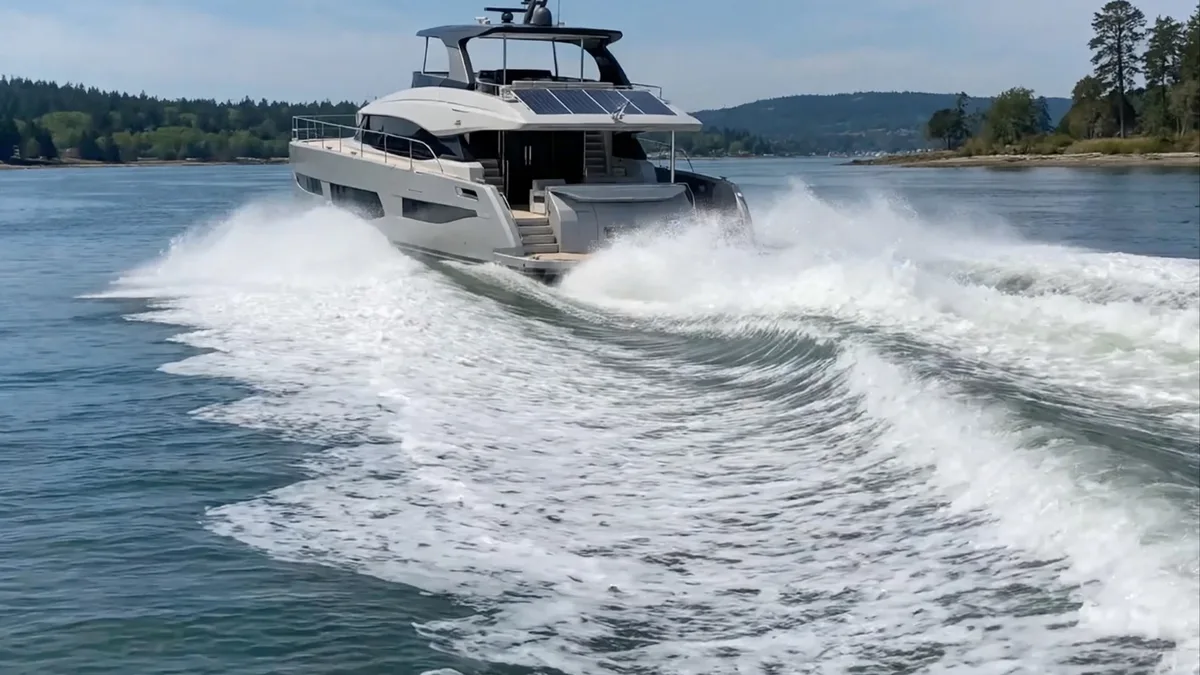
The core fact is the power curve, and it is brutal. A boat does not roll along a road. It pushes water aside, constantly, and the faster it goes, the more water it has to push. For a displacement hull there is a natural speed limit called hull speed, beyond which drag rises steeply as the boat tries to climb over its own bow wave. Below hull speed, modest power goes a long way. Above it, every extra knot demands an enormous increase in power, and the battery pays for it in minutes.
The numbers make the point better than any argument. One maker’s test of a small electric boat showed that cruising at five miles per hour delivered 42 nautical miles of range, while pushing the same boat to 12 miles per hour cut that to 18 — a 57 percent loss of range from seven extra miles per hour. Scale that up to a yacht with twin 300-kilowatt motors and the maths gets worse, not better: at full throttle, a big battery pack can be emptied in well under an hour, and the practical range shrinks to a dozen miles or less. An 80-horsepower-equivalent electric outboard with a 30-kilowatt-hour battery, by the industry’s own worked examples, runs wide open for about 35 minutes and covers 12 to 18 miles. A petrol boat with the same power runs for five and a half hours. That is not a gap that a bigger battery closes. It is a gap that a bigger motor widens.
Power you cannot use is weight you cannot lose
The second argument is weight, and it compounds the first. Big motors need big batteries, and big batteries are heavy. A yacht that was meant to be light and efficient ends up carrying tonnes of lithium, and every tonne of battery is a tonne that makes the hull sit deeper, push more water and need more power — which needs more battery.
That weight also eats the space that makes a yacht a yacht. The yacht’s owner paid for luxury and got a battery room. And the battery itself is the single most expensive part of the vessel, so the overpowered yacht is not just heavier and shorter-ranged — it is more expensive to buy, more expensive to insure and more expensive to replace when the cells age. Our guide to the best electric boat propulsion systems shows the pattern clearly: the systems that succeed are the ones matched to the hull, not the ones with the biggest number on the brochure.

The speed nobody needs, at a price nobody should pay
It is worth asking who the speed is for, because on the water it is rarely the owner. Yachts spend most of their lives at displacement speed: leaving harbour, crossing a bay, anchoring for lunch, coming home at dusk. The speeds that matter are five to eight knots, sustained for hours, in comfort and silence. A yacht that can do 25 knots for twenty minutes and then must limp home at five knots has not bought speed. It has bought a party trick, and it has paid for it with the thing its owner actually uses: range.
None of this is an argument for slow boats. It is an argument for honest boats: a yacht with enough power to hold its speed against wind and current, to manoeuvre in a marina, to outrun weather when it must — and no more. The diesel comparison makes the same point from the other side: our head-to-head of diesel versus electric yacht propulsion shows how the electric advantage — silence, instant torque, almost no maintenance — is strongest where the power is modest and the boat is allowed to do what it is good at.
The honest case for power, answered
There is a genuine case for more power, and it deserves an honest answer. A yacht needs reserve power for emergencies: to hold position in a strong current, to punch through a head sea, to get home when the weather turns. A yacht with too little power is a yacht that cannot look after itself, and that is a safety problem, not a virtue. Nobody should argue for an electric yacht so weak it cannot cope.
But reserve power and headline power are different things, and the industry has blurred them on purpose. Reserve power is a margin — a motor sized for the worst hour of the year, not the best minute of the brochure. It is a 30-kilowatt motor on a boat that cruises on 10, not a 300-kilowatt installation on a boat that cruises on 15. The difference between the two is not safety. It is marketing, and it is paid for in battery weight, charging time, purchase price and range, every single day the yacht is used.
The right answer is the one the best electric boats already demonstrate, and it is the same answer our own case for smaller electric yachts makes from the other direction: match the power to the water, not to the brochure. A modest motor, a hull designed for displacement speed, a battery sized for a full day at the speed the boat actually travels — that is an electric yacht that works. The overpowered version is a petrol yacht’s specification sheet bolted onto an electric boat, and the sea has never cared about specification sheets. It cares about energy, and it always wins.

Verdict
Electric yachts should stop racing each other on horsepower and start racing on endurance. The overpowered electric yacht is a fast boat for twenty minutes and a slow boat for the rest of the day, a heavy boat with a huge battery and a short range, a silent boat that is only silent when it is going slowly. The physics of water has not changed, and no battery on the market changes it. Fit the power the journey needs, size the battery for a full day at displacement speed, and let the petrol boats keep the top-speed crown. The electric yacht’s crown is different: quiet, clean, cheap to run, and out on the water long after the fast boats have gone home to charge.


