Every electric ferry launch seems to come with the same boast: faster. A new top speed, a shorter crossing time, a few minutes shaved off the timetable. It sounds like progress, and for a press release it is. But for the people who actually run ferries, and for the passengers who ride them, speed is the wrong thing to chase. The case for slower electric ferries is simple: go a little slower, use far less energy, travel further on a charge, and give everyone on board a calmer crossing. That is not a compromise. It is a better ferry.
The physics is unforgiving, and it is on the side of slowing down. The power a hull needs rises steeply with speed, far faster than the speed itself. Push a ferry from 12 knots to 16 knots and the energy demand can roughly double, because drag grows with the square of speed and power with the cube. That is an estimate, but the shape of the curve is not in dispute: the last few knots are the most expensive a ferry will ever buy. An operator that accepts a crossing a few minutes longer can cut its energy use dramatically, and on a battery-powered vessel that saving goes straight to range, to smaller battery packs, or to both.
The fastest knots are the most expensive
Think about what a ferry actually does all day. It runs the same short route, back and forth, dozens of times. It is not crossing an ocean. It is crossing a harbour, a river, or a strait, and the difference between a fast crossing and a slightly slower one is often measured in minutes, not hours. Passengers do not plan their day around saving four minutes on a twenty-minute crossing. They plan around the timetable: does the ferry leave when it says it will, and does it arrive reliably? A slower ferry that keeps its schedule is worth far more than a faster ferry that arrives with a nearly empty battery and needs a long charge before it can turn around.
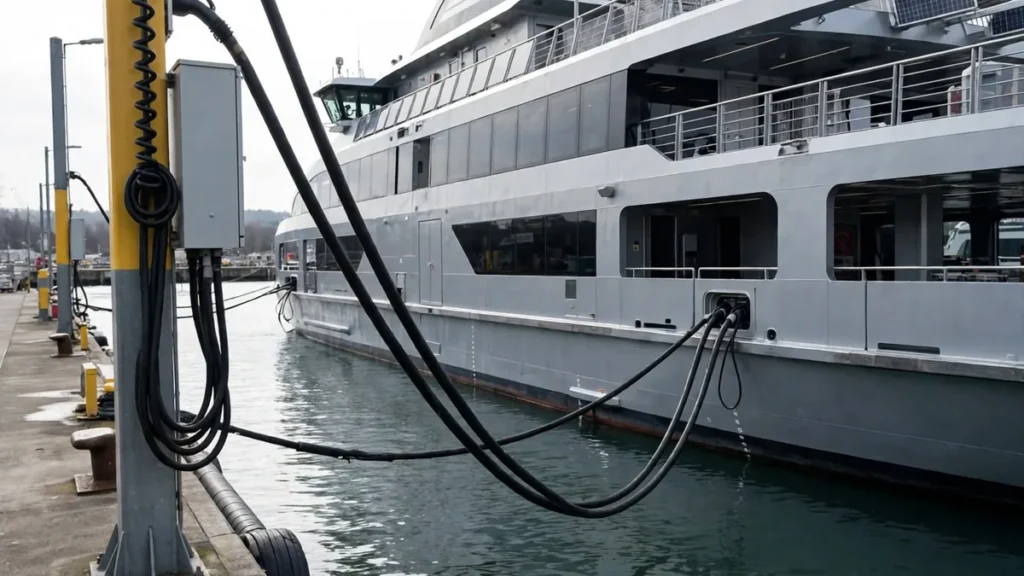
That turnaround is where speed quietly costs operators money. A ferry that burns through its battery at high speed needs bigger chargers, longer stops, or a larger and heavier battery pack. Batteries are the most expensive part of an electric ferry, and every extra tonne of battery is a tonne that is not passengers or vehicles. Slowing down breaks that spiral: a smaller pack charges faster, costs less, lasts longer, and leaves more room for the payload that earns money.
The comparison with diesel is instructive, even if the conclusion is different. The argument for electric ferries over diesel rests on lower running costs, cleaner air and quieter operation. All of that is true, but it is most true at modest speeds. Run an electric ferry flat out and much of the advantage is burned away in the wake. Run it at a sensible pace and the electric drivetrain is in its element: efficient, quiet, and cheap to maintain. Speed is the one thing that can make an electric ferry look like a bad deal, and it is a choice, not a law of nature.
Range is freedom, and speed spends it
Range anxiety is not just a car problem. For a ferry operator, range is the whole business. A vessel that can make ten crossings on a charge is a different asset from one that can make six, even if the second one is faster. The slower vessel needs fewer charging stops, it can keep running through the busy evening peak without a long layover, and it can cope when a charger is out of service or a timetable slips. That resilience matters more than any headline speed figure, because a ferry that cannot complete its roster is a ferry that cancels sailings, and cancelled sailings are what passengers remember.
Some routes that most need electrification are longer crossings, where the battery must last the whole trip with a margin for weather and delays. A ferry designed around a moderate cruising speed can serve a longer route on the same battery a fast ferry would exhaust halfway. That is the difference between a route that can be electrified today and one that must wait years for bigger batteries.

A calmer crossing is a better product
Passengers notice speed less than operators think, and they notice comfort more. A ferry running hard throws up a bigger wake, rolls more in a chop, and makes the deck a less pleasant place to stand. Coffee spills, children stumble, and the whole vessel feels hurried. A slower ferry rides flatter, its wake is smaller, and the crossing feels like what it should be: a short, calm break in the journey rather than a race across the water.
A smaller wake matters beyond the vessel too. Wash from fast ferries erodes banks, disturbs moored boats, and churns up shallow water where wildlife feeds. Harbour authorities already limit speeds in many places for exactly this reason, and a ferry designed to be efficient at those speeds is a better neighbour.
None of this means ferries should crawl. There is a sensible cruising speed for every hull, a point where the vessel is efficient, stable and on time, and the argument here is to design for that point instead of chasing a top speed that is only used to impress. The best electric ferries are not the fastest ones. They are the ones that balance speed, range, comfort and cost, and on that balance the slower vessel usually wins. A ferry that arrives four minutes later but never cancels, never strands its passengers, and charges quickly enough to keep its timetable is the better ferry by every measure that matters.
What slower design actually looks like
Designing for slower speeds changes the vessel in good ways. The hull can be shaped for efficiency at cruising speed rather than for a top speed it rarely reaches. The propellers can be larger and slower-turning, which is quieter and more efficient, and the motors, cooling system and drivetrain can all be smaller and lighter. Together they make a ferry that is cheaper to build, cheaper to run, and easier to keep in service.
There is a parallel in the way electric ferry propulsion works at its best: a motor that delivers its torque smoothly and quietly, without the noise and vibration of a diesel, is wasted if the vessel is driven so hard that the hull itself becomes the source of noise and discomfort. The electric drivetrain invites a different kind of operation, one where the quiet and the smoothness are part of the product, not just a side effect. Slowing down lets passengers actually experience what electric propulsion is good at.
The verdict
The ferry industry does not need faster electric ferries. It needs more of them, on more routes, running reliably all day, and that is exactly what slower design delivers. A few minutes longer on the water buys a large cut in energy use, a longer range, a smaller and cheaper battery, faster turnarounds, a calmer crossing and a smaller wake. That is a trade any sensible operator should take, and any sensible passenger should welcome.
Speed has had its turn as the measure of a good ferry. It is time to judge ferries by what they are for: moving people and vehicles across the water, on time, in comfort, without burning energy and money to save minutes nobody needed. The slower electric ferry is not a step backwards. It is the ferry done properly.