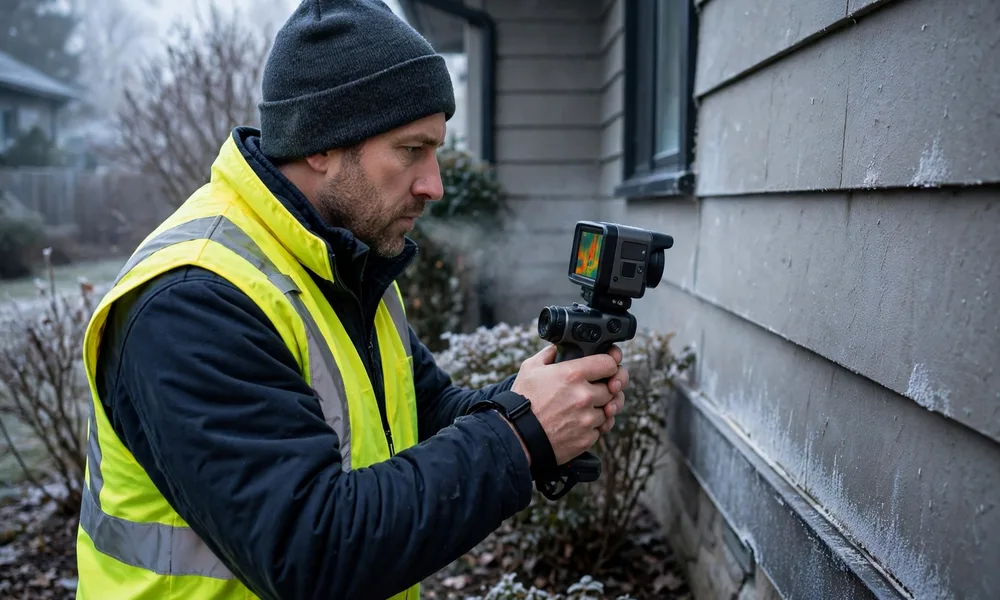
Point a normal camera at a house on a cold night and you will see darkness, a porch light, and not much else. Point a thermal camera at the same house and the walls light up like a map: warm patches where heat leaks through the insulation, cold streaks where a draught slips in around a window, a bright smear where a pipe runs behind the plaster. The camera is not seeing light at all. It is seeing heat, and the numbers on its spec sheet describe how finely it can see it.
A thermal camera sensor, called a microbolometer, is a grid of tiny heat-sensitive pixels that warm up by a fraction of a degree when infrared radiation lands on them. Each pixel’s temperature change becomes one dot in the image. Its spec sheet is a strange mix of numbers. Here is what each one actually tells you.

Resolution: How Many Heat Pixels
Thermal resolution is the number of pixels on the sensor, usually written as something like 160 × 120, 320 × 240, or 640 × 480. Those numbers look tiny next to a phone camera’s 12 megapixels, but they are the honest measure of a thermal sensor: 640 × 480 is a high-end sensor, and 160 × 120 is entry level. More pixels mean a sharper image and the ability to spot a small hot spot — a faulty wire, a damp patch — from further away. The sensor resolution is the number that matters, and it is the first thing to check. If you want the full picture, start with how a thermal camera sensor works before comparing numbers.
Thermal Sensitivity (NETD)
The most important number on a thermal spec sheet is also the least familiar: NETD, or noise equivalent temperature difference, measured in millikelvins (mK). It describes the smallest temperature difference the sensor can detect — a NETD of 50 mK means it can tell two surfaces apart if they differ by 0.05 °C. Lower is better: a 40 mK sensor sees subtler differences than a 100 mK sensor, which matters when you are looking for a faint damp patch or a slow leak rather than a blazing hot pipe. Cheap sensors often sit around 100 to 150 mK, while good ones reach 40 to 50 mK.
Spectral Range
Thermal sensors do not see all infrared light. Most uncooled microbolometers are sensitive in the long-wave infrared band, roughly 8 to 14 micrometres, which is the band where everyday objects at room temperature give off most of their heat. That range is why a thermal camera can see a warm wall but not through glass — ordinary window glass blocks long-wave infrared almost completely, so a window looks cold and opaque to the sensor even when the room behind it is warm. For building inspection, electrical work and wildlife watching, the 8 to 14 micrometre range is the standard.
Pixel Pitch
Pixel pitch is the distance between the centres of neighbouring pixels, measured in micrometres — 17 µm was the standard for years, and newer sensors use 12 µm. A smaller pitch lets the maker fit more pixels into the same sensor area, which means higher resolution in a smaller, cheaper package. But smaller pixels collect less heat each, which can worsen sensitivity unless the design compensates. That is why a 12 µm sensor is not automatically better than a 17 µm one: the pitch must be read together with the NETD.

Frame Rate
Frame rate is how many thermal images the sensor captures each second, and it decides whether the picture feels live or laggy. A rate of 9 Hz — nine frames per second — is common in cheaper cameras, partly because export rules once limited faster thermal cameras, and it is fine for scanning a wall slowly. But sweep the camera quickly across a scene at 9 Hz and the image smears and stutters. A 30 Hz or 60 Hz sensor feels smooth and is far better for tracking a moving animal, a running motor, or a person walking through a building.
Temperature Range and Accuracy
Every thermal sensor has a measurement range — the span of temperatures it can read — often quoted as something like −20 °C to 150 °C for a general-purpose camera, or up to 650 °C for an industrial model. Outside that range the readings become unreliable, and at the extremes the sensor can saturate, turning everything white. Accuracy is usually quoted as ±2 °C or ±2% of the reading, whichever is larger, and it assumes the user has set the emissivity correctly — the number that describes how well a surface gives off heat. That is the most common beginner mistake: trusting the number on the screen without checking what the surface is made of.
Field of View and Lens
Field of view, given in degrees, describes how much of the scene the camera sees at once — a wide 50-degree lens suits a room, while a narrow 25-degree lens suits a roof inspected from the ground. The lens is made from germanium or chalcogenide glass, because ordinary glass blocks infrared, and it is often the most expensive single part of the camera. The materials inside a thermal camera sensor explain why that lens costs so much: germanium is rare, brittle, and hard to polish, and a scratched lens cannot simply be swapped for a cheap replacement.
The Specs at a Glance
| Resolution | 160 × 120 entry level, 640 × 480 high end |
| Thermal sensitivity (NETD) | 40–50 mK good, 100–150 mK basic |
| Spectral range | 8–14 µm long-wave infrared, standard |
| Pixel pitch | 17 µm older, 12 µm newer sensors |
| Frame rate | 9 Hz basic, 30–60 Hz smooth |
| Temperature range | −20 °C to 150 °C typical, 650 °C industrial |
| Accuracy | ±2 °C or ±2% of reading, whichever is larger |
What Does It Cost?
A handheld thermal camera costs roughly $200 to $500 (estimate) at the entry level, $1,000 to $3,000 (estimate) for a good professional model, and $5,000 or more (estimate) for high-resolution industrial cameras. The price follows the sensor almost exactly: resolution and sensitivity are what you pay for, with the germanium lens a close second. For occasional home use that is plenty; for daily professional inspection, the wider range and better sensitivity of a dedicated camera pay for themselves quickly.
A Rare Fact
The first thermal cameras were military tools so sensitive and so secret that early civilian models were deliberately slowed to 9 frames per second by export rules — a limit that still shapes the budget market today. The sensor at the heart of them, the microbolometer, uses a tiny bridge of vanadium oxide that changes its electrical resistance when it warms by a thousandth of a degree. That hair-thin bridge, repeated hundreds of thousands of times across a chip the size of a fingernail, is what lets a camera see the heat of a handprint left on a wall minutes after the hand is gone. If you enjoy this kind of hidden engineering, the materials inside a cinema camera sensor show how the visible-light side of imaging faces a surprisingly similar set of trade-offs.