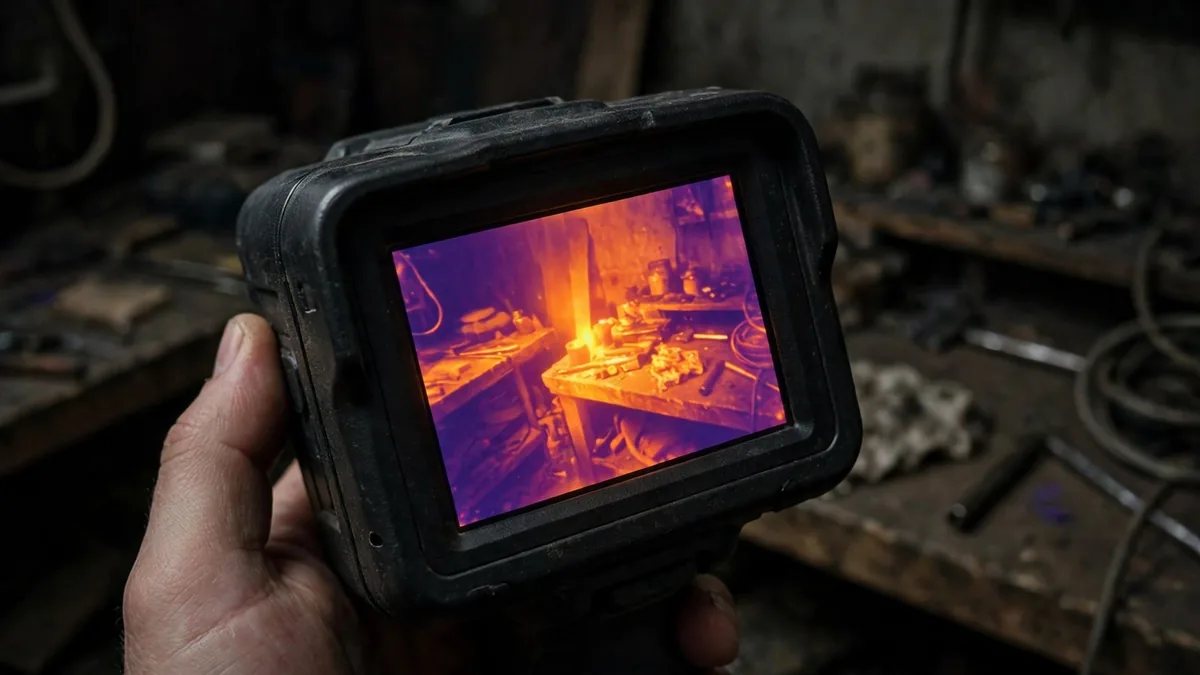
The firefighter steps into a hallway filled with smoke so thick that his helmet torch is useless. He cannot see the door at the end of the corridor. Then he raises a small camera to his eye, and the darkness turns into a picture: the warm outline of a body on the floor, the cool shape of a window. Nothing is lit, and yet everything is visible.
That picture is not made from light. It is made from heat. Every object gives off invisible infrared radiation, and a thermal camera sensor catches that radiation and turns it into an image our eyes can understand. It needs no lamp, flash, or moonlight. As long as things are warmer than absolute zero, which is everything in ordinary life, the sensor has something to see.
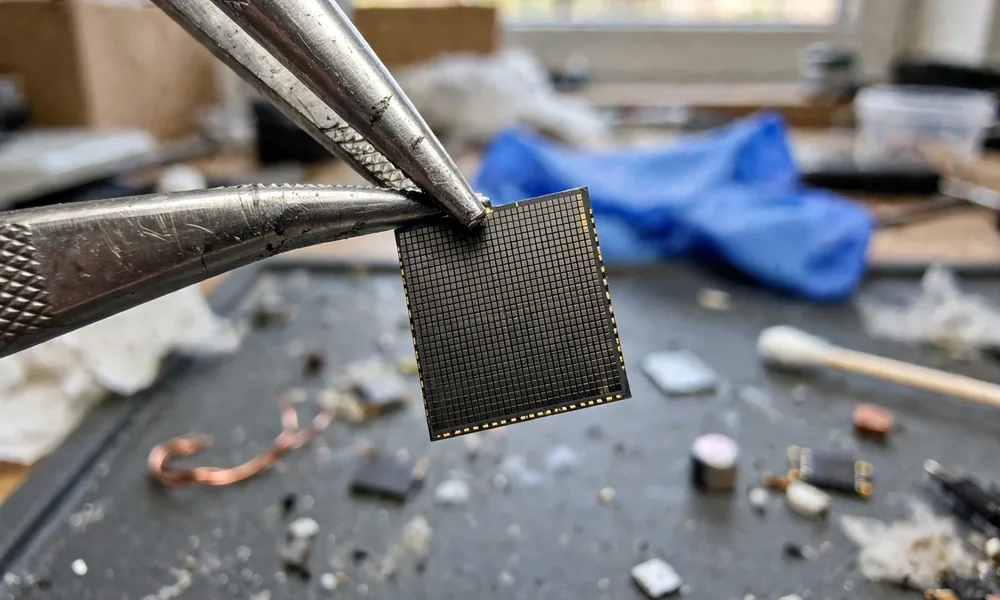
The sensor at the heart of most thermal cameras is a microbolometer, a grid of tiny heat-sensitive pixels that warm by a fraction of a degree when infrared radiation falls on them. That tiny warming changes their electrical resistance, and the camera measures the change, pixel by pixel, thousands of times a second. Here is how the whole chain works.
How It Works
Step 1: Catching heat instead of light
Ordinary camera sensors catch visible light, the band of radiation our eyes can see. A thermal sensor works further along the spectrum, in the long-wave infrared band between roughly 8 and 14 micrometres, where the heat given off by people, engines, and buildings is strongest. The front of the camera is fitted with a lens made not of glass, which blocks infrared, but of germanium, a grey metallic-looking material transparent to heat radiation. Sensors that map the world with pulses of light work on a different principle, as how lidar sensor works explains.
Step 2: The microbolometer grid warms up
Behind the lens sits the microbolometer array, a chip covered with a grid of tiny pixels, often 320 by 240 or 640 by 480 of them, each one a small bridge of vanadium oxide or amorphous silicon suspended over a hollow cavity. When infrared radiation hits a pixel, it absorbs the energy and warms by a tiny amount, sometimes less than a thousandth of a degree. The cavity underneath insulates it from the chip below, so the heat stays long enough to be measured. Each pixel is only about 12 to 17 micrometres across, smaller than a human hair.
Step 3: Heat becomes an electrical signal
That tiny warming changes the pixel’s electrical resistance, and this is the measurement that matters. A circuit beneath the array passes a small current through every pixel in turn and reads how much resistance it meets. Warmer pixels, struck by more infrared radiation, show a different resistance from cooler ones. The readout electronics sweep through the whole grid many times a second, building a fresh map of resistances for every frame. No shutter fires and no flash goes off; the only moving part is the flow of electrons through the chip.
Step 4: Calibration keeps every pixel honest
Microbolometers drift. Their resistance changes with the temperature of the camera itself, so a sensor that is accurate in a cold warehouse may read wrong after half an hour in a warm pocket. To fight this, the camera regularly swings a small shutter across the sensor, a flat plate of known, uniform temperature. The camera measures what every pixel reports when looking at that plate and stores a correction for each one, a process called non-uniformity correction. Many cameras do this automatically every few minutes, freezing the image briefly with a soft click. Staying honest in a pocket-sized device is a challenge shared by other tiny sensors, as smartwatch health sensor materials engineering shows.
Step 5: Turning numbers into a picture
The corrected resistance map is still just numbers, so a processor turns it into an image. Each temperature is assigned a colour from a palette, often ironbow, where cool areas appear dark blue and purple and hot areas glow yellow, orange, and white, or a simpler greyscale where hot is bright and cold is dark. The processor sharpens edges, smooths noise, and can blend the thermal picture with a faint visible-light outline so doors and faces are easier to recognise. The result is shown on a small screen or sent to a phone, usually at 9 or 30 frames a second, fast enough to follow movement through smoke or darkness.
Step 6: Focusing and measuring the scene
The last step belongs to the user. The germanium lens is focused, by hand or by a small motor, until the heat picture is sharp, and the software can then read out the temperature of any point in the frame. Electricians find overheating wires in crowded panels, inspectors find damp insulation behind walls, and mechanics spot brake discs running hotter than their neighbours. The sensor never touches what it measures, which is why it can check a live electrical cabinet, a moving engine, or a wild animal from a safe distance. Small motors do the same delicate focusing in other cameras, as camera autofocus motor materials engineering explains.
| Sensor type | Uncooled microbolometer array |
| Resolution | Commonly 320 by 240 or 640 by 480 pixels |
| Pixel size | About 12 to 17 micrometres across |
| Infrared band | Long-wave infrared, roughly 8 to 14 micrometres |
| Lens material | Germanium, transparent to infrared |
| Frame rate | Typically 9 or 30 frames per second |
| Temperature sensitivity | Below 0.05 degrees Celsius |
| Calibration | Automatic shutter-based correction |
What Does a Thermal Camera Cost?
A compact thermal camera that plugs into a phone is estimated at roughly $200 to $500, while a professional handheld unit with a 640 by 480 sensor, a sharp germanium lens, and measurement software is estimated at $2,000 to $8,000 or more. The price climbs with resolution, sensitivity, and lens quality, and a single germanium lens can cost more than an entire budget camera. Drone-mounted and scientific thermal cameras sit higher still, estimated at $10,000 to $50,000, adding stabilisation and higher frame rates. Most of the cost is the sensor and the lens: growing a flawless germanium crystal is slow, expensive work.
A Rare Fact
The first thermal cameras were so large they needed a truck to carry them, and their sensors had to be cooled with liquid nitrogen to work at all. The detectors of the 1960s only functioned near minus 196 degrees Celsius, which meant a bulky flask of cryogenic liquid and a warm-up time measured in minutes. The microbolometer changed everything because it works at room temperature, with no cooling at all. That single change shrank a truck-sized military instrument into a camera that fits in a jacket pocket, and thermal imaging moved from the battlefield into fire stations and building sites within a generation.
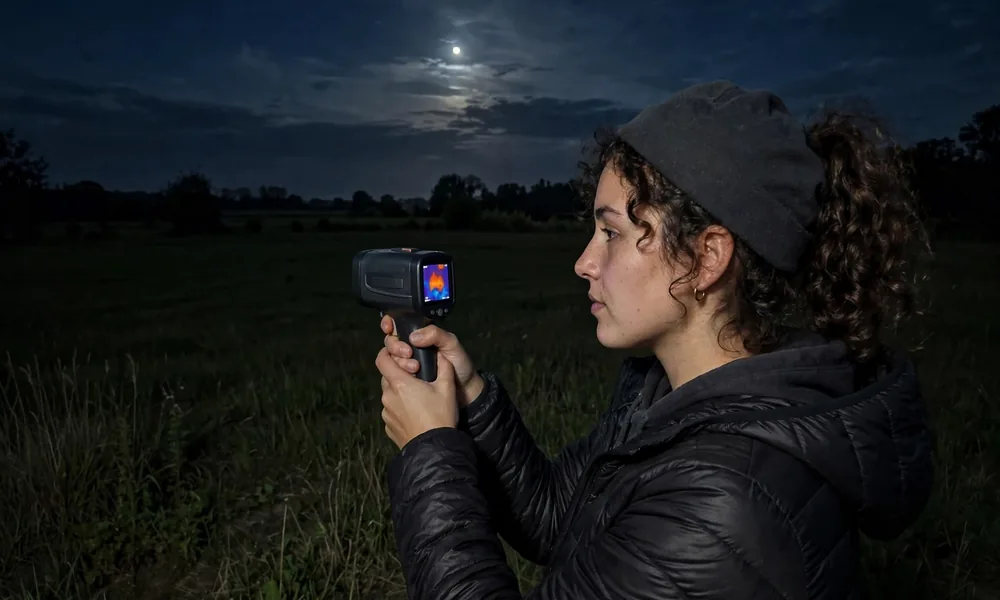
The next time a screen shows the world in orange and purple, it is worth remembering how little is happening inside the camera. No light is gathered and nothing touches the subject. A grid of microscopic bridges is warming by a thousandth of a degree, a circuit is reading the change, and a processor is painting heat as colour. The camera does not see the world as it looks. It sees the world as it feels.


