A yacht’s deck is where the boat meets its people. It is walked on barefoot, baked by the sun, soaked by the sea and expected to look beautiful after years of all three. Choosing a deck material is therefore not a styling decision but an engineering one, balancing grip, heat, weight, maintenance and cost against the simple question of how it feels underfoot on a hot afternoon.
This guide ranks eight yacht deck materials from the weakest to the strongest all-round choice, judging each on grip when wet, comfort in the heat, durability, maintenance and looks. The ranking reflects the best balance for a typical cruising yacht.
The Best Yacht Deck Materials, Ranked
8. Painted fibreglass
Painted fibreglass is the simplest deck of all: the deck moulding itself, finished with a non-slip paint. It costs almost nothing extra, adds no weight and can be repaired with a tin of paint and an afternoon’s work. For a small daysailer or a workboat, that is often enough, and there is something to be said for a surface that asks so little of its owner.
The problem is comfort and grip. In strong sun a dark painted deck becomes hot enough to be painful barefoot, and once the non-slip texture wears smooth, the surface turns treacherous when wet. Painted fibreglass is honest and cheap, but it ranks last because it does the least to make life on deck pleasant.
7. Carpet and marine carpet
Marine carpet feels wonderful underfoot, soft, warm and quiet, and it is popular on flybridges and in cockpits where people gather in the evening. It hides dirt, muffles footsteps and gives a deck a cosy, domestic feel that hard surfaces cannot match.
But a deck is not a living room. Carpet holds water, and water held against a deck breeds mould, smells and rot in the structure below. It stains, it fades in the sun and it must be lifted and dried after heavy weather. For an open deck that takes green water, it is a maintenance burden that never really ends.
6. PVC synthetic decking
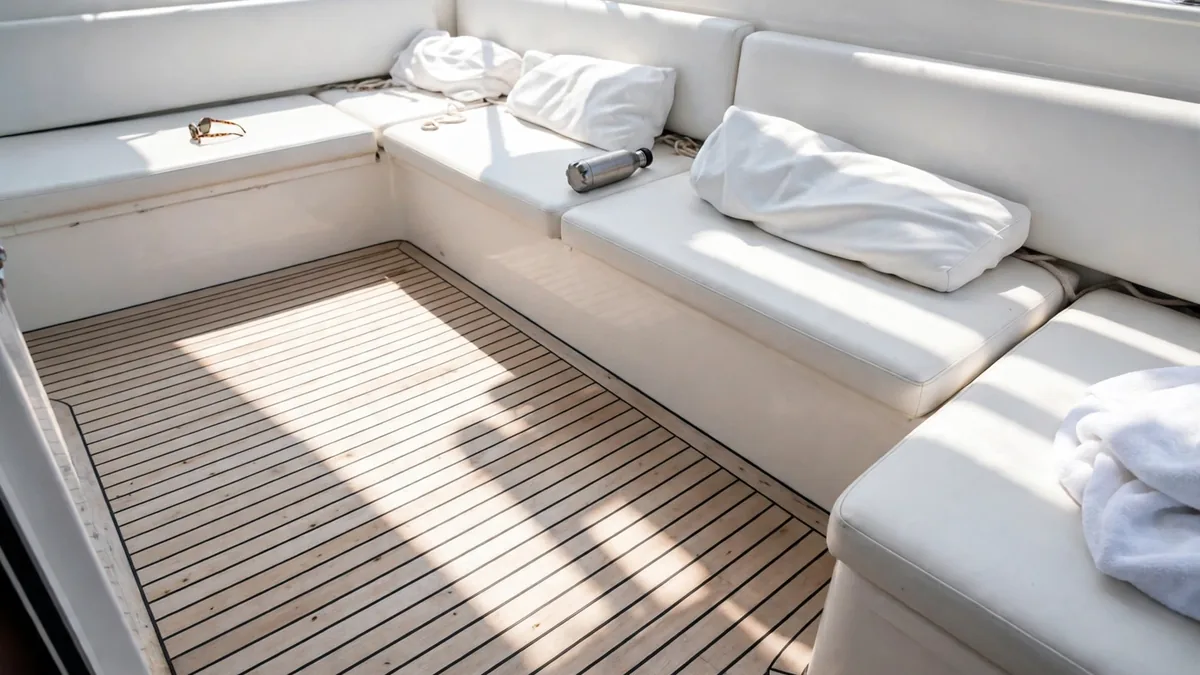
PVC decking promises the look of teak without the work: planks of coloured plastic, laid in strips with dark seams, that never need oiling, sanding or caulking. It is light, it is easy to clean with a hose, and it comes in colours from pale sand to weathered grey.
The shortcut has costs. PVC can feel plasticky underfoot, it gets hot in direct sun, and cheaper products fade or go brittle after a few seasons. Good PVC decking is genuinely useful; it ranks in the middle because it imitates the best material rather than beating it.
5. Cork decking
Cork is the surprise on this list. Made from the bark of cork oak trees, it is naturally grippy when wet, cool underfoot in the sun, light, and kind to bare feet. It absorbs sound, it does not get slippery, and it is a renewable material, which appeals to owners who want their yacht to tread lightly. Fitted in planks with dark seams, it can look strikingly like teak from a few steps away.
Its weakness is durability under hard use. Cork is softer than wood, so it dents under heavy furniture, marks where chairs are dragged, and needs a protective coating that must be renewed. For a lightly used deck in a warm climate, cork is excellent; for a busy charter deck, it asks for more care than it gives back.

4. Aluminium decking
Aluminium decking is the working choice: strong, light, fireproof and almost impossible to damage. Expedition yachts and commercial vessels use it because it shrugs off dropped anchors, dragging tenders and years of abuse without complaint.
What it cannot do is feel like a yacht deck. Bare aluminium is cold in the morning, hot in the afternoon sun, noisy underfoot and hard on bare feet. Aluminium ranks fourth because it is superb engineering and mediocre comfort, the right material for the parts of the boat where work happens, and the wrong one for the parts where people relax.
3. Composite teak alternatives
Modern composite decking, usually a mix of recycled wood fibre and polymer, has become the serious rival to real teak. It is stable, it resists staining, it needs no oiling, and it can be made in long, consistent planks with no knots or colour variation. The best products are hard to tell from real teak at a glance, and they hold their colour for years with little more than a wash.
The trade-off is feel and repair. Composite is heavier than cork and lighter than stone, but it never quite has the warmth of real wood, and a deep scratch cannot be sanded out the way teak can. It ranks third because it does almost everything teak does with a fraction of the upkeep, and for many owners that is the deciding factor.
2. Natural stone and porcelain
Stone and porcelain tiles are the luxury choice for deck areas that stay mostly dry, like a covered aft deck or a beach club floor. They are beautiful, they never fade, they clean with a hose, and they give a yacht the feel of a villa terrace rather than a boat. Porcelain in particular can now mimic marble, travertine or slate while being almost impossible to stain.
The catch is weight and slip. Stone is heavy, and every kilogram on deck raises the centre of gravity, so it is used sparingly and low down. Used in the right place, with the right finish, stone is superb. It ranks second because it is the best-looking material on this list, held back only by its weight.
1. Teak, the benchmark
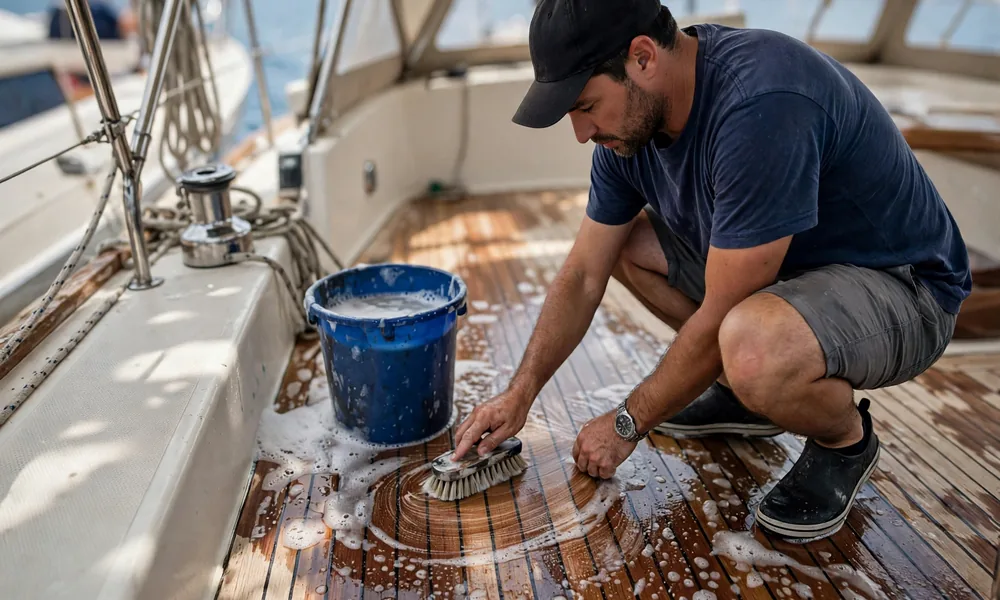
Teak still wins. No other material matches its combination of grip when wet, comfort in the heat, durability and sheer beauty. Its natural oils resist rot and salt, its grain gives bare feet purchase even when soaked, and it stays cooler than any synthetic in direct sun. A well-kept teak deck ages gracefully, silvering over time, and it can be sanded back to fresh wood again and again across decades of service.
The cost is real: teak is expensive, it needs regular cleaning and occasional caulking, and responsible sourcing matters, since old-growth teak is a limited resource. Our guide to how a yacht teak deck is made shows the craft behind it, and the numbers in yacht teak deck specs explain why the planks are sized and spaced the way they are. The foundation it all sits on is the hull itself, covered in how a superyacht steel hull is made.
The Takeaway
The best deck material is the one that suits how the yacht is actually used. A working expedition boat wants aluminium; a covered terrace wants stone; a family cruiser wants teak or a good composite. Choose for your climate and your tolerance for maintenance, not for the brochure photograph, and remember that any deck is only as good as the structure beneath it. A beautiful surface on a weak deck is a disappointment waiting to happen.


