The fastest cars on earth now come in two flavours, and they could hardly be more different. On one side stands the twin-turbo V8, a 5.0-litre Koenigsegg Jesko making 1,600 hp on E85 fuel, or a 6.6-litre Hennessey Venom F5 making 1,817 hp. On the other stands the electric hypercar, led by the Rimac Nevera with 1,914 hp from four motors, and its even faster Nevera R sibling with 2,078 hp. In August 2025 the Jesko retook the 0-400-0 km/h record from the Nevera R by half a second.
This comparison judges the V8 and the electric powertrain across nine rounds: power, torque, acceleration, top speed, sound, weight, range, running costs and the hybrid middle ground. Each round has a winner, and the final verdict depends on what you value most in a hypercar. Figures are maker claims or independently verified records.
Round 1: Power — electric wins
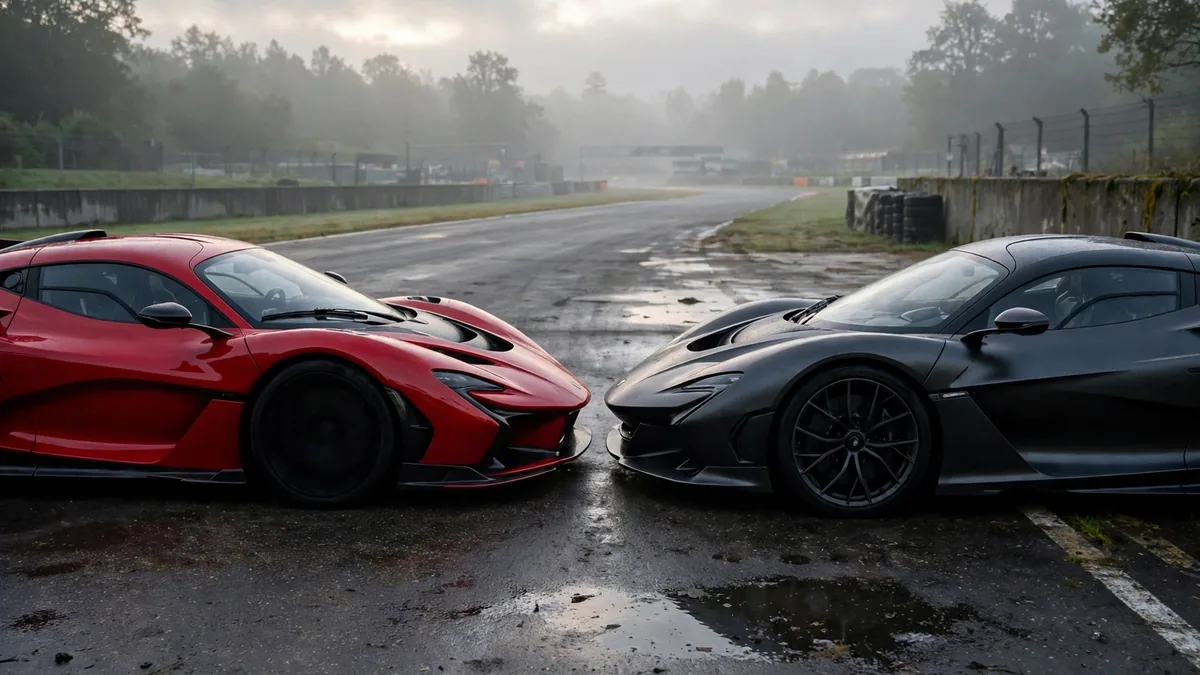
Electric takes the first round on outright power. The Rimac Nevera makes 1,914 hp from four permanent-magnet motors, and the Nevera R raises that to 2,078 hp, making it one of the most powerful production cars ever built. The Lotus Evija claims 2,000 hp and the Pininfarina Battista 1,900 hp, both from four-motor electric layouts. The best V8s are close but behind: the Hennessey Venom F5 makes 1,817 hp from its 6.6-litre twin-turbo V8, and the Koenigsegg Jesko makes 1,600 hp on E85 fuel, or 1,280 hp on ordinary petrol.
Round 2: Torque — electric wins
Torque is where the electric powertrain embarrasses the V8. The Nevera makes 1,740 lb-ft, and it makes all of it from zero revs, the instant the driver touches the throttle. The Jesko’s V8 makes 1,106 lb-ft, and only at high revs, after the turbos have spooled. The Venom F5 does better at 1,193 lb-ft, but it still needs revs and boost to get there. In practice, this means the electric hypercar launches like it has been fired from a catapult, while the V8 car needs a launch procedure, a warm gearbox and a perfect surface.
Round 3: Acceleration — electric wins
Acceleration follows torque, and the electric cars win by a margin that still shocks people who drive them. The Nevera reaches 60 mph in 1.74 seconds, and the Nevera R does it in 1.66 seconds, with the quarter mile taking 7.9 seconds. The Jesko needs around 2.5 seconds to reach 60 mph, and the Venom F5 around 2.6 seconds, which is ferociously quick by any normal standard and still a second behind. The most telling contest is the 0-400-0 km/h run: the Nevera R managed 25.79 seconds in July 2025, and the Jesko answered with 25.21 seconds a month later.
Round 4: Top speed — V8 wins
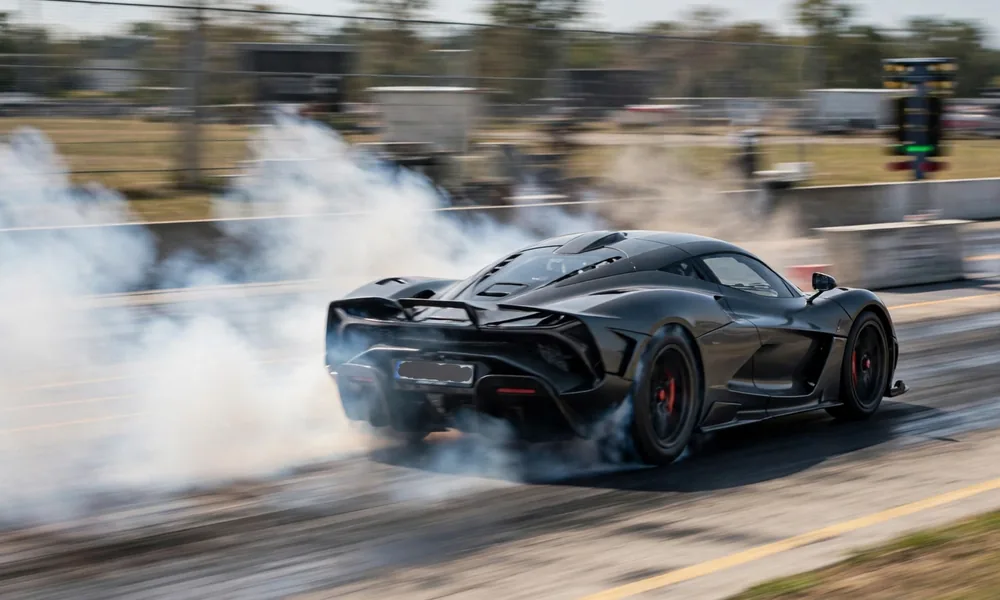
Top speed is the V8’s home ground, and it wins this round clearly. The Jesko Absolut is built for a claimed top speed above 330 mph, with a drag coefficient of just 0.278, and the Venom F5 claims more than 311 mph. The Nevera is limited to 258 mph, and even the Nevera R, with a new electric top-speed record of 268 mph, cannot match the V8 cars. The Jesko’s nine-speed Light Speed Transmission is a masterpiece of engineering, shifting in milliseconds. Until electric hypercars get multi-speed gearboxes, the top-speed crown stays with combustion.
Round 5: Sound and feeling — V8 wins
No number captures what a V8 sounds like at 8,500 rpm. The Jesko’s flat-plane-crank V8 screams, the Venom F5’s big V8 thunders, and the whole car shakes, smells of hot oil and feels alive in a way that is hard to describe and impossible to measure. The Nevera is astonishingly fast, but it is also quiet, smooth and almost serene, and some drivers find that eerie rather than exciting. This round is subjective, but it matters: people buy hypercars for how they make them feel, and the V8 makes them feel more.
Round 6: Weight and handling — V8 wins
Weight is the electric hypercar’s biggest problem. The Nevera carries a 120 kWh battery, and the whole car weighs around 2,150 kg, which is roughly 700 kg more than a Jesko. The Jesko, at around 1,390 kg, changes direction like a much smaller car, and its lightness is felt in every input. The electric cars hide their weight well, and the Nevera’s handling is genuinely brilliant, but physics is physics: a lighter car is a better handling car, and the V8 cars are much lighter. This is the round the electric side must solve next, with lighter batteries.
Round 7: Range and refuelling — V8 wins
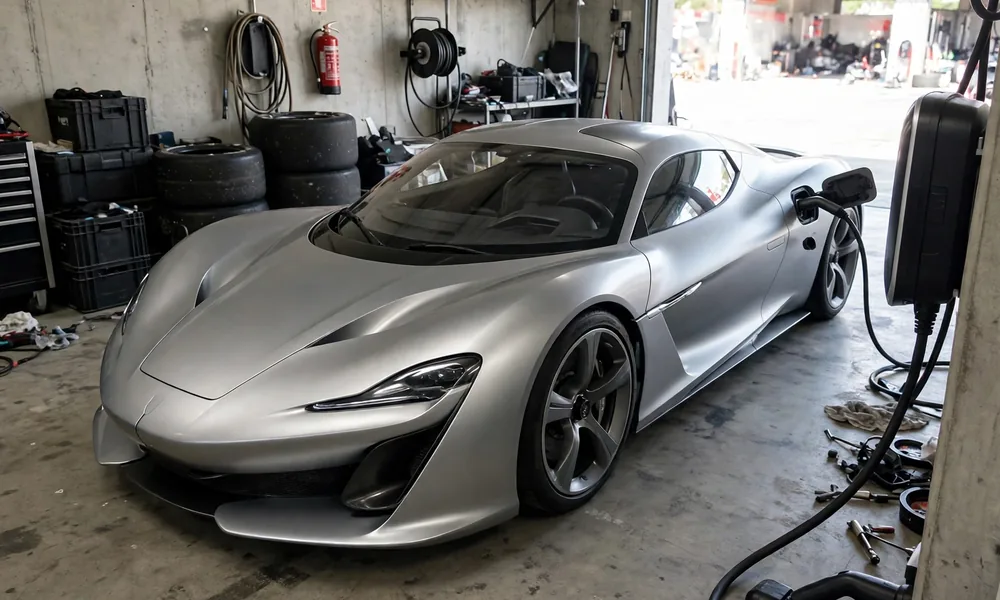
A V8 hypercar refuels in five minutes at any filling station and then drives hundreds of miles. An electric hypercar needs a fast charger, and even the best ones take half an hour to add meaningful range, assuming a charger is available at all. The Nevera’s real-world range is around 300 miles in gentle driving and far less when driven hard, while the Jesko will cover a similar distance at any speed and refill anywhere. The braking that makes these speeds safe is covered in our guide to the best hypercar braking systems compared.
Round 8: Running costs — electric wins
Running costs favour the electric powertrain, although at hypercar prices the sums are almost comic. A V8 hypercar drinks fuel at a prodigious rate, needs frequent servicing, and its engine, gearbox and turbos are all wear items that cost a fortune to rebuild. The Nevera has four motors, a battery and very little else to service, and electricity costs a fraction of racing fuel. Over a normal ownership period, though, the electric car is cheaper to run and spends less time in the workshop. How the two approaches are combined is explained in our guide to how a hypercar hybrid powertrain works.
Round 9: The hybrid middle ground — a draw
The most interesting cars of the next few years will not be pure V8 or pure electric, but hybrids that use both. The Bugatti Tourbillon pairs a naturally aspirated V16 with electric motors, the Ferrari F80 and McLaren W1 use hybrid V6 and V8 layouts, and the Ferrari SF90 has shown how electric motors can fill the gaps in a combustion engine’s power delivery. A hybrid keeps the sound, the light weight and the fast refuelling of combustion, and adds the instant torque and torque vectoring of electric drive.
Verdict: which powertrain wins?
The score is four rounds to electric, four to the V8, and one draw, which is exactly right: neither powertrain has won this war. If you want the fastest car from a standstill, buy the Nevera R. If you want the fastest car full stop, and the one that stirs your soul, buy the Jesko. And if you want both, wait for the hybrids, because they are coming, and they will make this whole argument look old-fashioned. The carbon fibre that wraps both kinds of car is covered in our guide to the best carbon fibre uses in supercars.