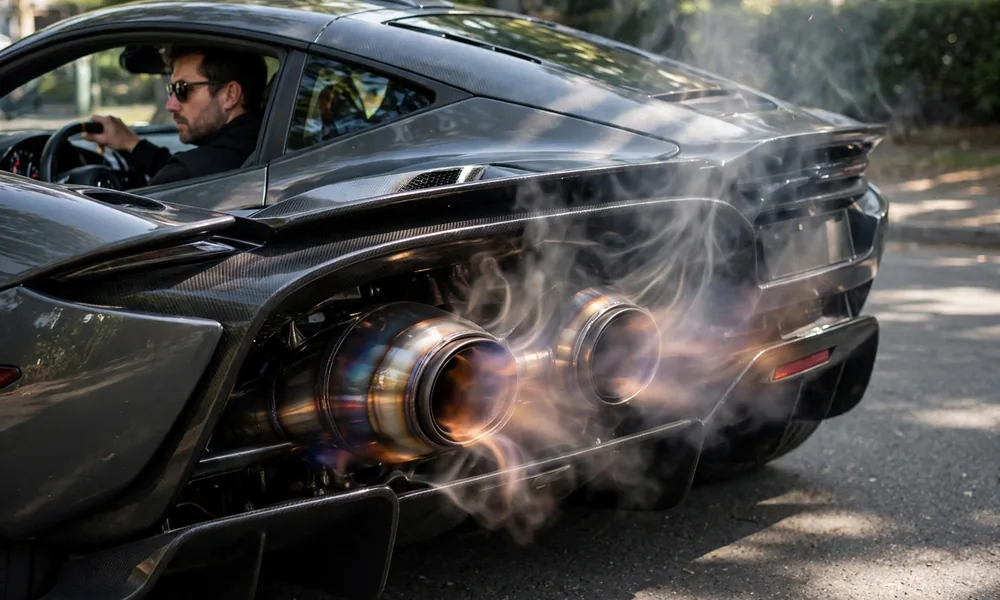
Ask a room full of car lovers which engine layout is best and you will get three different answers, all shouted at once. The V8 crowd talks about torque and thunder, the V10 crowd about a scream nothing else can copy, and the V12 crowd just smiles, because twelve cylinders have topped the tree for a century. All three still exist in 2027, but only just, and each wins on different ground. This is the comparison that decides the choice: power, sound, smoothness, weight, cost, and what each engine feels like to live with.
The shorthand is simple: a V8 has eight cylinders in two banks of four, a V10 ten in two banks of five, and a V12 twelve in two banks of six. More cylinders usually means more power and smoothness, but also more weight, fuel, and cost. The real differences are subtler than the count suggests, because crankshaft design, turbocharging, and rev limits matter at least as much as the number of pistons.
The Three Contenders
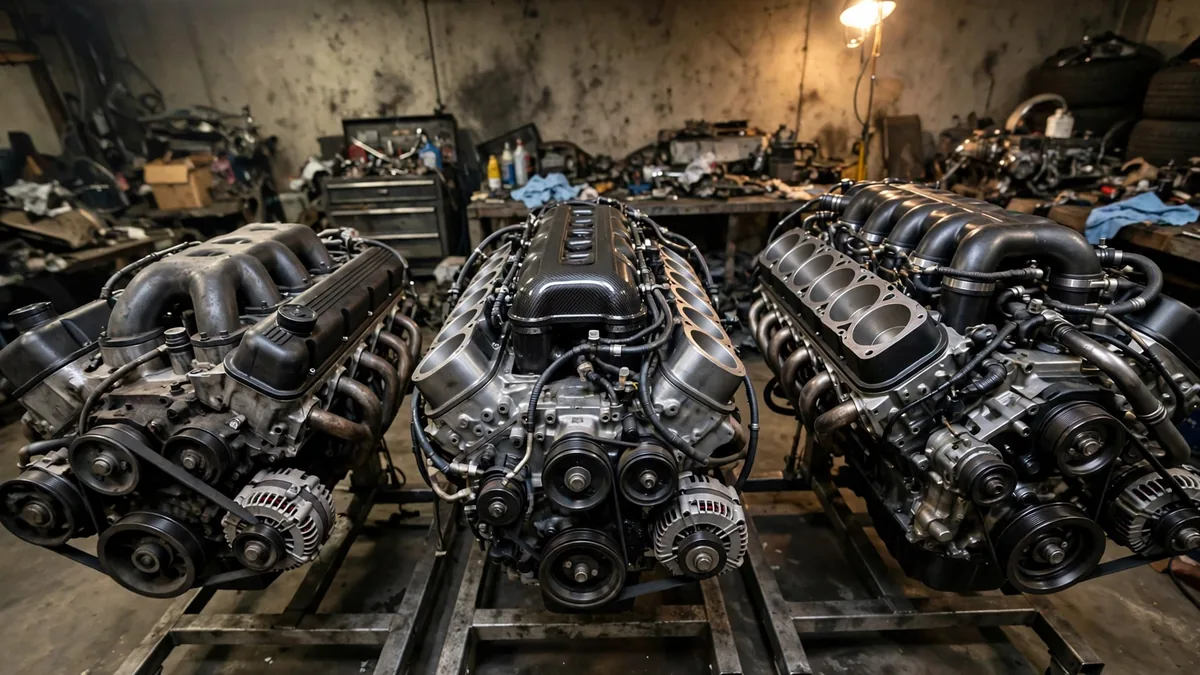
The modern V8 is the workhorse of performance. Ferrari’s 3.9-litre twin-turbo V8 makes huge power from a small package, McLaren builds its whole range around a 4.0-litre twin-turbo V8, and American muscle still uses big cross-plane V8s for low-down torque. The V10 is the rarest: Lamborghini’s 5.2-litre in the Huracan makes 631 horsepower and revs to 8,500 rpm, the Lexus LFA’s 4.8-litre revs to 9,000 rpm, and the Dodge Viper’s 8.4-litre was the biggest of them all. The V12 is the flagship: Lamborghini’s 6.5-litre in the Revuelto, Ferrari’s 6.5-litre in the 812, and Aston Martin’s Cosworth-built 6.5-litre in the Valkyrie, which revs to 11,100 rpm.
Power and Torque
On outright power the V12 wins, but the margin is smaller than the cylinder count suggests. Production V12s run from about 560 to more than 830 horsepower before hybrid help, and the Revuelto’s hybrid system pushes the total past 1,000. Twin-turbo V8s run from about 500 to nearly 800 horsepower, and make torque much earlier: a turbo V8 can deliver full pulling power from under 2,000 rpm, while a naturally aspirated V12 needs revs to wake up. The V10 sits in the middle, from about 500 to 645 horsepower, but makes its torque high in the rev range, so it feels less muscular at low speed. For usable thrust, the turbo V8 is strongest; for top-end power, the V12 still rules.
Sound
Sound is where the three layouts separate most clearly, and it is the reason most buyers choose one over the others. A cross-plane V8 rumbles at idle with the uneven beat American muscle made famous, while a flat-plane V8, the kind Ferrari and McLaren use, screams at high revs with a sharp, urgent wail. The difference comes from the crankshaft, and it is so large that the flat-plane crankshaft deserves its own explanation. The V10 sounds like neither: five cylinders per bank create a frequency between a V8’s rumble and a V12’s wail, a raw scream that climbs as the revs build. The LFA’s V10 is the famous example, revving from idle to 9,000 rpm in six-tenths of a second. The V12 is smoother, a deep rumble at idle that opens into a symphonic wail. For pure noise, the V10 is the most exciting and the V12 the most beautiful, while the V8 is the most versatile, sounding like two different engines depending on its crankshaft.
Smoothness and Character
A V12 is the smoothest of the three by a clear margin. Twelve cylinders firing in sequence balance each other’s vibrations almost perfectly, which is why Rolls-Royce and Ferrari use V12s in grand tourers meant to cross continents without tiring their drivers. A V10 is also well balanced but less so, and its character is deliberately rougher: it shakes and buzzes a little more, and that rawness is part of the appeal. A V8’s smoothness depends on its crankshaft: cross-plane is smooth low down but coarse at the top, flat-plane vibrates more at idle and smooths out as it revs. A V12 car feels calm and expensive at any speed, a V10 car feels alive and urgent, and a V8 car feels like whichever crankshaft its maker chose.
Weight and Packaging
More cylinders mean more metal, and the V12 pays for its smoothness in size and weight. A V12 is longer and heavier than a V8 of similar power, which pushes weight over the front axle and makes the car harder to balance. That is one reason mid-engined hypercars often use V8s: the shorter engine leaves room for a better chassis. In a front-engined grand tourer the V12’s weight matters less, because the car is already large and refinement is the point. In a mid-engined supercar, the V8’s compact size is a genuine advantage, and why McLaren and Ferrari build their fastest cars around eight cylinders.

Running Costs and Reliability
None of these engines is cheap to run, but the V8 is the least painful by a long way. It is the most common layout, parts are widely available, and many independent specialists know it well. Fuel economy reflects the same order: turbo V8s typically manage 15 to 19 miles per gallon in real use, V10s 12 to 16, and V12s 11 to 17. The V10 is the most expensive to keep, not because it breaks more often, but because so few were made: parts for a Huracan or an LFA are rare and priced accordingly. The V12 needs more frequent specialist care, and a twelve-cylinder service bill is exactly as large as it sounds. If you plan to drive rather than store the car, the V8 will not punish you for the miles.
Rarity and the Future
The V10 is already effectively extinct in new cars, with the Huracan’s replacement moving to a twin-turbo V8 hybrid and the R8 gone the same way. That makes surviving V10 cars instant collectibles, and values for clean LFA and Huracan examples reflect it. The V12 survives only at the very top: Ferrari, Lamborghini and Aston Martin still build them, but each new V12 is now paired with hybrid assistance, and every maker has said the end is near. The V8 has the brightest future, because hybrid turbo V8s meet emissions rules while keeping the character buyers want. The V10 and V12 are the layouts to buy now, while you still can.
Verdict
There is no single winner, because the three engines answer different questions. The V8 is the best all-rounder: the strongest usable torque, the lowest running costs, the most compact package, and a secure future The V10 is the best experience: the rarest layout, the most exciting sound, and a car that feels like an event every time you start it. The V12 is the best engine, full stop: the smoothest, the most powerful, and the most prestigious, the layout that has topped the hierarchy for a century, the engine to buy if you want the finest thing of its kind, regardless of cost.
If one car had to represent each layout, the choice is easy. The V8’s champion is the turbocharged Ferrari or McLaren, the V10’s is the Lamborghini Huracan, and the V12’s is the Lamborghini Revuelto V12, which pairs the classic twelve-cylinder engine with hybrid power. Our own V12 vs V8 comparison reaches a similar conclusion, and the three-way view only strengthens it: the V12 wins on prestige and smoothness, the V8 on usability, and the V10 on emotion. Buy the V8 to drive, the V10 to feel, and the V12 to keep.