Some engines make a noise you feel in your chest before you hear it with your ears. A deep, rolling rumble that sounds like thunder rolling down a street. Others make a sharper sound, a high scream that climbs and climbs until it seems impossible for metal to spin that fast. The difference between those two sounds is not just the exhaust or the size of the engine. Often it comes down to a single piece of steel hidden deep inside the engine block.
That piece is the crankshaft, the part that turns the up-and-down movement of the pistons into the spinning motion that drives the wheels. And in a V8 engine, the crankshaft comes in two very different shapes. One is called a cross-plane crankshaft, and it gives the classic American V8 its burble. The other is the flat-plane crankshaft, and it is the reason some of the fastest and most exciting V8s in the world sound like racing cars.
The Crankshaft, in Plain English
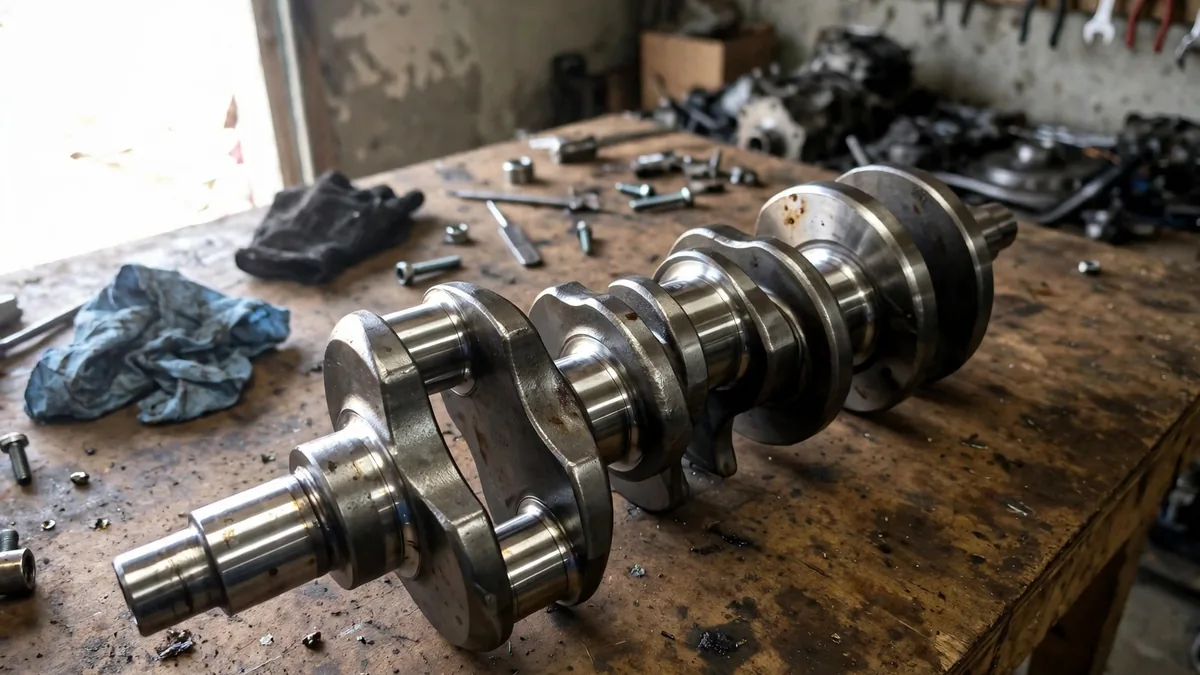
To understand the flat-plane crankshaft, it helps to picture what a crankshaft does. Each piston in an engine moves up and down inside its cylinder, pushed by the burning fuel above it. The crankshaft sits below the pistons, and each piston connects to it with a rod. As the pistons move, they push the crankshaft around in a circle, and that rotation is what eventually reaches the wheels.
In a V8, there are eight pistons arranged in two banks of four, set at an angle to each other like the letter V. The crankshaft has eight crank pins, one for each piston’s rod, and the angle between those pins decides the order in which the cylinders fire. Change the angles, and you change everything: the sound, the smoothness, how high the engine can rev, and how much vibration it makes.
A cross-plane crankshaft spaces its pins at 90 degrees, like the points of a compass. A flat-plane crankshaft spaces them at 180 degrees, so all the pins lie in a single flat plane, like a straight line viewed from the end. That one geometric choice is the whole story, and its consequences reach into every part of how the engine behaves.
How the Flat Plane Works
With the pins 180 degrees apart, the cylinders on opposite banks fire alternately, left, right, left, right, in an even rhythm. The exhaust pulses arrive at regular intervals, and that even spacing is what makes the exhaust note sharp and high-pitched. It is also why the engine can breathe more efficiently at high revs: each exhaust pulse follows the last in a clean sequence, helping to pull the next charge of air and fuel into the cylinder.
That efficiency is the flat-plane crankshaft’s great strength. Because the firing order is even, engineers can use simpler exhaust designs that scavenge well, and the engine can rev higher without running into breathing problems.
There is a price, though. The even firing order means the pistons on each bank move up and down together in pairs, and that creates vibration that a cross-plane crankshaft naturally cancels out. A flat-plane V8 shakes more, especially at low revs, and that shaking has to be managed with stiffer engine mounts, careful balancing, and sometimes extra vibration dampers. It is a trade: smoothness for speed.
Why Engineers Choose It Anyway
The main reason to choose a flat-plane crankshaft is revs. A higher rev limit means more power from a smaller engine, because power is torque multiplied by speed, and spinning faster is one way to make more power without adding size or weight. That matters enormously in a sports car, where weight is the enemy and a compact, high-revving engine is worth more than a big, lazy one.
The flat-plane design is also lighter. The crankshaft itself is simpler and needs less counterweighting than a cross-plane crank, so it has less rotating mass. Less mass means the engine can change speed more quickly, which is why flat-plane engines feel so responsive. Our guide to how a hypercar V12 engine is made shows the same obsession with lightness and precision at the very top of engine building, where every gram of rotating mass is fought over.
Then there is the sound. It is not the main engineering reason, but it matters to buyers, and manufacturers know it. The high, hard-edged scream of a flat-plane V8 is unmistakable, and it signals performance in a way that no amount of styling can.
Flat Plane Versus Cross Plane
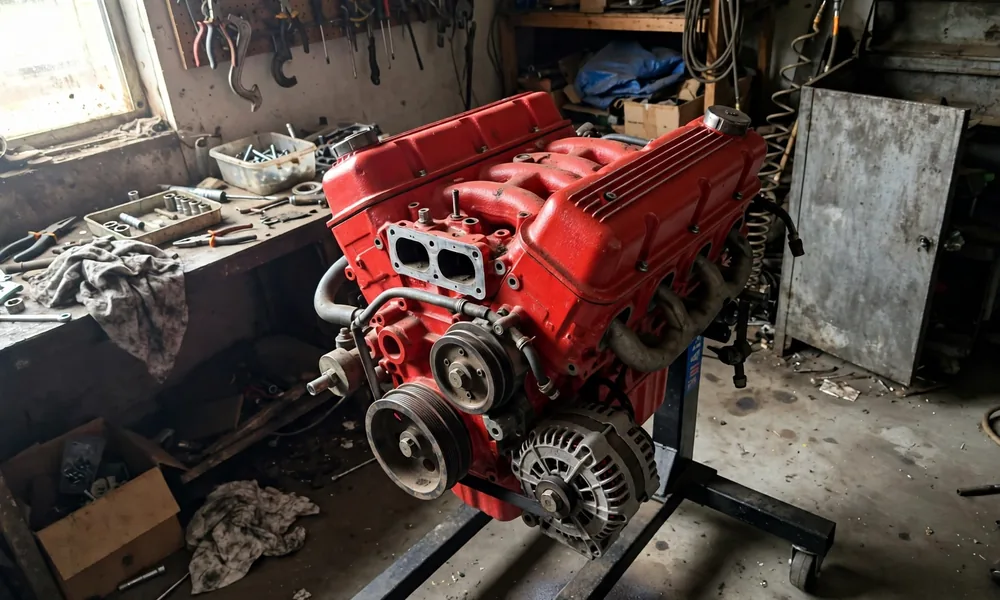
The cross-plane crankshaft is the traditional choice, and it has real strengths. Its 90-degree pin layout cancels out many of the vibrations that trouble the flat-plane design, so the engine runs smoothly and quietly. That is why it dominates in large luxury cars and American muscle cars, where a deep, relaxed rumble and a smooth idle matter more than chasing the last few hundred revs.
The difference shows up in the exhaust as well. A cross-plane crankshaft fires its cylinders in an uneven pattern, and that unevenness is what creates the famous V8 burble, the loping idle that sounds like the engine is breathing slowly. A flat-plane engine fires evenly, so it sounds more like two four-cylinder engines running together, with a sharper, more urgent note. The numbers behind those engines tell their own story, and Bugatti’s W16 engine specs explained is a good reminder of how far engineers will go when they decide that ordinary limits do not apply.
Where You Find a Flat-Plane Crankshaft
Flat-plane V8s are most famous in Italian sports cars. Ferrari has used them for decades, and the sound of a Ferrari V8 at full revs is the flat-plane crankshaft’s greatest advertisement. Lotus, McLaren and a handful of others have used them too, and in recent years the idea has spread to American performance cars, most notably in track-focused versions of the Chevrolet Corvette, where the flat-plane engine gives the car a completely different character from its cross-plane predecessors.
You will also find the flat-plane idea in racing, where it is the natural choice for engines that live at high revs all day. Formula 1 engines of the past, sports prototypes and GT racing cars have all used flat-plane crankshafts, because in racing the vibration penalty is a small price for the revs and the power. The way those racing engines are put together is a story in itself, and our look at how the Bugatti W16 engine is made shows the level of care that goes into engines built to survive at the edge.

The Simple Version
A flat-plane crankshaft is a V8 crankshaft with its pins arranged in a single flat plane, 180 degrees apart. That arrangement makes the cylinders fire evenly, which lets the engine rev higher, breathe better and sound sharper, at the cost of more vibration and less low-speed smoothness. It is the choice for engines built to be fast and exciting rather than quiet and relaxed.
If you ever hear a V8 that screams instead of burbling, and seems to gain revs almost too quickly to follow, you are probably hearing a flat-plane crankshaft at work. It is a small piece of geometry with an outsized effect, and it is one of the clearest examples of how a single engineering decision can give a car its whole personality.