Watch a foiling trimaran at full speed and the first thing you notice is how much of the boat is not there. The long central hull hangs in the air, the two smaller outer hulls hang in the air beside it, and the whole vessel seems to be standing on three thin blades that disappear into the sea. The deck is wide and flat, the mast towers above, and the boat is doing speeds a normal sailing yacht could never reach.
A foiling trimaran is a three-hulled sailing yacht fitted with hydrofoils, underwater wings that lift all three hulls clear of the water once the boat is moving fast enough. It is the fastest kind of sailing boat that regularly crosses oceans, and it exists because three hulls solve the two problems that make foiling hard: staying upright, and carrying enough sail to go fast. This is what a foiling trimaran is, how it works, and why the third hull matters so much.

What Makes a Trimaran Different
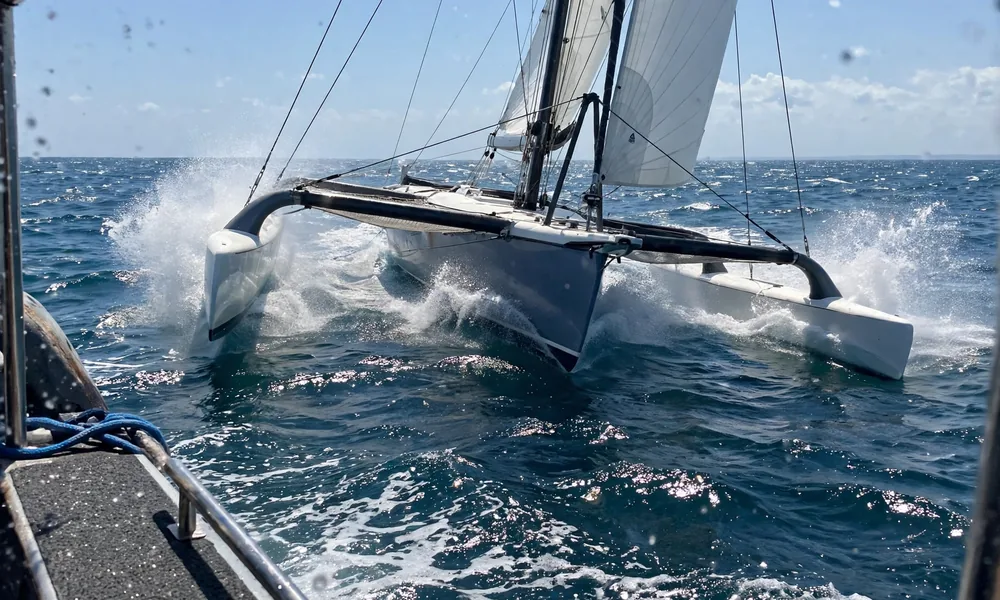
A trimaran has three hulls: a long, narrow central hull where the crew lives, and two smaller outer hulls, called amas, held out to each side on crossbeams. Their job is stability. Push on one side of the boat and the ama on the other side acts as a lever, resisting the tip. Sailors call this righting moment, and a trimaran has far more of it than any single-hull yacht.
That wide stance is the first reason trimarans took to foiling so early. A foiling boat must stay level for its foils to work, since a foil only lifts properly when it meets the water at the right angle. A single-hull yacht heels as the wind builds, leaning its foils sideways and forcing the crew to fight to keep it flat. A trimaran barely heels at all. The third hull is not decoration. It is the platform that makes foiling practical.
How a Foiling Trimaran Lifts Three Hulls
The lift comes from hydrofoils, underwater wings that work like an aircraft wing in water. Water flowing over a curved foil creates lower pressure on one side and higher pressure on the other, pushing the foil upward. Lift grows with the square of speed, so doubling the speed makes roughly four times the lift. At take-off speed, which on a large racing trimaran is around 15 to 18 knots, the lift equals the weight of the boat, and all three hulls rise out of the water.
Once foilborne, only the foils and the rudders still touch the sea, so the drag that normally limits a boat falls away. The fastest ocean-going foiling trimarans now sail at more than 40 knots, and the largest of them, the Ultim class, have crossed the Atlantic at average speeds above 30 knots.
The Foil Layout of a Trimaran
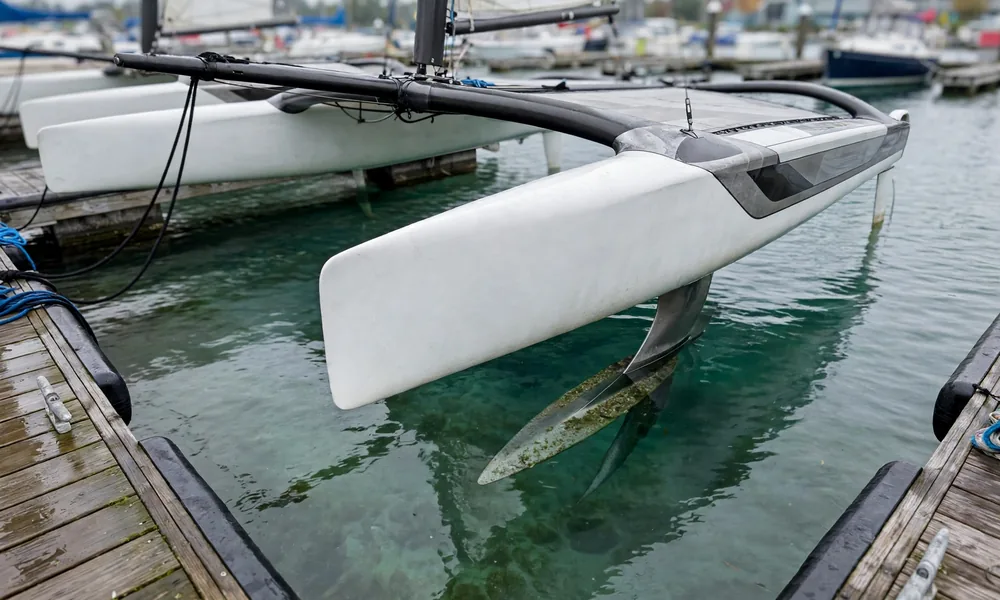
A modern foiling trimaran carries three main foils, one in each hull, and the arrangement is different from any other foiling boat. The central hull carries a daggerboard foil, a large wing that slides down through the hull and provides most of the lift. Each ama carries its own smaller foil, usually an L-shaped or T-shaped wing on a daggerboard, which lifts the outer hulls and keeps the boat level from side to side.
The foils work together as a system. At low speed the amas float on the water and provide stability while the central foil starts to lift. As speed builds, the ama foils take over more of the weight, and the central hull rises. At full speed the boat is balanced on the three foils like a table on three legs, with the crew trimming the flaps on each foil to hold the height. What is a foiling catamaran explains the two-hull version of this idea, where the foils live in a pair of hulls instead of three.
How the Crew Keeps It Flying
Keeping a foiling trimaran in the air is a full-time job, and on the big ocean racers it is done by a small crew working with sensors and hydraulics. The foils carry flaps, small hinged surfaces that change the lift, and the crew adjusts them constantly: more lift to take off, less lift to avoid flying too high, and different settings on each side as the wind shifts.
That crash is the danger every foiling trimaran crew respects. The loads are enormous: a 30-metre trimaran at 40 knots carries forces that can snap a foil or a crossbeam if the boat lands badly. Modern boats use ride-height sensors that measure the distance to the water and adjust the flaps automatically, but the crew still watches constantly. Foiling is not a mode you switch on and forget. It is a balance the crew maintains, second by second, for hours at a time.
Real Examples: From ORMA to Ultim
The foiling trimaran has a clear family tree. The ORMA 60 class of the 1990s and 2000s was the first generation of large racing trimarans, fast but not fully foiling, and many of them capsized spectacularly, which taught the sport hard lessons about the limits of three hulls. The MOD70 class that followed was a one-design trimaran built for speed and safety, and it became the test bed for foiling.
The current generation is the Ultim 32/23 class: 32-metre giants like Banque Populaire XI, SVR Lazartigue and Actual Leader, built to race single-handed around the world. These are fully foiling trimarans, with foils in all three hulls, and they are the fastest offshore sailing boats ever built.
Why Three Hulls Beat Two for Foiling
A trimaran’s central hull gives it something a catamaran lacks: a long, narrow hull that can carry the mast, the crew and the main foil, while the amas sit far out to the sides and provide the stability. What is a foiling yacht covers the single-hull side of the family, where the crew must fight heel to keep the foils working at all.
The Limits of a Foiling Trimaran
Foiling trimarans have hard limits, and they are more dramatic than on any other foiling boat. Capsize is the first. A trimaran that tips past a certain angle cannot be righted by its crew; it stays upside down, and the crew must wait for rescue or a tow. The amas that make the boat so stable also make a capsize final. Every foiling trimaran carries this risk, and every crew trains for it.
Cost is the second limit. Three hulls, three foils, crossbeams strong enough to hold them together at 40 knots, and a rig to match: the engineering bill is far higher than for a single-hull yacht, and the maintenance is specialised. A foil strike on debris at racing speed can end a campaign. That is why foiling trimarans live almost entirely in professional ocean racing, not in cruising. How a luxury trimaran works shows what the same three-hull idea looks like when comfort, rather than speed, is the goal.
So, What Is a Foiling Trimaran?
A foiling trimaran is a three-hulled sailing yacht that flies above the water on hydrofoils, using its wide stance to stay level, carry enormous sail area, and reach speeds no other sailing boat can match over ocean distances. Its central hull carries the crew and the main foil, its two amas provide the stability that makes foiling possible, and its crew works constantly to keep the balance. It is the fastest thing under sail on the open ocean, and also one of the most demanding: expensive to build, unforgiving to sail, and impossible to right if it goes over. The third hull is what makes it possible, and what makes it final.


