A hydrofoil yacht is a yacht that flies above the water instead of pushing through it. Under the hull, slim wings called foils reach down into the water, and as the boat picks up speed those wings generate lift. At a certain point the lift is strong enough to raise the whole hull clear of the surface, leaving only the foils and their thin supports in the water. The yacht then travels on what looks like stilts, skimming along with far less drag than a conventional hull.

How a foil lifts a hull
A hydrofoil works in the same way as an aeroplane wing, only in water. The foil is shaped so that water flows faster over one side than the other, and that difference in speed creates a difference in pressure. The pressure pushes the foil upward, and because the foil is fixed to the hull through a strut, the whole boat is pushed up with it. Water is far denser than air, so a foil much smaller than a wing can lift a heavy boat.
At low speed the yacht behaves like any other boat. The hull sits in the water, the foils are submerged, and the engines push the boat forward against the drag of the hull. As speed rises the lift from the foils grows, and there comes a point, called take-off speed, where the lift matches the weight of the boat. Past that point the hull rises out of the water and the drag falls sharply, because only the thin struts and the foils themselves are left cutting through the water.
That drop in drag is the whole point. A normal hull has to push a bow wave aside and drag a large wetted surface through the water, and the resistance climbs steeply with speed. A foil-borne hull escapes most of that, so it goes faster on the same power and rides more smoothly.
The parts of a foiling system
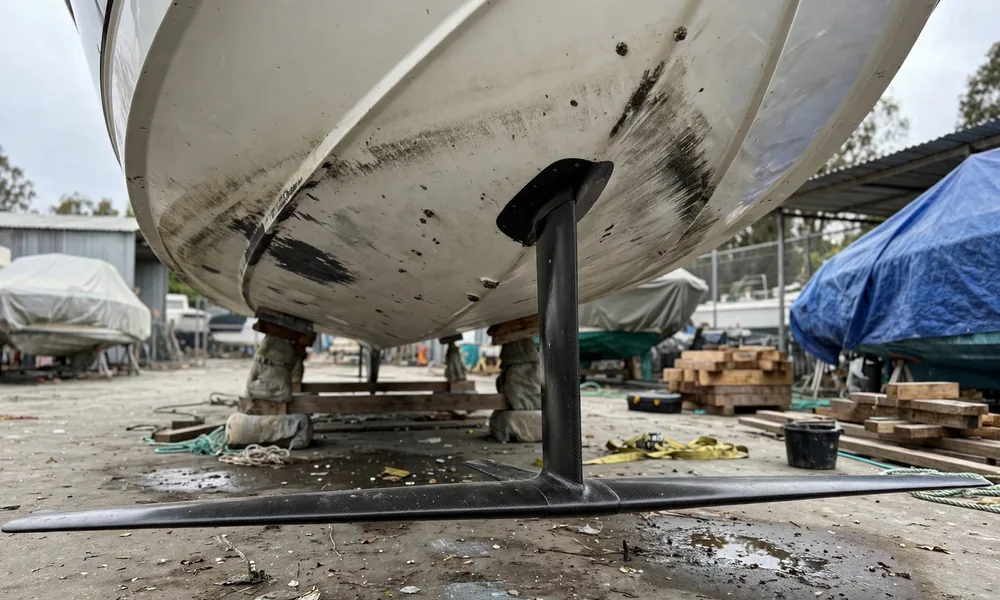
A typical hydrofoil yacht has two sets of foils, one forward and one aft, each mounted on a vertical strut that passes through the hull. The forward foil carries roughly a third of the weight and the aft foil the rest, though the split changes with speed and trim. The foils themselves are usually made from carbon fibre or stainless steel, shaped with a careful profile and polished smooth, because even a small patch of roughness or marine growth can spoil the flow and cut the lift.
Most modern foils carry movable flaps on their trailing edges, much like the flaps on an aircraft wing. Moving a flap changes the lift of that foil, which lets the control system keep the boat level and at the right height. The struts are kept as thin as the strength allows, because every square centimetre of strut in the water adds drag. On some designs the whole foil assembly can retract into the hull, so the yacht can enter shallow water or sit in a marina berth like a normal boat.
The ride height is set by sensors that measure how high the hull sits above the water. On modern yachts it is done electronically: height sensors, accelerometers and gyroscopes feed a computer that adjusts the flaps many times a second, which is what makes a foiling yacht practical for an owner rather than a racing team.
Take-off and landing
Getting a hydrofoil yacht airborne is the busiest part of the trip. The skipper brings the power up smoothly, the bow rises slightly as the hull climbs onto the plane, and then the lift takes over and the hull rises clear in a few seconds. Passengers feel a gentle lift rather than a jolt, and the noise drops as the hull leaves the water. From then on the boat rides on the foils, with the hull a metre or so above the surface, depending on the design.
Landing is the reverse. As the boat slows below take-off speed, the lift fades and the hull settles back into the water. A good system does this gently, lowering the boat in a controlled way rather than dropping it.
What powers a hydrofoil yacht
Early foiling yachts used diesel engines, and some still do. The engine drives a propeller or a waterjet, and the foils do the rest. But foils and electric power are a natural match. An electric motor gives instant torque for take-off, runs quietly, and has no exhaust to deal with, which suits a boat whose whole appeal is a smooth, silent ride. Several recent foiling yachts are fully electric, with battery banks in the hull and motors mounted on the foil struts themselves.
Putting the motor on the foil has a neat advantage: the propeller sits in clean, undisturbed water below the hull, and the strut carries the power cables down to it. It also keeps the propeller clear of the hull when the boat is flying.
Range is the honest limit. A foiling electric yacht is efficient once airborne, but the battery still holds far less energy than a tank of diesel. Most electric foiling yachts are designed for day trips and short coastal hops rather than ocean crossings, with typical cruising ranges measured in tens of nautical miles at foiling speed.

What the ride feels like
Passengers notice two things first: the quiet and the smoothness. With the hull out of the water, the slap and pounding of waves on the bow disappears. The boat still moves with the sea, but the motion is gentler and slower, because the foils are working in calmer water below the surface chop. People who suffer from seasickness often find foiling easier, though a foiling yacht is not a cure and a rough sea is still a rough sea.
The second thing is the speed. A foiling yacht can cruise at speeds that would need a far bigger engine on a conventional hull, and it does so without the bow-up, stern-down attitude of a planing boat. The deck stays level, the wake is flat and narrow, and the boat feels planted rather than skittish.
There are limits worth knowing. Foils are vulnerable to floating debris, and a strike at speed can damage a foil or a strut. Marine growth on the foil surface hurts performance, so the foils need regular cleaning. None of these are deal-breakers, but they are part of owning the technology rather than a conventional boat.
The Takeaway
A hydrofoil yacht is a yacht that trades hull drag for wing lift, using underwater foils to raise the hull clear of the water once it reaches take-off speed. The result is a faster, quieter and smoother ride, built on modern carbon foils, electronic ride-height control and electric propulsion. The trade-offs are cost, complexity and limited range on pure electric power. For a day boat or a coastal cruiser, though, it is one of the most striking changes in yachting in decades: a boat that spends its time flying. If you want to see how the same idea works on a working boat, read what a hydrofoil ferry is, and for the racing side of foiling, what a foiling catamaran is and what a foiling trimaran is show how the same lift is used at racing speed.


