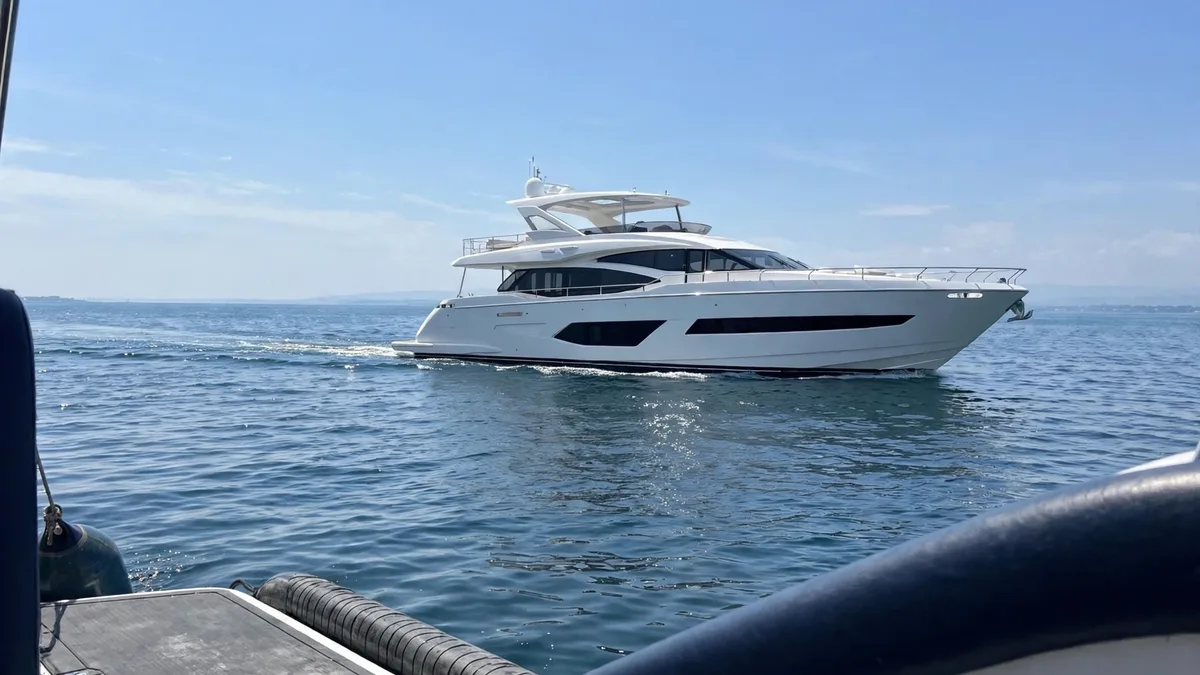
A yacht that runs on hydrogen sounds like science fiction. There is no diesel smell, no exhaust smoke, and no engine rumble, just a quiet hum and a thin stream of water dripping from an outlet in the hull. The boat refuels in minutes, like a diesel yacht, and cruises in silence, like an electric one. That combination is why hydrogen fuel-cell yachts have gone from concept drawings to real boats in the water, and why shipyards and owners are watching them closely.
What a fuel cell actually is
A fuel cell is not a battery and not an engine. It is a device that turns chemical energy directly into electricity, without burning anything. Inside it, hydrogen gas flows across one side of a thin membrane and oxygen, taken from the air, flows across the other. A catalyst splits the hydrogen into protons and electrons. The protons pass through the membrane, the electrons are forced to travel around an outside circuit, and that flow of electrons is the electric current that powers the boat. On the far side, the protons, electrons and oxygen combine to form water.
The most common type for boats is the proton exchange membrane fuel cell, usually shortened to PEM. It works at relatively low temperatures, starts up quickly, and responds well to changing power demands, all of which suit a yacht that needs to accelerate, manoeuvre, and then cruise steadily. Other types exist, but PEM is the one you will find in the hydrogen yachts actually sailing today.
From hydrogen tank to propeller
The energy chain on a hydrogen yacht has four stages, and each one matters. First, the hydrogen itself is stored on board, usually as a compressed gas in strong cylindrical tanks, at pressures of 350 or 700 bar. The tanks are built to exacting standards, with multiple safety layers, and they are mounted in ventilated compartments away from living spaces, because hydrogen is light, flammable, and escapes upward quickly if it leaks.
That battery also gives the yacht a useful fallback. If the fuel cell needs servicing, or the hydrogen runs low, the battery alone can move the boat slowly for a short distance, enough to reach a berth or a safe anchorage. It is not a second fuel tank, it is a buffer, but it is the part of the system that makes the whole arrangement practical at sea. The way that buffer is managed is close to the systems on a pure battery yacht, and our guide to how electric yacht battery management works explains the thinking behind it.
Range, speed and the refuelling advantage
The strongest selling point of a hydrogen yacht is refuelling time. A battery yacht with a large pack can take hours to recharge, even on a fast shore supply, and that shapes every passage plan around charging stops. A hydrogen yacht refuels in minutes, much like a diesel boat: connect the hose, fill the tanks, disconnect, and go. For a yacht that needs to cover long distances on a schedule, that is a decisive difference.
The refuelling problem
Here is the honest difficulty, and it is not on the boat. It is on the shore. Hydrogen refuelling stations for boats are rare. A handful of marinas in Europe and a few elsewhere have hydrogen facilities, often built for a specific project or a ferry service, but the network is nothing like the diesel pumps found in every harbour. A hydrogen yacht owner today must plan passages around the few places that can refuel them, and that is a serious limitation.
There is also the question of where the hydrogen comes from. Most hydrogen today is made from natural gas, a process that produces carbon dioxide, which rather defeats the purpose of a clean yacht. Green hydrogen, made by splitting water with renewable electricity, is genuinely clean, but it is more expensive and less widely available. A hydrogen yacht is only as clean as its fuel supply, and buyers who care about emissions should ask where their hydrogen comes from, not just what comes out of the exhaust.

Hydrogen versus diesel, and versus batteries
Compared with diesel, a hydrogen yacht is quieter, cleaner at the point of use, and free of the smell and vibration that define a diesel boat. It refuels almost as quickly and it can match diesel for the kind of steady cruising that long passages demand. What it cannot yet match is the infrastructure: diesel is available everywhere, hydrogen almost nowhere, and a diesel yacht can be repaired in any port in the world, while a hydrogen system needs specialist support.
The comparison with diesel is not just about yachts. Large ships face the same choice, and the economics there are different again, because a ship can carry far more hydrogen and its routes are fixed. Our comparison of diesel versus hydrogen ship propulsion looks at the same question at ship scale, and the conclusions are instructive for anyone weighing hydrogen for a yacht.

Safety at sea
Hydrogen has a reputation that worries people, and it deserves a straight answer. Hydrogen is flammable, it burns with a nearly invisible flame, and it can leak through seals that would hold other gases. Those are real properties, and the marine industry takes them seriously. The safety systems on a hydrogen yacht are built around them: tanks tested to survive impacts and fire, ventilated compartments that let any leaked gas escape upward and away from the boat, sensors that detect hydrogen at tiny concentrations and shut the system down, and piping designed so that a leak cannot pool in a bilge the way diesel or petrol vapour can.
What matters for an owner is maintenance and training. A hydrogen system must be serviced by people who understand it, the crew must know what the alarms mean, and the boat must be surveyed by a classification society that certifies hydrogen installations. That is more demanding than owning a diesel boat, and it is a cost and a commitment that should be weighed alongside the fuel savings and the silence.
Who is building them, and what they cost
Cost reflects that. A hydrogen yacht costs substantially more than an equivalent diesel or battery yacht, because the fuel cell, the tanks, and the safety systems are all expensive, and because each boat is effectively a custom build. Operating costs are also uncertain, because green hydrogen is expensive and the refuelling network is thin. The buyers today are pioneers, research institutions, and owners for whom the silence and the statement matter more than the price. For a sense of what the same money buys in a conventional electric yacht, our guide to hydrogen fuel-cell yacht specs explained sets out the numbers in detail.
The verdict
A hydrogen fuel-cell yacht is a real boat, not a concept, and it does something no other yacht can do: cruise silently and cleanly, and refuel in minutes. That is a powerful combination, and it is why the technology will not go away. But it is also a boat that depends on infrastructure that barely exists, fuel whose cleanliness depends on how it was made, and systems that need specialist care.
For now, hydrogen makes most sense where the refuelling is guaranteed, on a fixed route, a ferry service, or a yacht based in a port with a hydrogen station. For the ordinary cruising yacht, the battery-electric boat is the simpler choice today, and the diesel boat remains the practical one for long passages. Hydrogen’s moment will come when the stations arrive and the price falls, and when it does, the boats are already ready. The sea, as ever, will decide.