A boat at anchor on a still evening runs on stored energy. The cabin lights, the fridge, the navigation instruments, the water pump — all of them draw from a bank of batteries tucked away below deck. For decades that bank was almost always lead-acid: heavy, slow to charge, and happiest when it was never drained very far. The marine lithium battery changed that bargain. It stores more usable energy in less space, charges far faster, and shrugs off the deep discharges that would kill a lead-acid bank in a season or two.
That sounds like a simple upgrade, and in some ways it is. But a marine lithium battery is not just a lighter box with the same terminals. It is a different chemistry, and a system that needs the rest of the boat — the alternator, the shore charger, the solar controller — to work with it rather than against it. Get those details wrong and the most expensive item on the boat can fail in its first year.
This guide explains what a marine lithium battery actually is, how it is built, and what makes it different from the batteries boats used before it.
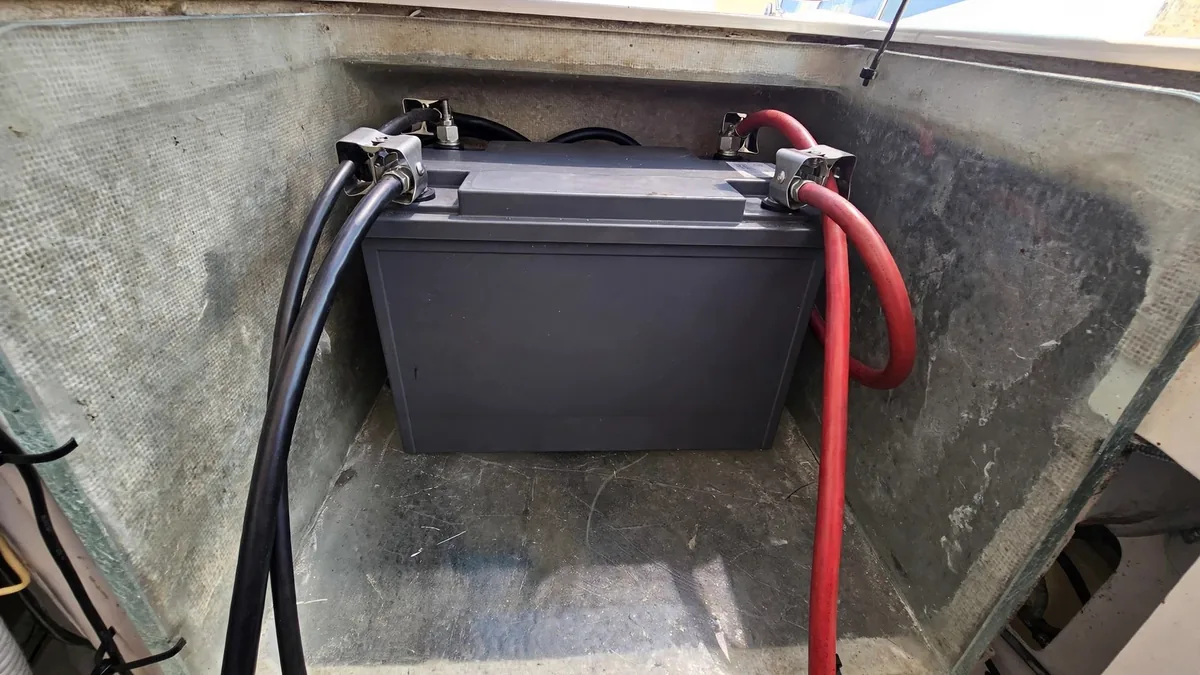
What a Marine Lithium Battery Is
A marine lithium battery is a rechargeable battery built from lithium-ion cells and packaged for life on a boat: sealed against spray, braced against vibration, and fitted with electronics that protect the cells from the abuse a marine environment dishes out. Most marine lithium batteries use lithium iron phosphate chemistry, known as LiFePO4 or LFP. It is not the most energy-dense lithium chemistry, but it is the most stable, and on a boat that matters more than squeezing in a few extra watt-hours.
Step 1: The cells store the energy
Inside the case are individual cells, usually large flat prismatic cells for a house bank, wired in series to reach the right voltage. Four LFP cells in series give a nominal 12.8 volts, eight give 25.6 volts, and sixteen give 51.2 volts. Each cell holds its charge in a lithium iron phosphate cathode and a graphite anode, with lithium ions shuttling between the two as it charges and discharges. The chemistry has a very flat discharge curve, so the voltage stays close to 13.2 volts for most of the discharge instead of sagging the way a lead-acid battery does. A typical marine LFP pack is rated for 2,000 to 5,000 full cycles, three to five times the life of a good AGM battery, and it can be discharged to 80 or 90 percent of its capacity regularly without damage.
Step 2: The battery management system guards the cells
The most important part of a marine lithium battery is not a cell at all. It is the battery management system, or BMS, a circuit board that watches every cell group for voltage, current, and temperature. The BMS balances the cells during charging so none drifts higher than the rest, and it cuts the battery off if anything goes outside safe limits: overcharging, deep discharge, a short circuit, or charging below freezing, which can permanently damage lithium cells. Many marine BMS units also report state of charge over Bluetooth or a CAN bus, so the helm display or a phone app can show exactly how much energy is left. Without a BMS, a lithium bank would be a fire risk; with it, the battery largely looks after itself.

Step 3: The case is built for the sea
A marine battery lives in a damp, salty, shaking compartment, often in the bilge or a lazarette, so the case matters as much as the cells. Good marine lithium batteries are sealed to IP65 or IP67, resisting water jets or even brief immersion, and the terminals are corrosion-resistant, usually tinned copper or stainless steel. The cells are braced internally so pounding through waves does not let them shift, and the case is flame-retardant. A 100 amp-hour LFP battery weighs roughly half as much as an equivalent AGM, and because it can be used far deeper, a smaller lithium bank can replace a much larger lead-acid one.
Step 4: House bank and starter stay separate jobs
On most boats the lithium battery is the house bank, running the lights, fridge, and instruments for hours at a time. Starting the engine is a different job: a short, very high-current burst measured in cranking amps rather than amp-hours. Some lithium batteries are rated for cranking, but many are not, and a BMS that disconnects to protect itself just as the starter motor demands current is a bad surprise. The usual arrangement is therefore a lithium house bank plus a separate lead-acid or cranking-rated start battery, joined by a voltage-sensitive relay or a DC to DC charger.
Step 5: Charging has to match the chemistry
Lithium charges differently from lead-acid, and the charging equipment has to know that. An LFP battery wants an absorption voltage around 14.2 to 14.6 volts and no long float stage, and it accepts a high charge current right up to nearly full, so a 100 amp-hour bank can recharge in two or three hours where an AGM might take six to eight. That speed creates the most expensive mistake in a marine lithium conversion: the alternator. A lithium bank can draw full current from the alternator for far longer than a lead-acid bank ever would, and a standard alternator is not built for sustained full output. The fix is a DC to DC charger between the alternator and the lithium bank, or an externally regulated alternator with temperature sensing, plus a shore charger and a solar controller both set to a lithium profile.

Step 6: Fusing and wiring protect the boat
Lithium batteries can deliver enormous fault currents, far higher than a lead-acid battery of the same size, so the protection around them has to be taken seriously. A Class T fuse belongs within a short distance of the positive terminal, sized to the cable and the load, and the cabling needs to be marine grade tinned copper with proper lugs and torque.
What to Check Before You Buy
The numbers that matter are not the headline amp-hours alone. Check the continuous discharge rating against your biggest loads, especially a windlass or a bow thruster. Check the cycle life at the depth of discharge you will actually use, the low-temperature charging cut-off, and whether the BMS communicates with your existing instruments. And compare usable energy, not rated energy: a 100 amp-hour lithium bank at 90 percent usable depth of discharge gives roughly twice the usable energy of a 100 amp-hour AGM that should only be taken to half.
Cost is the honest trade-off. A marine lithium battery costs several times more than a lead-acid battery of the same rated capacity, and the charging upgrades add to the bill. Over a decade of use, though, the arithmetic usually flips: one lithium bank can outlast three or four sets of lead-acid, charges faster from every source, and never needs watering. That is why the technology has moved from racing yachts and long-distance cruisers into ordinary weekend boats.
For a fuller picture of how the stored energy is used at sea, see how a solar sailing yacht system turns sunlight into power for the same house bank, how diesel and electric yacht propulsion compare when the battery has to drive the boat itself, and what the electric yacht battery specs mean in practice.


