Stand on any marina pontoon on a sunny day and you will see them: sailing yachts with dark panels spread across the stern arch, the bimini or the coachroof, quietly turning sunlight into electricity while the boat sits still. Some of these boats carry a panel or two as a handy extra. Others are built around the sun from the start, with solar power doing most of the daily work. The line between the two is where the term solar sailboat begins to mean something specific.
A solar sailboat is a sailing yacht in which solar panels are a primary source of onboard electricity, designed into the boat rather than bolted on as an afterthought. The sails still do the moving. The sun does the housekeeping: the fridge, the lights, the instruments, the water pump and the charging of phones and laptops. This is what the term actually covers, how you tell a real solar sailboat from a boat that merely owns a panel, and what the idea can and cannot do.

What Counts as a Solar Sailboat
There is no official register of solar sailboats and no certificate a boat must earn. In practice the term covers any sailing yacht whose solar array is sized and placed to meet most of the boat’s daily electrical demand at anchor. A typical cruising yacht uses somewhere around one to two kilowatt-hours a day for its fridge, lights and instruments. A solar sailboat carries enough panel capacity, usually 300 to 800 watts or more, to replace that energy on an average sunny day.
That definition leaves out most boats with a single small panel keeping a starter battery topped up. A solar sailboat is still a sailboat first. The wind moves it, the sails are its engine, and the solar array is there to make life aboard self-sufficient. The distinction matters because it decides what you can reasonably expect from the boat.
Designed In, or Bolted On
Solar sailboats come in two kinds. The first is designed that way from the drawing board: the naval architect places the panels where they will see the sun, keeps the rig and the sails from shading them, and sizes the battery bank to store a day or two of solar harvest. The panels sit on a stern arch, a hard bimini or a dedicated solar gantry, tilted toward the sun and clear of the boom. The boat looks like it was meant to carry them, because it was.
The second kind is a retrofit, and it is far more common. An owner adds panels to an existing yacht, usually on the stern arch or the coachroof, and upgrades the batteries and the charge controller to match. A good retrofit can work very well, but it fights the boat’s original design: the mast and boom cast moving shadows, deck space is scarce, and the panels end up where they fit rather than where the sun is. The result is often a boat that harvests less than its panels promise, especially in the morning and evening.
How a Solar Sailboat Gets Through the Day
A day aboard a solar sailboat follows a simple rhythm. In the morning the panels wake up with the sun and begin replacing what the fridge and the anchor light used overnight. By midday the array is producing at its peak, and the batteries climb back toward full. In the afternoon the boat is usually running on sunshine directly, with the surplus going into the bank. After dark the boat runs on what was stored, and the cycle repeats.
The numbers are modest by land standards, and that is the point. A few hundred watts of panels, a lithium bank of a few kilowatt-hours, and careful use of power are enough for a comfortable life at anchor: cold food, charged devices, light at night and instruments that never sleep. The system works because a yacht at anchor uses little energy, and because the sun is overhead for most of the day. How solar power works on a sailing yacht explains the chain of panels, controllers and batteries behind this rhythm in detail.
Solar-Assisted, or Solar-Primary
Within the idea there is a further split. A solar-assisted sailboat uses the sun for its hotel loads but still relies on its diesel engine or a generator to charge the batteries on cloudy stretches and to run heavy loads like air conditioning. Most solar sailboats live in this group, and honestly so: the sun handles the ordinary days, and the engine is there for the exceptions.
A solar-primary sailboat goes further, aiming to run without the engine for days or weeks at a time. It needs a larger array, a larger battery bank, and a crew willing to manage power carefully: cooking with gas, skipping the air conditioning, and waiting for sun before running the watermaker.
Real Examples on the Water
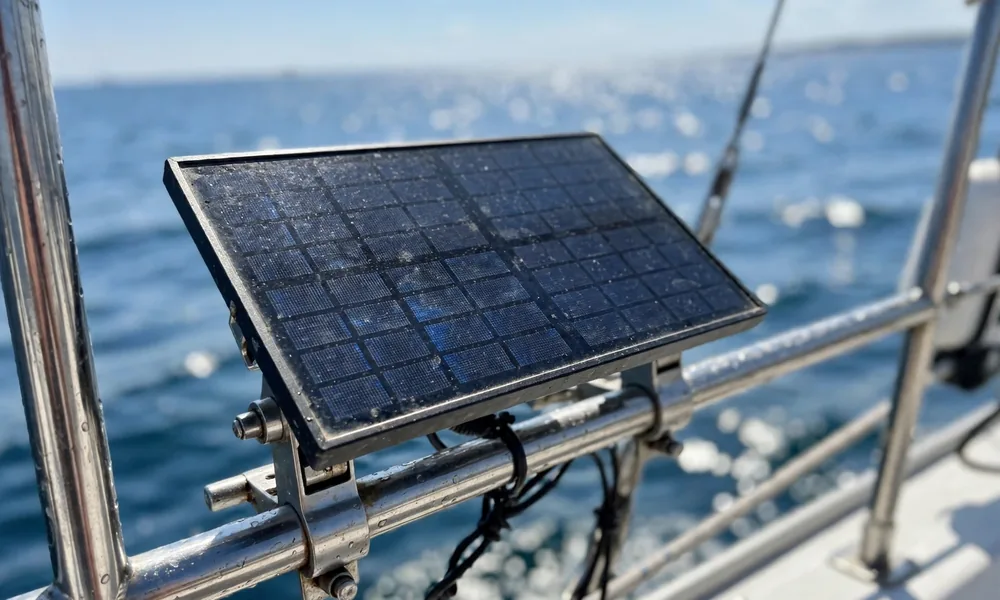
You do not need to look far for real solar sailboats. The cruising world is full of ordinary production yachts that have been turned into solar boats by their owners, from 30-foot coastal cruisers to 50-foot liveaboards crossing oceans. The pattern is the same everywhere: an arch over the stern carrying two or four panels, a lithium bank below, and a crew that rarely starts the engine just to charge.
What a Solar Sailboat Can and Cannot Do
What it can do is remove the generator from daily life. A yacht that can run its fridge, lights and instruments from the sun can sit at anchor for days without ever starting an engine. That silence is the real product, and it is why owners convert. It can also cut fuel use sharply: the engine stops being a charging machine and goes back to being a propulsion machine, used only when the wind fails.
What it cannot do is replace the engine. Solar panels cannot push a yacht through a calm, and no realistic array can run air conditioning all day or power a large electric motor for long. The honest claim is narrower and better: the sun can run the boat’s daily life, and the engine can stay off for days at a time. The case for solar yachts argues the wider point, that solar should be the default source of a yacht’s hotel power, and it is worth reading alongside this one.
How to Tell One Apart in a Marina
Spotting a solar sailboat is easy once you know what to look for. Look for panels that are part of the boat’s structure rather than clamped to a rail: a proper arch, a hard bimini with panels built in, or a gantry across the stern. Look for the absence of a generator exhaust note at anchor, and for a boat whose crew never seems to run the engine in the morning. How a yacht solar panel works explains the panel itself, the part that starts the whole chain.

So, What Is a Solar Sailboat?
A solar sailboat is a sailing yacht that treats the sun as its main source of onboard power, with an array sized to meet its daily needs and a battery bank to carry it through the night. It is still a sailboat, driven by wind, and it still carries an engine for the days the sun cannot help. What makes it different is the quiet: days at anchor without a generator, a fridge that runs on light, and a boat that asks the sky for its electricity instead of a fuel dock. That is the whole idea, and on a sunny coast it works remarkably well.


