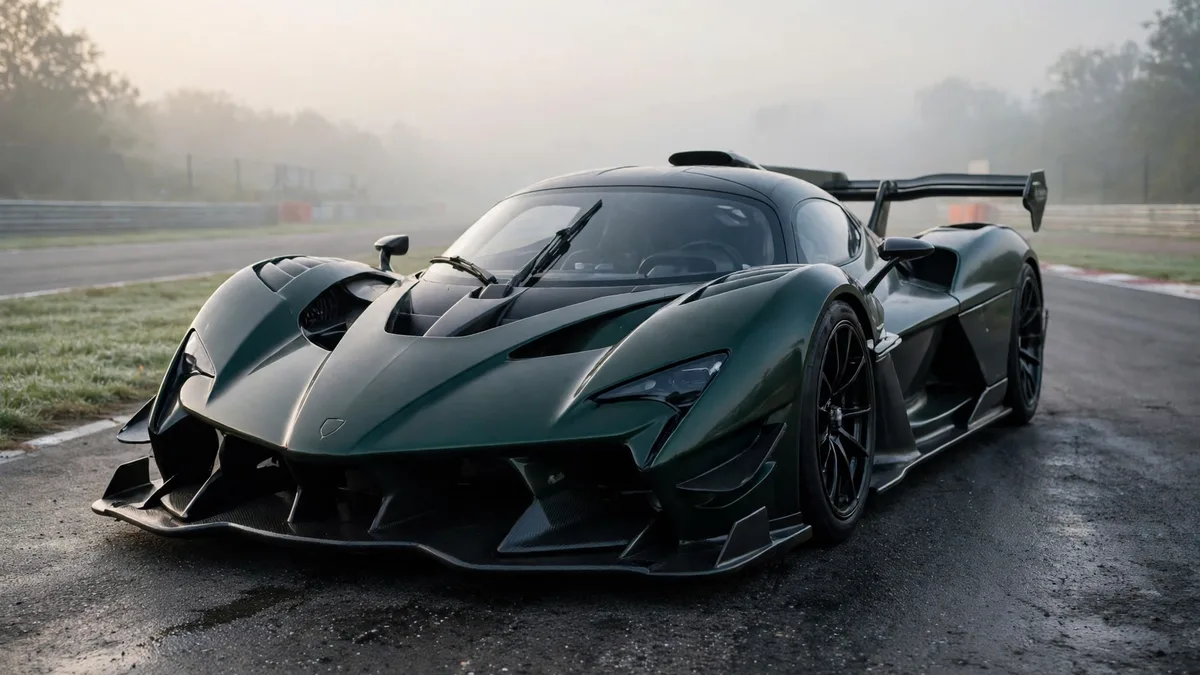
There is a car that looks less like a car and more like something that escaped from a wind tunnel. Low, wide, and dark, with a cabin squeezed between two vast tunnels of air, the Aston Martin Valkyrie is the closest thing to a Formula 1 car that has ever been allowed on the road. It costs several million dollars (estimate), it was built in a run of just 150 road cars, and almost every part exists because the designer Adrian Newey refused to accept that a road car had to look like one. The price is not for luxury. There is almost none. The price is for what happens when a racing car is made road-legal, and for the engineering that makes it possible.
The Valkyrie began with the air. Most cars are shaped first and made aerodynamic second; the Valkyrie was shaped by the air from the start, built around two huge Venturi tunnels underneath that suck it onto the road. Everything else, the engine, the seats, the shape of the cabin, was fitted around that idea. The result is a machine that weighs barely more than a tonne, makes more than a thousand horsepower, and generates downforce greater than its own weight at speed. It is a car that could, in theory, drive on the ceiling.
Why the Aston Martin Valkyrie Costs So Much
1. It was designed by a Formula 1 genius, without compromise
Adrian Newey is the most successful designer in Formula 1 history, and the Valkyrie is his first road car. He approached it the way he approaches a racing car: weight is the enemy, aerodynamics is everything, and comfort is a distant third. It has almost no storage space, no sound deadening, and a cabin so tight the seats are moulded to each owner’s body. That uncompromising design is the reason the car exists, and it is also the reason it costs so much: nothing was simplified for the sake of cheap manufacturing. The materials behind the Valkyrie read like a catalogue of the lightest substances engineering can offer.
2. The engine is a hand-built masterpiece
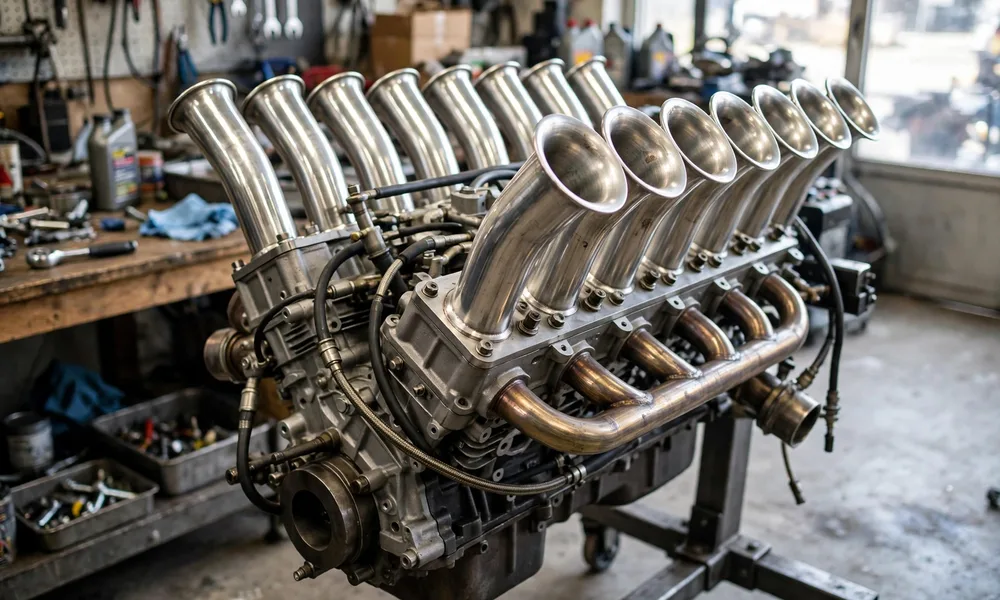
The Valkyrie’s engine is a 6.5-litre naturally aspirated V12, built by Cosworth, that revs beyond 11,000 rpm. It is one of the most extraordinary engines ever fitted to a road car, and each one is assembled by hand. The connecting rods are titanium, the pistons are forged aluminium, and the block is cast aluminium alloy with magnesium parts where even aluminium is too heavy. Parts that rev this high are machined to tolerances measured in microns. The engine is also a stressed member of the chassis, bolted directly to the monocoque, which saves the weight of a subframe but demands absolute precision in how it is made.
3. The aerodynamics are Formula 1 technology, made road-legal
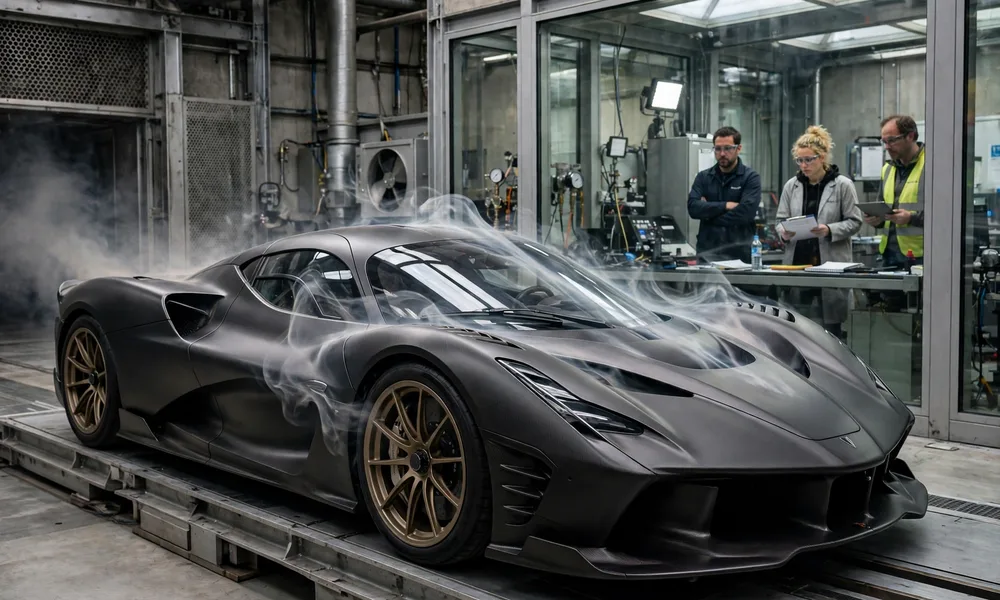
The Valkyrie generates more than 1,800 kilograms of downforce at top speed (estimate), which is more than the car weighs. That downforce comes from the Venturi tunnels under the car, the sculpted bodywork, and a rear wing that works with the air rather than against it. Developing this aerodynamics took thousands of hours in the wind tunnel and in computer simulation, and every surface of the car had to be shaped, tested, and reshaped. The making of the Valkyrie is dominated by this work: the car is, above all else, a shape that the air agrees with.
4. The carbon fibre monocoque is a work of art
At the heart of the Valkyrie is a carbon fibre monocoque, a single rigid tub that forms the cabin and the structural core of the car. It is laid up by hand, cured in an autoclave, and checked by laser measurement at every stage, because a tub that is a millimetre out of true will never handle correctly. The bodywork is carbon fibre too, the suspension is titanium and carbon fibre, and the wheels are magnesium. Every gram was fought over.
5. The hybrid system is a racing system, not a road system
The Valkyrie is a hybrid, but not in the way a family car is. A small electric motor, developed with Rimac, fills in the gaps in the V12’s power delivery, adding torque where the engine is weakest. The battery is small and light, because a big battery would add weight the car cannot afford. The system is a piece of racing technology adapted for the road, and it is integrated with the engine and the chassis in a way that took years of development. It is not there to save fuel. It is there to make the car faster.
6. Only 150 were ever built
Aston Martin built 150 road-going Valkyries, plus a small number of track-only AMR Pro versions. Every car was assembled by hand, with body panels fitted, removed, trimmed, and fitted again until the gaps were even and the aerodynamics exactly as designed. The development cost of the car, which ran into hundreds of millions of dollars (estimate), was spread across those 150 cars, which is why each one carries such a large share of it. A car built in the thousands can spread its development cost thinly; a car built in the hundreds cannot.
7. Each car is tailored to its owner
Every buyer had a seat moulded to their body and pedals adjusted to their reach. The car is not bought off a shelf. It is fitted, like a suit, and the fitting takes time and skilled people. That personalisation is part of what the buyer is paying for, and it is part of why the car cannot be made cheaply. The W16 engine in the Bugatti shows the same logic at another great maker: when the numbers are this small, everything is hand work.
Aston Martin Valkyrie at a Glance
| Specification | Detail |
|---|---|
| Engine | 6.5-litre naturally aspirated V12, over 11,000 rpm |
| Power output | Over 1,000 horsepower combined with hybrid assist |
| Weight | Around 1,000 kilograms dry (estimate) |
| Downforce | Over 1,800 kilograms at top speed (estimate) |
| Chassis | Carbon fibre monocoque, cured in an autoclave |
| Bodywork | Carbon fibre, shaped for Venturi downforce |
| Production run | 150 road cars |
| Top speed | Over 350 kilometres per hour (estimate) |
What Does It Cost?
New, the Valkyrie was priced at around two to three million dollars (estimate), with the track-only AMR Pro version costing more still (estimate). Values on the second-hand market have remained at or above the original price (estimate), because the car is a statement about what is possible when weight, not power, is what matters most. The price reflects the materials, the hand-building, the tiny production run, and the fact that the car carries a Formula 1 designer’s signature in every curve of its bodywork.
A Rare Fact
The Valkyrie generates so much downforce that at top speed it could theoretically drive on the ceiling of a tunnel. The tunnels under the car and the wings above it produce downforce that exceeds the car’s own weight, which means the aerodynamic grip alone would hold it upside down, if only the engine could be kept fed with oil and fuel while inverted. A car that could drive on the ceiling is a car that has stopped being a car in the ordinary sense and become something closer to an aircraft that happens to touch the ground.