A battery is happiest at room temperature. Too cold and it sulks, giving up energy slowly. Too hot and it ages fast, loses capacity, and in the worst case becomes dangerous. An electric car battery is a box of thousands of cells that must all stay within a few degrees of each other, whether the car is charging at full power in a desert summer or crawling through winter traffic. Keeping it there is the job of the cooling system — and it is one of the most complicated parts of the car.
The cooling system is invisible to the driver. There is no temperature gauge to watch, no fan to hear, no warning until something has already gone wrong. Yet it works constantly, moving heat from the cells to the outside air, warming the battery when it is cold and cooling it when it is hot. It is a quiet piece of engineering that decides how long the battery lasts, how fast the car charges, and how far it goes — which is why it costs so much.
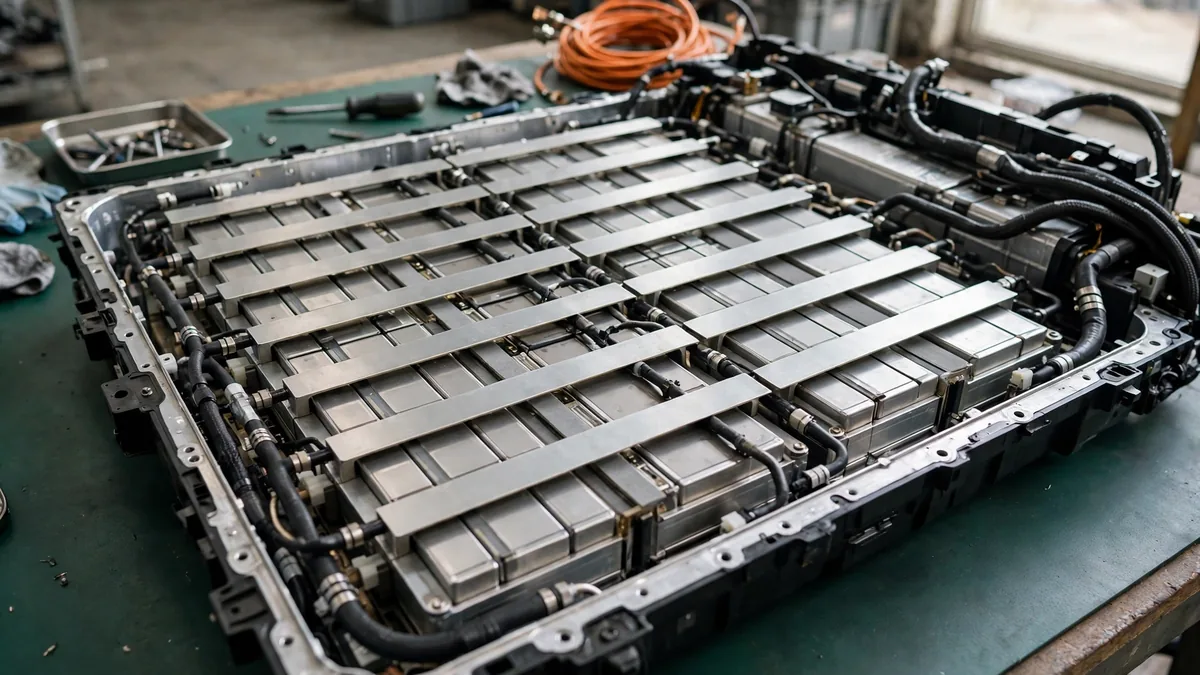
Why EV Battery Cooling Costs So Much
A battery cooling system looks like a few pipes and a pump, but it is really a precision thermal machine wrapped around the most expensive part of the car. Here are the seven reasons why.
Reason 1: Every cell must stay at the same temperature
A battery pack can contain thousands of cells, and if one part runs hotter than another, the cells age at different rates. The weaker cells then limit the whole pack, like the slowest runner in a team. The cooling system must deliver the same cooling to every cell, which means coolant channels designed to a fraction of a millimetre, and flow rates balanced across the pack. Designing that balance takes computer modelling and months of testing, and it is the first reason the system is expensive. The principles are explained in how EV battery cooling works.
Reason 2: The cold plate is a precision part
Most cooling happens through a cold plate: a flat metal plate with winding channels inside, pressed against the cells. The channels must be wide enough to carry coolant freely, narrow enough to fit many of them in, and smooth enough not to trap air. The plates are made by friction-stir welding, brazing or extrusion, and each one is pressure-tested before it is fitted. A plate that leaks inside a battery pack is a disaster, so testing is as strict as anything in the car. The plate looks simple. Making it is not.
Reason 3: The coolant is not just water
The fluid that carries the heat is a special mixture, usually water and glycol with additives that stop corrosion and prevent freezing. It must not conduct electricity, because a leak near high-voltage cells would be dangerous, and it must stay stable for years without breaking down. The hoses, seals and connectors are made from materials chosen to resist it, and every joint is a potential leak that must be tested. The coolant is a small part of the cost; the system built around it is not.
Reason 4: Fast charging makes enormous heat
Fast charging is where cooling earns its keep. Pushing 150 kilowatts or more into a battery creates heat faster than any normal driving, and the cooling system must remove it as fast as it is made — or the car must slow the charge down. The system is therefore sized for the worst case: a full-power charge on a hot day, with the air conditioning also running. That means a bigger pump, a bigger radiator and more coolant than driving alone would ever need. The hardware is sized for a few minutes of charging, and carried around for the life of the car. The materials that make this possible are chosen with the care described in EV battery cooling materials.
Reason 5: It must also heat the battery
Cooling is only half the job. In cold weather a battery must be warmed before it can charge quickly or deliver full power, so the system includes a heater, valves and controls that reverse the flow of heat. It must switch between heating and cooling without wasting energy, whether the car is parked, charging or driving. The valves and sensors that manage this are precision parts, and the software that decides when to heat and when to cool is tuned over thousands of hours of testing in climate chambers.
Reason 6: A leak must be impossible, not just unlikely
Coolant and high-voltage electricity do not mix, so the cooling system is built to a standard where a leak is treated as a failure that must not happen, rather than a fault to be managed. Hoses are routed away from electrical parts, joints are minimised, and the system is pressure-tested and monitored by sensors that can detect a tiny loss of coolant. The car is designed so that even if a hose fails, the coolant cannot reach the cells. That level of safety costs money in design, parts and testing — money no carmaker can skip.
Reason 7: It is tuned for every car, and it never stops being tested
The final reason is development. A cooling system is designed for one specific battery pack, in one specific car, and the work — modelling, prototypes, climate-chamber testing, track testing — takes years. It is tested in deserts and in arctic cold, at full charge and at full discharge, until the engineers are confident it will keep the battery safe for a decade or more. That testing is done by specialists in facilities that cost millions of dollars (estimate) to run. It is the same kind of work that goes into the whole thermal system, as how EV thermal management works shows, and the cooling loop is the hardest part of it.

EV Battery Cooling at a Glance
| Specification | Detail |
|---|---|
| Cooling method | Liquid cold plate, glycol coolant |
| Ideal cell temperature | 20 to 30°C (estimate) |
| Temperature spread across pack | A few degrees (estimate) |
| Fast-charge power handled | 150 kW and more |
| Heating | Electric heater and heat pump |
| Main materials | Aluminium plate, rubber seals, glycol |
| Typical system cost | $1,000 to $3,000 (estimate) |
| Main benefit | Longer battery life, faster charging |

What Does It Cost?
A battery cooling system typically costs between $1,000 and $3,000 (estimate), as part of a battery pack that can cost $10,000 or more (estimate). What the money buys is time: a battery that stays cool lasts years longer, charges faster for longer, and keeps more of its range. A pack without proper cooling would lose capacity quickly, charge slowly, and in the worst case become unsafe. For the owner, the cooling system is invisible — but it is why the battery still works well after a hundred thousand kilometres, and that is what the money pays for.
A Rare Fact
Some electric cars cool their batteries using the air conditioning system — the same one that cools the cabin. When the battery gets hot during fast charging, the car diverts cold refrigerant to a chiller that cools the battery coolant, in effect giving the battery its own air conditioning. On a hot day at a fast charger, the battery may be using more cooling power than the passengers. It is a neat piece of sharing: one refrigeration system, two jobs, and a battery charging at full speed while the driver sits in comfort.