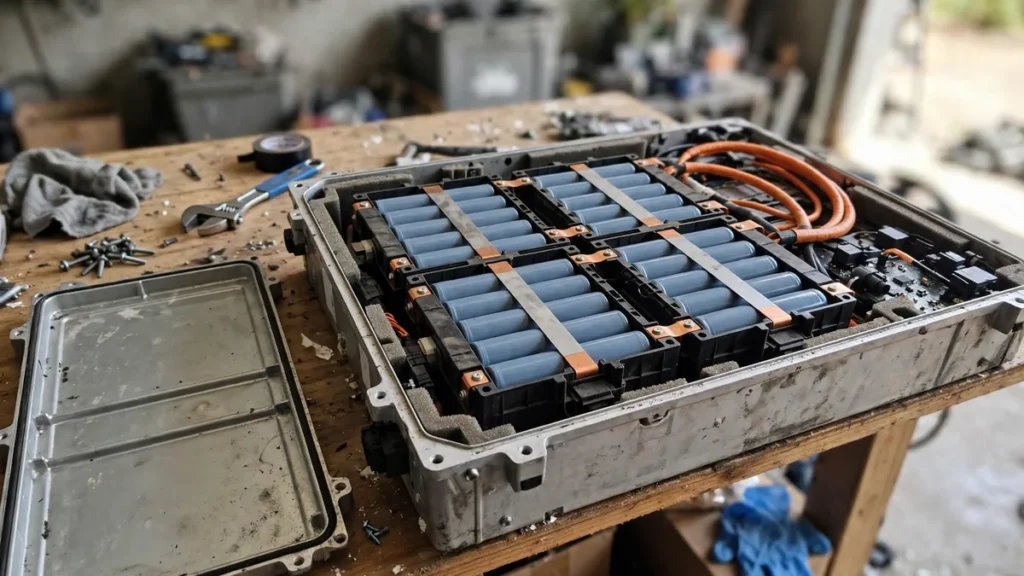
Slide under an electric car and you will find its most expensive secret: a flat slab of metal the size of a mattress, bolted to the floor, weighing as much as a grand piano. That slab is the battery pack, and it can account for a third or more of the entire cost of the car. It holds no engine, no gears, no moving parts at all — just thousands of small cells, wired together, cooled, protected, and watched over by computers every second of their lives.
It seems strange that something so quiet should cost so much. The answer is in the materials inside those cells, the factories that make them, and the engineering that keeps them safe. A battery pack must store an enormous amount of energy, release it on demand, survive crashes, floods, and freezing winters, and keep working for a decade or more. Building one that does all of that, millions of times over, is one of the hardest manufacturing jobs in the world.
This is where the money goes — and why the battery, more than any other part, decides what an electric car costs.

Why It Costs So Much
1. The raw materials are scarce and contested
A lithium-ion cell needs lithium, nickel, cobalt, manganese, graphite, copper, and aluminium, and several of those are mined in only a few places on Earth. Lithium comes mostly from salt flats and hard-rock mines, cobalt largely from one country, and nickel suitable for batteries from a small number of refineries. Prices swing wildly with demand, politics, and speculation, and car makers must buy years ahead to secure supply. The materials alone are estimated to make up roughly half the cost of a finished cell, before any manufacturing has happened.
2. The cells demand clean rooms and precision
Battery cells are made in dry rooms where the air is drier than a desert, because a trace of moisture inside a cell can cause it to fail or catch fire. Electrodes are coated in layers a few microns thick, dried in long ovens, wound or stacked with separators thinner than a human hair, filled with electrolyte, and sealed — all without a speck of dust. The machines that do this cost hundreds of millions of dollars per factory, and a single gigafactory can cost several billion dollars to build. The journey from raw chemicals to a sealed pack is described in how ev battery pack is made, step by step.
3. Thousands of cells must act as one
A typical long-range pack contains several thousand individual cells, grouped into modules and wired together. Every cell must be matched to its neighbours in capacity and resistance, because the weakest cell limits the whole pack. The battery management system measures the voltage and temperature of cell groups constantly, balancing charge between them and shutting the pack down if anything goes wrong. That electronics and software is a significant cost on its own, and it never stops working for the life of the car. The numbers behind each cell — capacity, voltage, and energy density — are explained in ev battery cell specs explained.
4. Cooling is a system, not an afterthought
Fast charging pours energy into the pack at a rate that generates serious heat, and heat is the enemy of battery life. Modern packs carry liquid cooling plates, pumps, channels, and sensors woven between the modules, keeping every cell within a narrow temperature band in summer heat and winter cold. Designing that cooling system, sealing it against leaks, and testing it under crash conditions adds cost and complexity to every pack. The engineering of that thermal system is covered in how ev battery cooling works, from the coolant loop to the radiator.
5. Safety engineering is non-negotiable
A battery pack stores as much energy as a small bomb, so it must be protected like one. The casing is a crash structure designed to deform without piercing a cell. Inside, firewalls separate modules, vents release gas safely, and fuses isolate faults in milliseconds. Every pack design is crash-tested, punctured, crushed, soaked, and set alight in testing, and the lessons from each test are engineered back into the design. That safety work is invisible when it works, and it is one of the largest hidden costs in the pack.
6. Yields, warranties, and recycling carry a price
Not every cell that comes off the line is good enough, and scrapping bad cells wastes materials and factory time. Car makers also warranty their packs for eight years or more, so they must set aside money for the packs that fail early. At the end of a pack’s life, recycling recovers valuable metals, but the process is expensive and still maturing. All of those costs — scrap, warranty, and end-of-life handling — are folded into the price of every new pack sold.

EV Battery Pack Specs
| Specification | Typical range |
|---|---|
| Capacity | About 40 to 100 kWh for a typical family electric car |
| Cell count | About 2,000 to 8,000 individual cells, depending on cell type |
| Voltage | About 350 to 800 volts across the full pack |
| Energy density | About 150 to 270 Wh per kilogram at cell level |
| Pack weight | About 300 to 700 kilograms for a long-range pack |
| Fast charging | About 10 to 80 percent in 18 to 45 minutes on a fast charger |
| Cycle life | About 1,000 to 2,000 full charge cycles before major degradation |
| Warranty | About 8 years or 160,000 km for most manufacturers |
What Does an EV Battery Pack Cost?
The battery is the single most expensive part of an electric car. A complete pack is estimated at roughly $6,000 to $20,000, depending on capacity, with a typical 75 kWh pack estimated at roughly $9,000 to $12,000. Cell prices are estimated at roughly $100 to $150 per kilowatt-hour at pack level, down from several hundred dollars a decade ago, but the pack housing, cooling, electronics, and assembly add thousands more. All prices are estimates only and vary widely by chemistry, capacity, and manufacturer, and they continue to fall as factories scale up — yet the pack still sets the price of the car.
A Rare Fact
The first electric cars carried their batteries like luggage, in boxes bolted wherever they would fit. Modern packs do the opposite: the battery is the floor of the car, a structural member that stiffens the body and lowers the centre of gravity. That change did more than save space. It made electric cars handle better and crash safer than their petrol equivalents, because the heaviest part of the car sits low and flat, between the axles, exactly where engineers always wanted the weight to be.
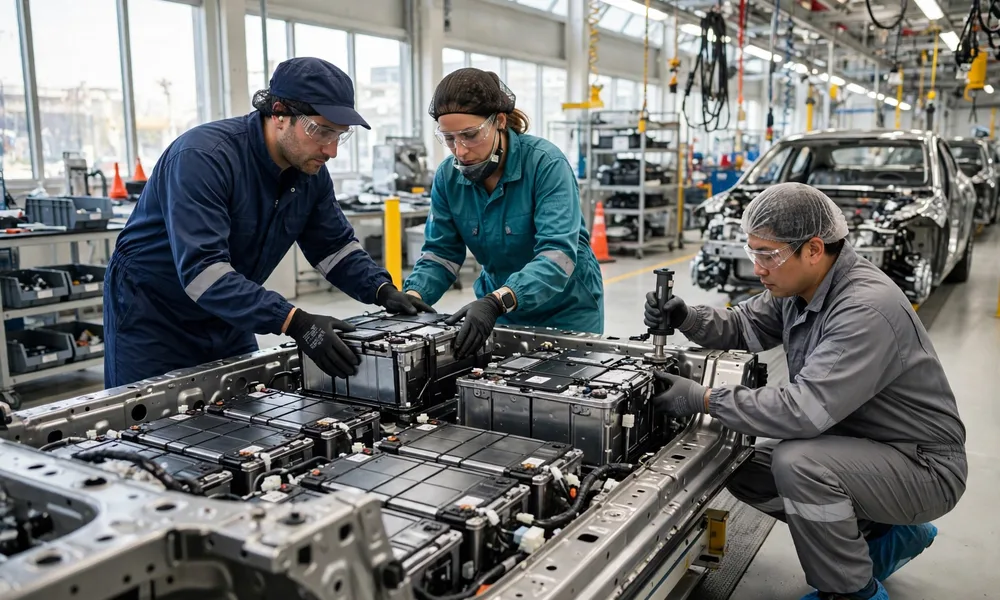
An EV battery pack is expensive because it is a chemical plant, a computer, a cooling system, and a crash structure folded into a single slab — built in billion-dollar factories, from materials dug out of a handful of mines, and warranted for the better part of a decade. The price is falling every year, but for now the battery remains the heart of the electric car, and the heart is the dearest part of all.