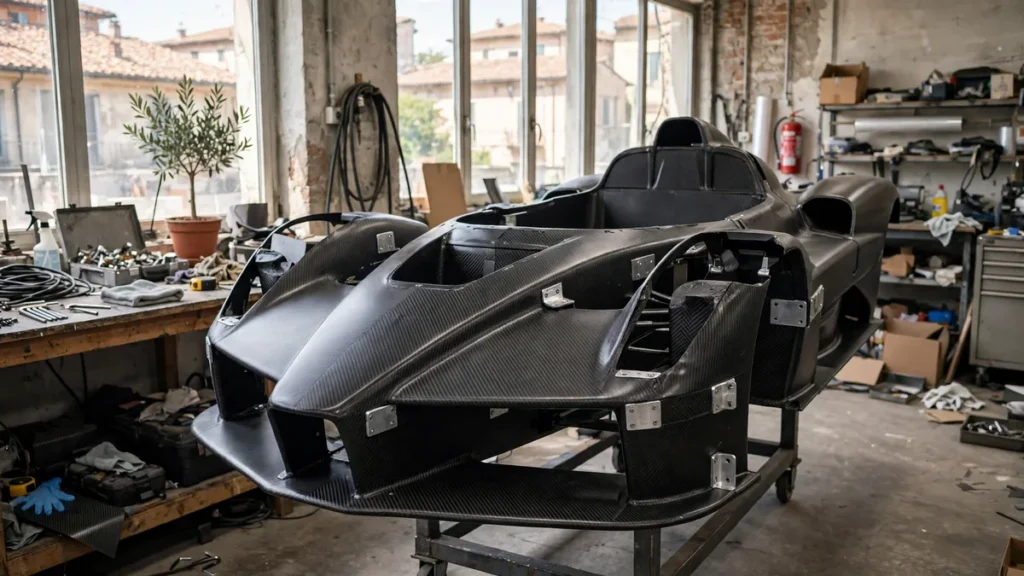
The car hit the barrier at nearly 200 kilometres an hour, broke apart, and caught fire. For a long second the whole circuit went quiet. Then the driver climbed out of the wreckage, walked away, and waved. The car was destroyed. The driver was not. What saved him was a carbon fibre tub barely bigger than a bathtub, hidden at the centre of the car.
That tub is the monocoque: the survival cell of a Formula 1 car. It is the chassis, the cockpit and the crash structure in one piece, carrying the driver, the fuel, the steering and the suspension, and protecting the driver when everything else fails. It is made from carbon fibre, built by hand, and costs more than most people will spend on a house.
A monocoque has to be light enough to win races, stiff enough to make the car handle, and strong enough to survive a crash that destroys everything around it. Here is where the money goes.
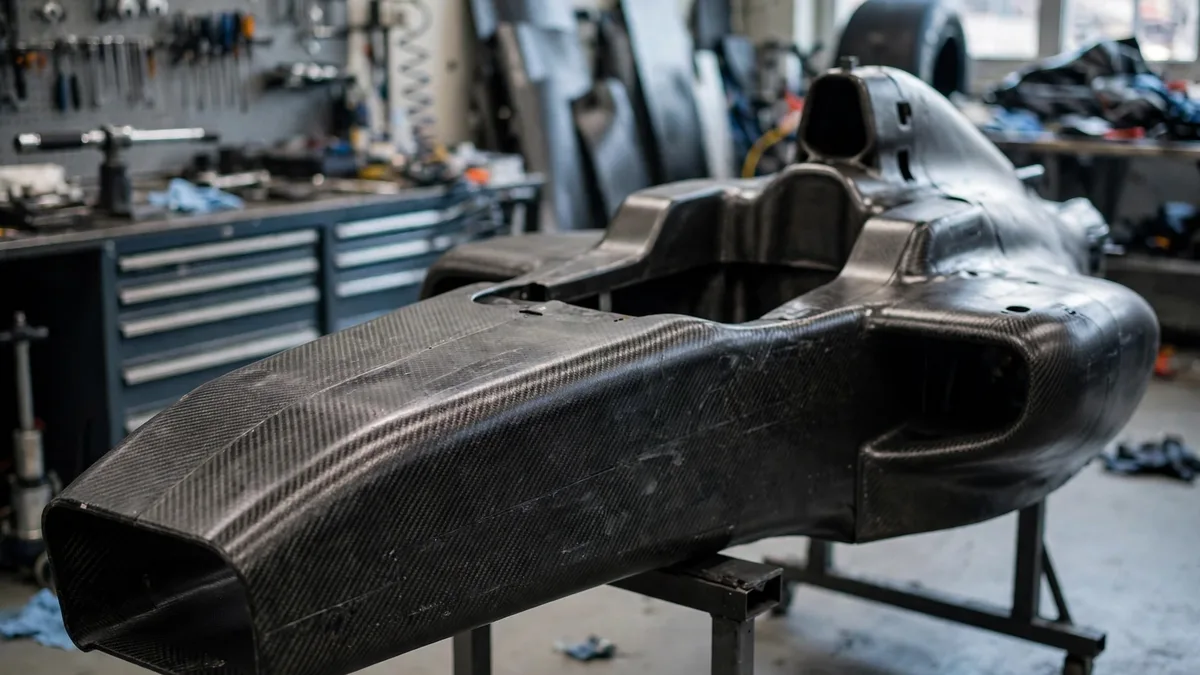
Why the Formula 1 Monocoque Costs So Much
1. Carbon fibre laid by hand, layer by layer
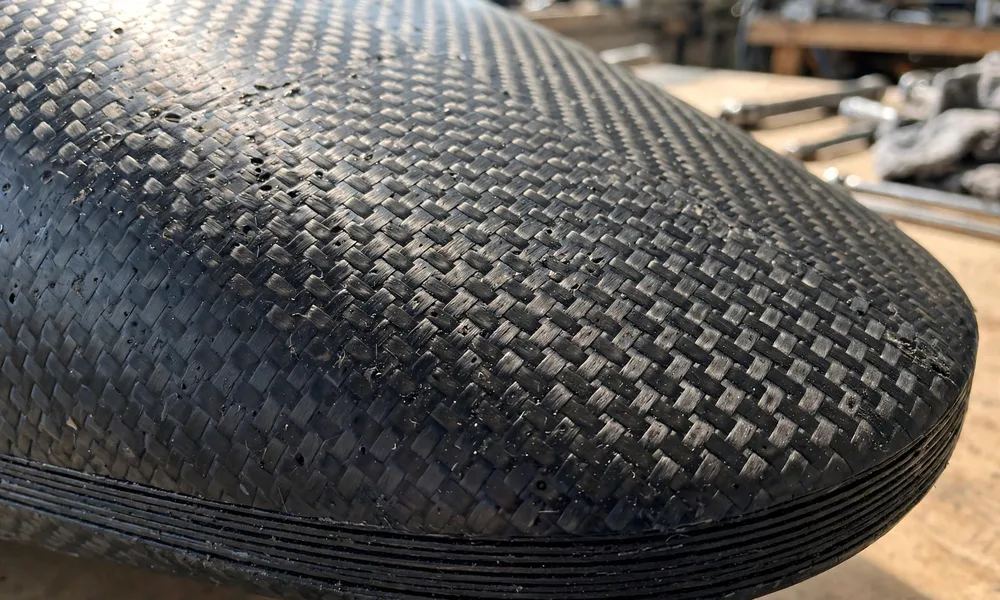
A monocoque is built from hundreds of layers of carbon fibre cloth, each one cut to a pattern and laid into a mould by hand, with the fibre direction set precisely for the loads that part of the car will carry. A single tub can take weeks of lay-up work, done by specialists in clean rooms, checking every layer against a plan. A misplaced layer is a weak spot no one can see from the outside. The labour alone — hundreds of hours of skilled handwork per tub — is a large share of the price.
2. Materials from the aerospace world
The carbon fibre in a Formula 1 car is not the fibre in a bicycle frame. It is aerospace-grade material, made from precursor chemicals, woven to exact specifications, and bought in grades that only a few suppliers in the world can produce. The resins are formulated for high temperature and high strength, the honeycomb cores inside the structure are aluminium or advanced composites, and the inserts where suspension and engine attach are titanium or special alloys. Every material is chosen for maximum strength at minimum weight, and every one of them is priced like the specialist product it is.
3. Cured in an autoclave the size of a room
Once laid up, the monocoque is vacuum-bagged and cured in an autoclave — a giant oven that applies heat and pressure for hours, bonding the layers into a single solid structure. The autoclave is a huge, expensive machine, and the curing cycle is carefully controlled: too hot and the resin degrades, too cool and it never fully hardens. A tub that cures wrong is scrap, and the materials and weeks of labour in it are lost. Teams cure test pieces alongside every tub, cutting them open to prove the cure worked, which adds cost and time to every single chassis.
4. Crash-tested to destruction, again and again
Before a monocoque design can race, it must pass the FIA crash tests: frontal, side, rear and rollover impacts, plus static load tests that push on the structure with forces of many tonnes. The tests are done on real tubs, which are destroyed in the process. A team may build several test tubs before the design is approved, each one costing as much as a race tub. The testing is the price of the sport’s safety record — and it is one of the biggest single costs in building a Formula 1 car.
5. Stiffness that wins races
A monocoque is not only a safety cell; it is the backbone of the car’s handling. If the tub flexes, the suspension cannot do its job, the tyres lose grip, and the car is slow. So the tub is engineered to be enormously stiff — far stiffer than a road car — while weighing around 80 kilograms. Achieving that stiffness at that weight takes careful design, advanced simulation, and endless small decisions about fibre direction and layer thickness. The engineering time behind a modern monocoque runs into thousands of hours, and it is all spent on a part that weighs less than its driver.
6. A fuel tank that is part of the structure
Hidden inside the monocoque, behind the driver, is the fuel cell: a flexible bladder that holds more than a hundred litres of fuel in a crash. It must not leak, not even in a violent impact, and it must be fitted inside the tub without weakening it. The cell is made from ballistic-grade materials, fitted with special foam to stop the fuel sloshing, and replaced on a strict schedule. It is a fuel tank built like body armour, and it is one more specialist system inside an already specialist structure.
7. Two cars, spare tubs, and a season of spares
A Formula 1 team does not build one monocoque. It builds several per season: two race cars, spare tubs, test tubs and crash-test tubs, all to the same design and all built by hand. The moulds, the tooling and the autoclave time are spread over a handful of tubs, not thousands, so each one carries a large share of the fixed cost. When a driver crashes heavily, a new tub must be ready within days. Keeping that pipeline running is a factory in itself, and it is priced into every tub.
Formula 1 Monocoque Specifications
| Specification | Typical figure |
|---|---|
| Material | Carbon fibre composite with honeycomb core |
| Weight | Around 80 kg for the survival cell |
| Length | Around 3 metres |
| Build time | Several weeks of hand lay-up per tub |
| Fuel cell | Flexible bladder, over 100 litres |
| Crash tests | FIA frontal, side, rear and rollover tests |
| Tubs per season | Several per team, including spares and test tubs |
What a Formula 1 Monocoque Costs
Prices are estimates, and teams do not publish them, but industry figures put a single Formula 1 monocoque at roughly $500,000 to $1 million, with a complete car costing $12 million to $20 million. The tub is the most expensive single structure on the car, and a team will build several of them in a season. It is a staggering price for an 80-kilogram shell — until the afternoon a car hits a barrier at 200 kilometres an hour, breaks apart, and the driver climbs out and walks away.
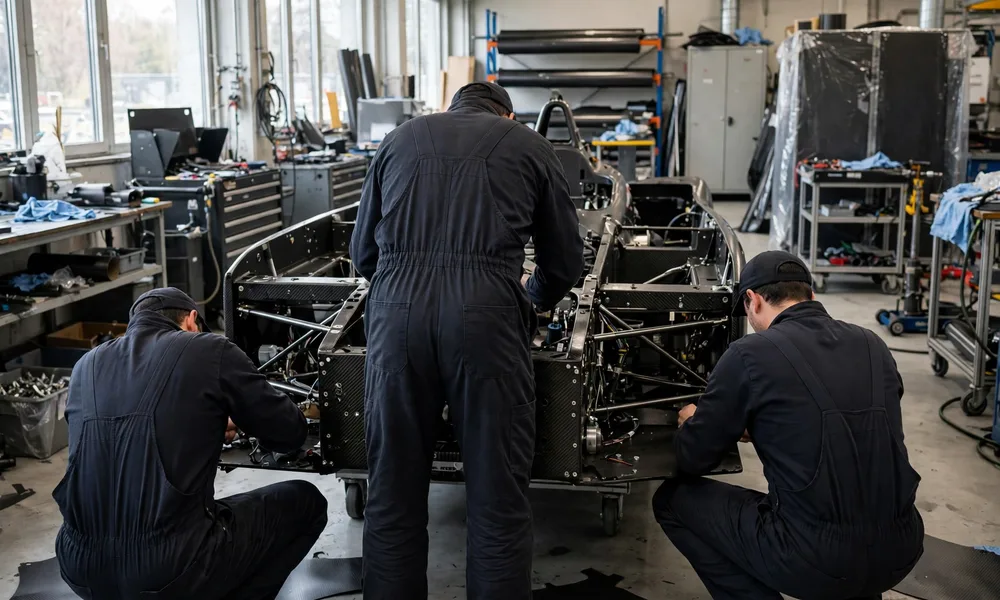
A Rare Fact About the Formula 1 Monocoque
The monocoque idea came from aircraft, and the first carbon fibre monocoque in Formula 1 was built by McLaren in 1981. Drivers were sceptical — a car made of fabric and glue sounded fragile — until John Watson walked away from a huge crash at Monza that would have killed him in an aluminium car. Within a few years every team had switched to carbon fibre, and the monocoque has saved more drivers’ lives than any other invention in the sport’s history.
A Formula 1 monocoque is expensive because it is asked to do three impossible jobs at once: be light enough to win, stiff enough to handle, and strong enough to save a life. It is a hand-built carbon fibre shell, cured under pressure, crash-tested to destruction, and replaced several times a season. That is a very hard job description — and the reason it costs what it does. For how the tub works, see how a Formula 1 monocoque works, the materials in Pagani Huayra monocoque materials, and carbon fibre weave materials.