There is a moment, just before a Rimac Nevera launches, when the whole car seems to hold its breath. No engine note rises, no clutch bites, no gears shuffle — and then the car simply leaves, hard enough to press you into the seat and blur the world at the edges, reaching 60 miles an hour in under two seconds. The thing making that possible is not visible at all. It is a flat slab of battery running the length of the car, weighing more than half a tonne, and holding enough energy to power a house for days.
The Nevera’s battery is not a fuel tank with wires attached. It is the structural heart of the car, the source of its 1,914 horsepower, and the reason the car can do what it does without an engine of any kind. Its specification sheet reads like science fiction, and every number has a job to do.
This guide reads those numbers in plain English. Capacity, power output, charging rate, cell count, voltage, thermal management, and weight — each one tells you something different about what the battery can do and why it costs what it costs.

The Specs That Matter
1. Capacity
Capacity is how much energy the battery holds, measured in kilowatt-hours, and the Nevera’s pack holds about 120 kWh — roughly twice the capacity of a typical family electric car and enough for a claimed range of about 550 kilometres. Capacity is the size of the fuel tank, and it decides how far the car goes, but it also decides how much power the car can deliver: a bigger pack can push more energy out at once without straining any single cell. The way that structure is put together is covered in how a Rimac Nevera battery is made, from cells to finished pack.
2. Power output
Power output is how fast the battery can deliver its energy, and the Nevera’s pack can feed its four motors with about 1,400 kilowatts — roughly 1,914 horsepower — which is why the car accelerates the way it does. That figure is only possible because the pack is so large: each of its thousands of cells only has to contribute a small share of the total, so none of them is pushed beyond its limits. A smaller battery asked to deliver the same power would overheat in seconds.
3. Charging rate
Charging rate is quoted in kilowatts, and the Nevera can accept about 500 kW at its peak on a fast charger — enough, in theory, to add a large share of its range in about 20 minutes. The number to watch is not the peak but the charging curve: how long the car holds a high rate before it tapers off, and that depends on the cooling system as much as on the charger itself.
4. Cell count and chemistry
The pack is made of about 6,960 individual lithium-ion cells, arranged in modules and wired together so that the failure of any one cell does not stop the car. The chemistry is a high-energy nickel-based blend, chosen for power density rather than for the longest possible life, because a hypercar’s battery is asked to deliver enormous bursts of power rather than to last for decades of gentle commuting. Each cell is monitored individually for voltage and temperature.
5. Voltage
Voltage is the electrical pressure in the system, and the Nevera runs at about 800 volts — double the 400 volts of most electric cars. Higher voltage means the same power can be delivered with half the current, and half the current means thinner cables, less heat, and faster charging. The jump to 800 volts is what makes 500 kW charging possible at all. The materials that make that voltage safe to live with are the subject of Rimac Nevera battery materials engineering, from cell chemistry to insulation.
6. Thermal management
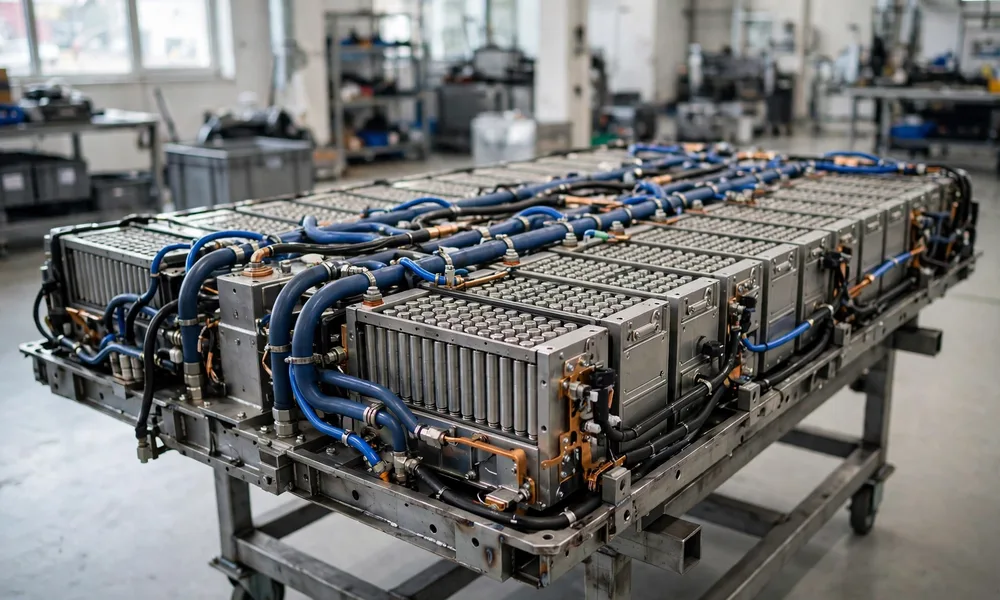
Thermal management is the cooling system that keeps the battery at its best temperature, usually about 20 to 40 degrees Celsius, and the Nevera uses liquid cooling with channels running between the cell modules. A battery that is too cold cannot deliver its full power, and a battery that is too hot ages quickly and can become dangerous, so the cooling system works before, during, and after driving — pre-conditioning the pack on the way to a charger and cooling it down after a hard run. The system must cope with the heat of four motors and a battery working at their limits at once.
7. Weight and structure
The battery pack weighs about 700 kilograms, more than a third of the car’s total weight, and it is not just carried by the car — it is part of the car. The pack forms a structural spine that stiffens the chassis, which is why the Nevera is so rigid despite having no engine block to brace against. That stiffness is what lets the suspension work precisely and the car corner flat, and it is the reason the battery cannot simply be swapped for a lighter one: change the pack and you change the car’s bones. The cost of building a battery that is also a chassis is covered in why a Rimac Nevera battery is so expensive, and the numbers there explain the price tag.
Rimac Nevera Battery Specs
| Specification | Typical value |
|---|---|
| Capacity | About 120 kWh |
| Power output | About 1,400 kW, about 1,914 horsepower |
| Charging rate | About 500 kW peak on a fast charger |
| Cell count | About 6,960 lithium-ion cells |
| Voltage | About 800 volts |
| Range | About 550 kilometres claimed |
| Pack weight | About 700 kilograms |
| 0 to 60 mph | About 1.7 seconds |
What Does a Rimac Nevera Battery Cost?
The Rimac Nevera itself is estimated to cost roughly $2,400,000, and the battery pack is estimated to account for roughly $300,000 to $500,000 of that total, depending on how the cost is divided between the pack, the motors, and the chassis it forms part of. A replacement pack, if one were ever needed, is estimated at roughly $300,000 or more before labour, and the specialist cooling and management systems are estimated to add tens of thousands more. All prices are estimates only and vary widely by specification, region, and the passage of time.
A Rare Fact
The Nevera’s battery is a structural part of the car — it is not a box bolted underneath, but a spine that the rest of the chassis is built around. Remove it and the car would lose a large part of its stiffness, which is why the pack was designed together with the body from the very first sketch rather than added afterwards. It is a reversal of a century of car design, in which the engine was the structural heart of the machine: in the Nevera, the fuel tank is the frame, the battery is the backbone, and the motors are almost an afterthought.
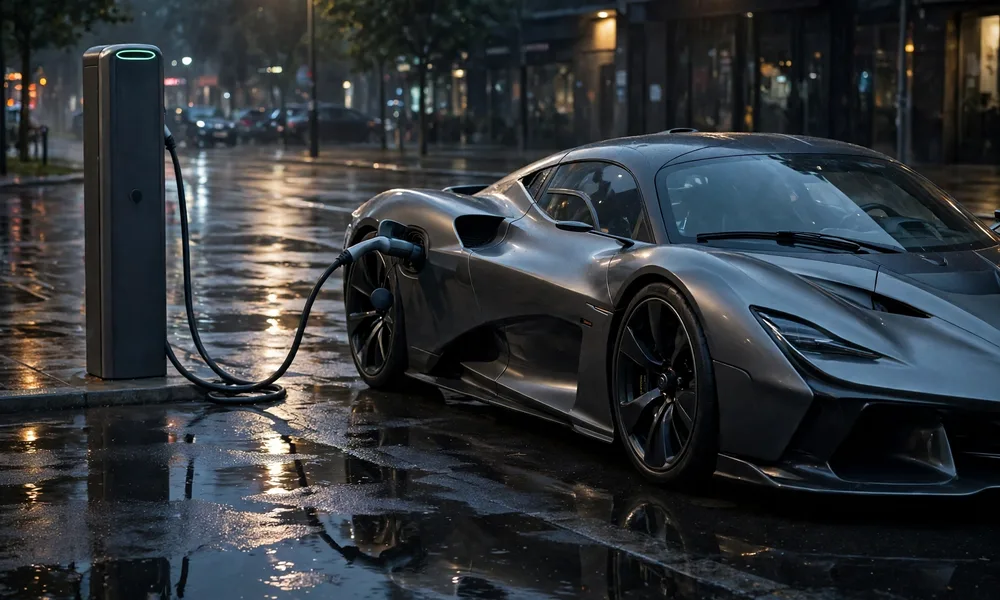
A battery that can launch a car to 60 in under two seconds, charge at half a megawatt, and hold the whole chassis together is not a fuel tank — it is the car itself, with wheels attached. Read the capacity, the power, and the voltage together, and the specification sheet stops being a list of big numbers and starts being a picture of the Nevera: a two-tonne car that behaves like a rocket, powered by a slab of chemistry that is also its spine.


