At two in the morning, in a harbour thick with smoke, the loudest sound is not the fire. It is the water. A fireboat sits off the burning pier with its monitors wide open, throwing arcs of water that look solid in the floodlights, and the whole boat shudders with every pump stroke. A fireboat is not a tugboat with a hose bolted on. It is a floating pumping station, built from the keel up to fight fires no land engine can reach, and every number on its specification sheet exists because somebody learned what happens when a fireboat comes up short.
Most people never see a fireboat at work. They see one tied up at a pier, red paint fading in the sun, and assume it is a museum piece. Then a warehouse catches fire on the waterfront, and the same boat is suddenly the most important machine in the city. It can pump more water in an hour than a neighbourhood of fire engines, and it can keep going when the shore supply has run dry. The luxury end of the fireboat world adds the best of everything: faster hulls, bigger pumps, and systems that let a small crew do the work of a large one.
So what do the numbers actually mean? A fireboat’s specification sheet reads like a tugboat’s until you reach the pumping figures. This is the plain-English guide to those numbers.

How a luxury fireboat is made
A fireboat is built around its pumps, and everything else is arranged to serve them.
1. The hull is shaped for pushing, not for speed alone
The hull is usually steel, wide in the beam and flat-bottomed enough to stay stable when the monitors fire sideways. Stability matters more than top speed, because a fireboat that rolls when its pumps open cannot aim. Naval architects model the thrust of every monitor before a single plate is cut, so the hull holds station with water pouring off one side.
2. The engines are sized for the pumps first
Main engines on a large fireboat produce thousands of horsepower, and a surprising share of that power never reaches the propellers. It drives the fire pumps. Designers size the engines by working backwards from the pumping requirement, then add the propulsion margin on top, which is why fireboats carry far more installed power than a tugboat of the same size.
3. The pumping system is the heart of the boat
High-capacity centrifugal pumps, often driven directly off the main engines through gearboxes, draw water through sea chests in the hull and push it to the monitors. A large modern fireboat moves tens of thousands of litres per minute. The pipework is oversized on purpose, because every bend costs pressure, and pressure is what turns a spray into a jet that can reach across a burning deck.
4. Monitors are fitted like artillery
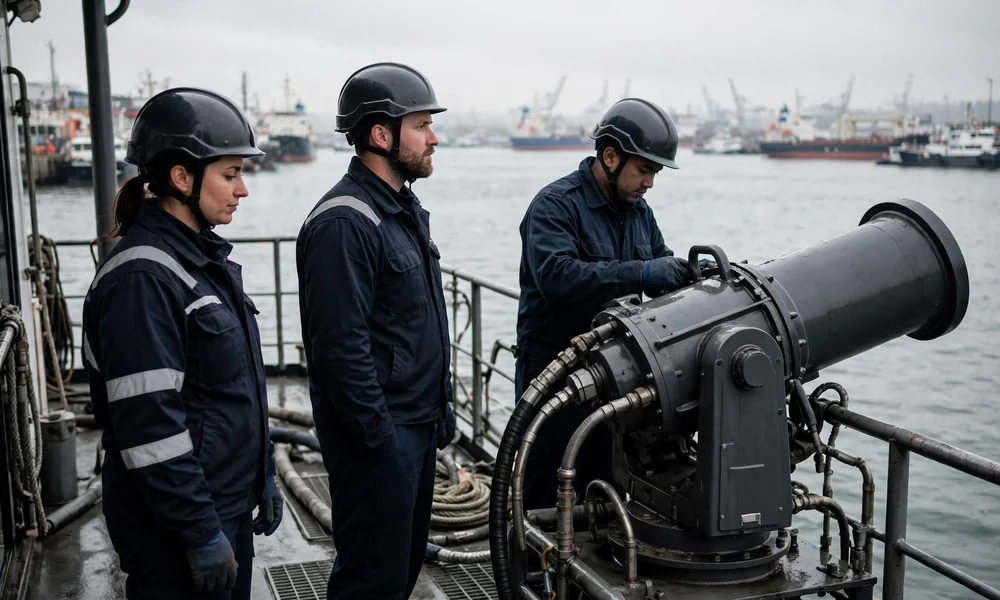
The water cannons, known as monitors, sit on the wheelhouse roof, the bow, and the stern, each on a powered mount one operator can aim by remote control. The best monitors throw water more than a hundred metres, and some can be aimed from inside the wheelhouse while the crew stays behind armoured glass and heat shielding.
5. Firefighting foam is added for fuel fires
Water alone cannot fight a fuel fire, so a luxury fireboat carries foam concentrate tanks and proportioning systems that mix foam into the water stream automatically. They are fitted early, because retrofitting a foam system into a finished boat is expensive and awkward.
6. The wheelhouse is built as a protected command post
The wheelhouse gets heat-resistant glazing, water spray curtains that keep the glass cool, and air filtration so the crew can breathe metres from a burning ship. Navigation, pump control, monitor aiming, and radio traffic all come together here, and on the best boats one officer can run the whole firefighting operation from one seat.
7. Sea trials test the pumps, not just the speed
Before delivery, the boat is tested with every monitor open at once, measuring flow, pressure, and throw distance against the contract, and checking that it holds position with full pumping load and that the engines stay cool. A fireboat that passes its speed trial but fails its pumping trial is not delivered.

The numbers that matter
Here are the headline figures for a large modern luxury fireboat.
| Specification | Typical figure |
|---|---|
| Length overall | 28 to 35 metres |
| Beam | 8 to 10 metres |
| Top speed | 30 to 38 knots |
| Main engines | Two diesels, about 2,000 horsepower each |
| Fire pump capacity | 30,000 to 60,000 litres per minute |
| Monitor throw distance | Up to 120 metres |
| Foam concentrate carried | 5,000 to 10,000 litres |
| Crew | 6 to 12 |
The figure that deserves the most attention is the pump capacity, because it decides whether the boat can save a burning ship. A fireboat moving 40,000 litres a minute delivers roughly the output of forty land-based fire engines at once, and it can do it for as long as the engines run, because it never needs a hydrant. Arriving five minutes earlier is worth more than arriving five knots faster, which is why harbours place fireboats where the risk is.
Power is the other number people misunderstand. Two thousand horsepower per engine sounds enormous for a boat of thirty metres, until you remember that the pumps take most of it. The propellers get what is left, and that is still enough for motorway speeds in a harbour. The gearbox arrangement lets the crew split power between propulsion and pumping on the fly, so the boat can manoeuvre hard while the monitors are wide open. That flexibility is what the reasons a luxury fireboat costs so much really come down to: the boat is two machines at once, a tug and a pumping station, sharing one set of engines.
What a luxury fireboat costs
A large modern luxury fireboat costs an estimated 8 to 15 million dollars, depending on size, pump capacity, and equipment. Smaller harbour fireboats cost far less, while the largest municipal boats, with full foam systems and heat shielding, can push past that range. The estimate covers the hull, engines, pumps, and electronics, but not crew training or years of maintenance, and running costs stay heavy: the pumps need regular testing and the foam concentrate has a shelf life. Pumps and monitors are the most expensive systems after the hull itself.
A rare fact about fireboats
Some fireboats can pump water into a burning vessel’s tanks to keep it upright while it burns, a technique that saved ships which would otherwise have capsized from the weight of the water poured on their decks. The job is not just about throwing water at flames. It is about understanding a ship, its stability, and its structure, and knowing when to stop pumping as well as when to start. The closest cousins to this work are the patrol boats that share the harbour, and luxury patrol boat is built shows the same obsession with strength, stability, and working in rough water at speed.
Harbour work is changing fast, and the making of an electric tugboat hints at where fireboats may go next, with battery-assisted pumping and quieter harbour operations. For now, the diesel fireboat remains the standard, because when a ship is burning, nobody wants to wonder whether the battery is charged.
A luxury fireboat is easy to admire and hard to justify on a spreadsheet, until the night it is needed. Its specifications are not marketing numbers. They are a list of promises: this much water, this far, for this long. Read them as a firefighter would. The pump capacity is the rescue. Everything else is how the boat gets there.


