The first time you stand next to a supercar in the flesh, the numbers stop mattering for a moment. The car is lower than your hip, wider than a family saloon, and shaped like something that was poured rather than built. The doors open upward. The engine sits behind your shoulders, visible through glass, ticking as it cools. A crowd gathers without being asked. Then somebody mentions the price — a figure with seven digits before the decimal point — and the question everyone asks is the same: what could possibly cost that much?
The answer is not one thing. A supercar is a road-legal race car, and everything about it is engineered to a standard that ordinary cars never attempt. The chassis is carbon fibre, the engine is hand-built by one person, the aerodynamics are tuned in a wind tunnel, and the interior is trimmed by hand. Each of those is expensive on its own. Together, they are the reason a supercar costs as much as a house.
This is where the money goes, and why the bill ends up where it does.

Where the money goes
A new luxury supercar costs an estimate of $400,000 to $2.5 million, depending on the maker, the model and the options. Here is how that figure breaks down.
| Cost area | Share of the price |
|---|---|
| Chassis and body (carbon fibre) | 25–30% |
| Engine and drivetrain | 25–30% |
| Aerodynamics and suspension | 12–15% |
| Interior and finish | 10–12% |
| Electronics and systems | 8–10% |
| Development and testing | 10–12% |
The chassis is the biggest single line, and it earns it. A carbon-fibre monocoque — the single-piece tub that the whole car is built around — takes hours in an autoclave to cure, layer by layer, and a mistake in one layer can scrap the whole piece. Carbon fibre is five times stronger than steel at a fraction of the weight, which is why a supercar can weigh 1,400 kilograms with a thousand horsepower. The tub is also the safety cell, the part that keeps the driver alive in a crash, so it is built to tolerances measured in fractions of a millimetre.
The engine: one person, one engine
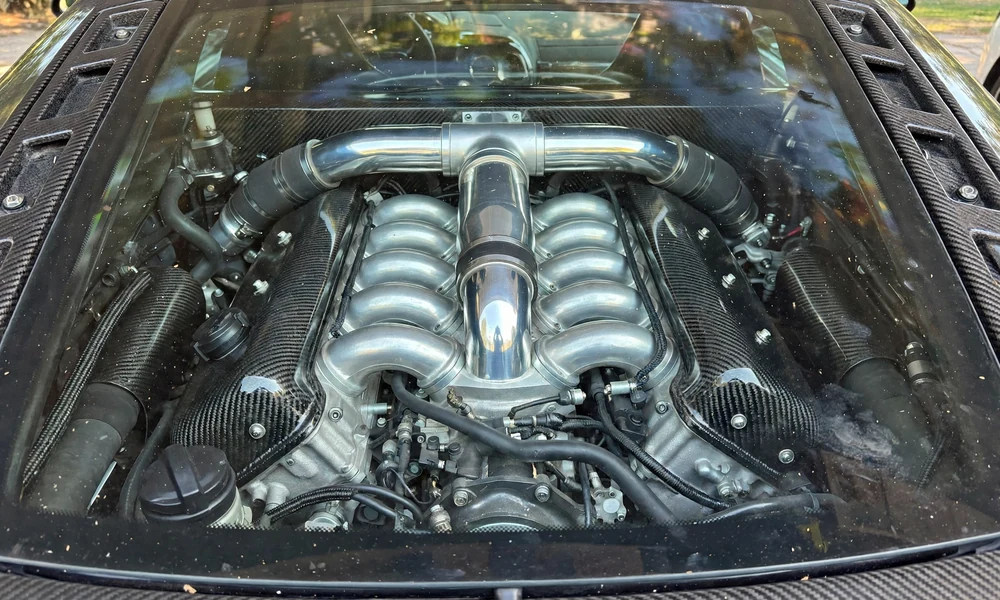
At the heart of most supercars sits an engine built by a single technician, from the first bolt to the last, who signs their name on a plaque on the finished unit. A twin-turbo V8 or a naturally aspirated V12 producing 700 to 1,000 horsepower costs an estimate of $80,000 to $150,000 to build, and the reason is the handwork: every component is balanced, every clearance is measured, and the engine is run on a dynamometer for hours before it is allowed near a car.
The electric supercar rewrites this section rather than deleting it. The battery pack and the motors replace the engine, but the cost moves, not vanishes — a high-density battery, its cooling system and the power electronics cost just as much, and the engineering challenge is keeping all of it light. The reasons an electric supercar is so expensive show a different ledger with the same bottom line: energy, cooling and weight, traded against each other at enormous cost.
Aerodynamics: the invisible bodywork
The bodywork you see is only half the car. Underneath, the floor is a carefully shaped wing that sucks the car onto the road, and at the rear a wing or an active spoiler adjusts itself dozens of times a second to keep the car planted. At 200 miles per hour, a supercar can generate more downforce than its own weight — the car could, in theory, drive upside down on a ceiling. In practice, the downforce is what lets a supercar corner at speeds that would throw an ordinary car off the road.
Developing that takes time in a wind tunnel, and wind tunnel time is charged by the hour at rates that make a lawyer blush. Every vent, every duct, every curve of the body is tested, because the air does not care how the car looks. A supercar’s beauty is a byproduct of its physics, and the physics is expensive to get right.
The interior: a cockpit, not a cabin
Inside, a supercar is a cockpit dressed as a lounge. The seats are carbon-fibre shells trimmed in leather by hand, the steering wheel carries more controls than some aeroplanes, and the dashboard is a single screen that changes its entire layout when the car switches from road mode to track mode. The leather is cut and stitched by people, not machines, and the stitching alone can take a craftsman a full day.
That handwork is the difference between a supercar and a very fast saloon. A luxury grand tourer is built to cross a continent in comfort, and how a luxury grand tourer works shows a car tuned for the long journey rather than the lap time. A supercar trades the grand tourer’s comfort for the track: stiffer, lower, louder, and built around the driver alone. A fast saloon splits the difference, and how a luxury sedan works shows how much performance can be hidden inside an ordinary-looking four-door car.
Development: the cost nobody sees
The line on the table that surprises people most is development. A new supercar costs an estimate of $500 million to $1 billion to develop, and it is sold in the hundreds or the low thousands, not the hundreds of thousands. Spread across 500 cars, a billion dollars of development is $2 million per car before a single part is bought. That is the real reason supercars are expensive: the engineering is amortised over a production run the size of a village, while a family hatchback spreads the same kind of engineering over millions of cars.
The low volume also means the factory is different. Supercars are built by hand, on a slow line, by small teams. There is no robot stamping out body panels by the thousand. Every car is, in a real sense, a prototype that happens to have a warranty.
Price: the full picture
Add it up and a new luxury supercar costs an estimate of $400,000 to $2.5 million, with the rarest limited editions reaching $4 million or more. Annual running costs are an estimate of $15,000 to $40,000 — servicing, tyres, insurance, and the occasional repair — and a set of tyres alone can cost $5,000 or more. Depreciation is the wild card: some supercars lose half their value in three years, while limited editions can gain value the moment they leave the showroom. The price of the car is only the first number in the ledger.

A rare fact
Here is the detail the spec sheet hides in plain sight: a supercar’s brakes cost more than most cars. A carbon-ceramic braking system — the huge discs and multi-piston calipers behind the wheels — can cost an estimate of $15,000 to $25,000 to replace, and the discs themselves are made from a material that is baked for weeks in a furnace to reach its final strength. The brakes must stop a car from 200 miles per hour, repeatedly, without fading, and they do it by turning speed into heat — so much heat that the discs glow orange on a track day. The car that goes fastest needs the brakes that cost most, and the brakes are worth every cent the one time they matter.
That is the supercar in one image: a machine that is too fast for its own good, engineered to survive its own speed, and sold in numbers so small that every car carries the cost of the whole programme on its back. The price is not a markup. It is the bill for building a race car you are allowed to drive to the shops.