The designer sat in a quiet studio, a thin slab of glass and metal on the desk in front of her, and the whole day’s work was on its screen. Sketches, photographs, notes, a film playing in the corner: everything she needed, carried in one hand, lighter than a paperback book. The tablet looked simple, almost effortless, and that was the trick. Nothing about making it had been simple at all. A luxury tablet can cost as much as a good laptop, and people who have never held one ask the obvious question. What makes a flat piece of glass cost so much?
The answer is that a luxury tablet is not a big phone or a small laptop. It is a machine built to do both jobs at once, with a screen that has to be good enough for professional artists, a body thin enough to disappear into a bag, and a battery that lasts all day. Here is where the money goes.

1. A screen that has to be perfect
The screen is the most expensive part of a luxury tablet, and it is easy to see why. It must be bright enough to read in sunlight, accurate enough for a photographer to trust the colours, and smooth enough that a stylus glides across it without lag. The best screens use thousands of tiny backlights that dim individually, so blacks are truly black and bright areas stay bright, and each panel is calibrated at the factory so the colours match a professional monitor. The numbers behind the hardware are set out in the guide to foldable tablet specs explained, where each figure is decoded in plain words.
2. A chip that thinks like a laptop
Inside a luxury tablet is a processor as powerful as the one in a good laptop, and it has to do its work in a body a few millimetres thick, with no fan and almost no room for cooling. The chip runs video editing, 3D drawing and dozens of apps at once, and it does so while sipping power, because the battery has to last all day. Designing a chip that is both fast and frugal is one of the hardest jobs in electronics, and the newest chips are made on processes so advanced that only a handful of factories in the world can build them. The cost of that factory, spread across the tablets that use the chip, is a large part of the price, and it is why the newest tablet always costs more than the last one.
3. A body carved from a single piece of metal
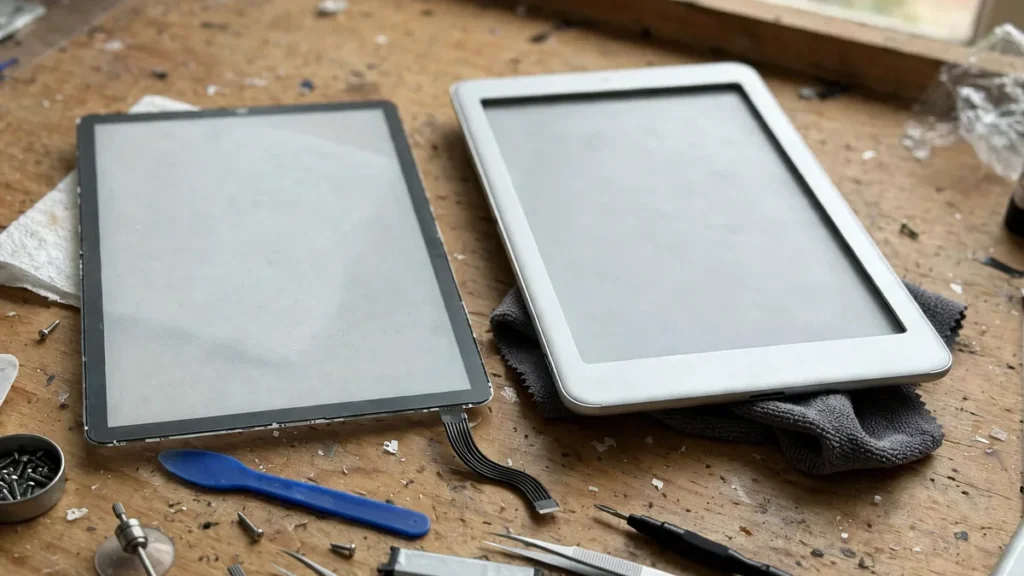
A luxury tablet is usually machined from a single block of aluminium, a process that takes hours and wastes most of the metal it starts with. The result is a body that is stiff, light and cool to the touch, with no seams to creak and no flex when you press the screen. The glass is bonded to the body with a precision measured in fractions of a millimetre, so there is no gap for dust to enter and no edge to catch on a pocket. Cheaper tablets are made from plastic or from several pieces screwed together, which is faster and cheaper, but it is also heavier, weaker and less pleasant to hold. The machining is invisible once the tablet is in your hand, which is exactly the point: the luxury is in the feeling, not the appearance. The way such a device is put together is described in the guide to how a foldable tablet is made, from the raw materials to the finished device.

4. A stylus that feels like a real pen
The stylus that comes with a luxury tablet is not a plastic stick. It senses pressure, tilt and speed, so a light touch draws a fine line and a firm press makes a bold stroke, just like a real pen. Building that takes tiny sensors, a custom chip and years of software tuning, and it is why the stylus alone can cost as much as a cheap tablet. For the artists and designers who buy these tablets, the stylus is the whole point: without it, the tablet is just a screen, and with it, it is a studio.
5. Cameras, microphones and speakers that disappear
A luxury tablet carries cameras good enough for video calls that look professional, microphones that pick up a voice across a quiet room, and speakers that fill a room with sound, all fitted into a body thinner than a pencil. Each of these is a small engineering problem on its own: the camera must sit in a bezel a few millimetres wide, the microphones must ignore the noise of the tablet itself, and the speakers must produce bass from a space barely bigger than a coin. None of it is visible, and none of it makes the tablet faster, but it is what makes the device feel complete instead of compromised. A related lesson comes from the guide to why a foldable tablet is so expensive, which shows how another kind of premium tablet is engineered for a different kind of user.
6. Software that lasts for years
A luxury tablet is supported with software updates for many years, often longer than a laptop, and that support is part of the price. The maker has to keep testing new software on old hardware, fixing security problems and adding features, long after the tablet has been sold. That costs money every year, and it is paid for by the original price. Cheaper tablets are often abandoned after a year or two, which is why they feel old so quickly. A luxury tablet bought today is expected to still feel fast in five years, and that expectation is built into the price from the start.

Price in context
A luxury tablet typically costs roughly $1,000 to $2,000 as an estimate, with the largest models with the most storage going higher, and a full kit with a keyboard, a stylus and a case can pass $2,500. Those prices are estimates only and vary by brand, model and retailer. Running costs add to the picture too. The accessories are expensive, the repairs are done by specialists, and a cracked screen can cost hundreds to replace. It is a flat piece of glass with a big price, and the price is the cost of making something simple that does the work of three machines at once.
A rare fact worth knowing
Some luxury tablets can sense a stylus hovering just above the screen, before it even touches the glass, and show a small cursor where the line will begin. The feature sounds like a small thing until you are drawing a fine detail and you realise you can aim the pen before you commit to the stroke. It is the kind of detail that never appears on the spec sheet but decides whether the tablet is worth its price to the people who use it every day.