On a bright bench in the assembly hall, a device no thicker than a paperback novel is coming together, and it feels almost too light to be a computer. There is a grey screen the size of a postcard, a battery as flat as a biscuit, and a pale plastic shell waiting to hold them both. In an hour this handful of parts will be a luxury e-reader.
This is how a luxury e-reader is made, from the paper-like display and its glass cover to the slim battery, the warm front light and the final page-turn test, where a real book is read on it from cover to cover.

Step 1: The e-ink panel is made and checked
Everything in an e-reader starts with the display, and it is unlike any other screen. An e-ink panel is made of millions of tiny capsules, each holding black and white particles suspended in clear fluid, and an electric charge pulls one colour to the surface to form a letter. The panel is built on a thin sheet of glass or flexible plastic, and it is checked under bright light for dead capsules and uneven patches before it is allowed any further. The display itself is a subject of its own, and the guide to how an e-ink display is made follows the panel from raw glass to finished sheet.
Step 2: The front light is layered in
Over the e-ink panel goes the front light, a thin layer of clear plastic with tiny light guides etched into it. Small LEDs sit along the edge of the layer, and their light is spread evenly across the page, so the reader can read in the dark without a glow shining into their eyes.
Step 3: The glass cover and touch layer are bonded
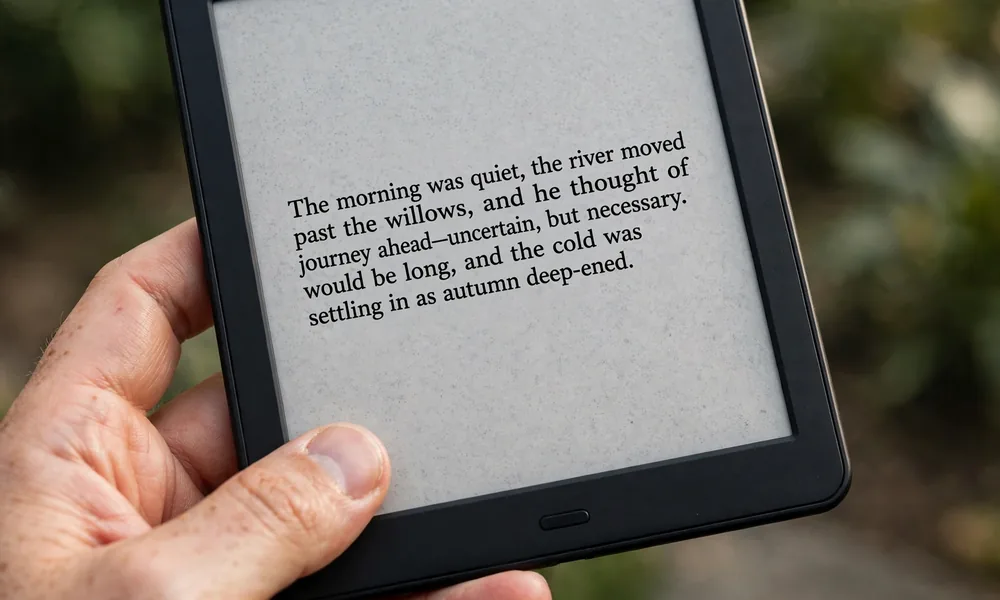
Next comes the cover glass, a thin sheet of hardened glass that protects the display and gives the page its smooth feel. A touch sensor is laminated beneath the glass, a nearly invisible grid that senses a fingertip by the tiny change in charge where it presses, so the reader can tap to turn a page or swipe to browse a library. The whole stack, panel, light layer and glass, is bonded together with no air gap, so the letters look as if they are printed on the surface rather than sitting behind it. The stack is then set into the shell, and a thin gasket seals the edge against dust and the odd splash of water. The seal is tested by holding the finished reader under a fine spray, because a leak at this edge would fog the display from the inside.
Step 4: The battery and main board are fitted
Behind the display sits the rest of the machine, and there is not much of it. A flat lithium-polymer battery fills most of the back, shaped to fit around the board, and it is glued in place to save space, which is why the e-reader is so thin. The main board is a small rectangle holding the processor, the memory and the wireless radio, and it is connected to the display by a flat ribbon cable that is folded with care, because a creased ribbon can crack and kill the screen. The whole back is then covered by a rear shell, usually a soft-touch plastic or a magnesium plate, and the two halves are clipped and screwed together. A final check of the seam runs a fingernail around the whole edge, feeling for any gap where dust could creep in over months of use.

Step 5: The software and library are loaded
With the hardware assembled, the e-reader is switched on for the first time and its software is loaded. The reading software is tuned for the e-ink panel, refreshing the page in a way that avoids ghosting, the faint shadow of the last page that can linger on a cheap display, and the fonts are chosen to stay sharp at every size. The numbers behind the panel matter here too, and the guide to e-ink display specs, explained sets out what resolution, contrast and refresh really mean for a reader.
Step 6: The page-turn test and final check
Before a luxury e-reader leaves the factory, it is read like a book. A tester opens a novel, turns page after page, and checks that each page appears cleanly, that the text is sharp from edge to edge, and that the light is even with no bright corners or dark patches. The tester tries the touch screen, the buttons, the library search and the dictionary, and then leaves the device on standby to check that the battery barely moves overnight. A look at inside e-ink display production shows the clean rooms and inspection benches where the panels themselves are made, long before they ever meet a shell and a battery.
The spec sheet at a glance
| Specification | Typical luxury figure | What it tells you |
|---|---|---|
| Display | 7 to 8 inch e-ink, 300 ppi | How sharp the text looks |
| Front light | Warm and cool adjustable LEDs | How it reads day and night |
| Cover glass | Hardened, flush with the frame | How the page feels to touch |
| Storage | 32 to 64 GB | How many books it can carry |
| Battery | Weeks of reading per charge | How rarely it needs a cable |
| Weight | 190 to 220 grams | How it feels held one-handed |
| Thickness | Under 8 mm | How easily it slips into a pocket |
| Water resistance | IPX8 on many models | Whether it survives the bath |
| Connectivity | Wi-Fi and USB-C | How new books arrive on it |
What good build looks like
A well-made luxury e-reader gives itself away in small details. The screen should look like paper even with the light off, with no grey patches and no ghost of the last page, and the front light should be perfectly even, with no bright edge or dark corner.
What it costs
A luxury e-reader typically costs an estimated $300 to $500, depending on the screen size, the storage, the waterproofing and whether it has a stylus for notes. The estimate covers the reader alone, not a case or a subscription. The price is mostly in the display: a high-resolution e-ink panel with an even, warm front light costs far more to make than the battery, the board or the shell put together.
A rare fact
One detail few readers ever learn is that an e-ink page uses no power at all once it is drawn. The charged particles stay where they were put until the next page turn, so an e-reader left on a single page could show that page for months without a battery. It is the page turns, the light and the wireless radio that drain the charge, which is why a reader who turns the light off and reads offline can go for weeks, while the same device downloading books all day will be flat far sooner.
From a sheet of e-ink on a clean-room bench to a finished reader slipped into its sleeve, a luxury e-reader is made in slow, dust-free stages, each one checked before the next begins. The result is a machine that disappears into the act of reading.


