A yacht already has a galley below deck, with an oven, a hob, and a fridge. So when the owner asks for a second kitchen on the open deck, the first question is why, and the second is why it costs as much as a small house. The outdoor kitchen looks like a row of steel counters with a grill and a sink, and the guests use it for an hour a day. It is for a kitchen that works outdoors, in salt air, on a deck that moves, and looks like furniture.
A luxury yacht outdoor kitchen is a full cooking area built into the aft deck or cockpit of a yacht, with a grill, a sink, a fridge, worktops, and storage, so the chef can cook and serve outside without going below. It is a second galley, not a barbecue with a tap, and the price comes from the steel, the appliances, the plumbing, and the fact that everything in it is made to order for one yacht. This is where the money goes.
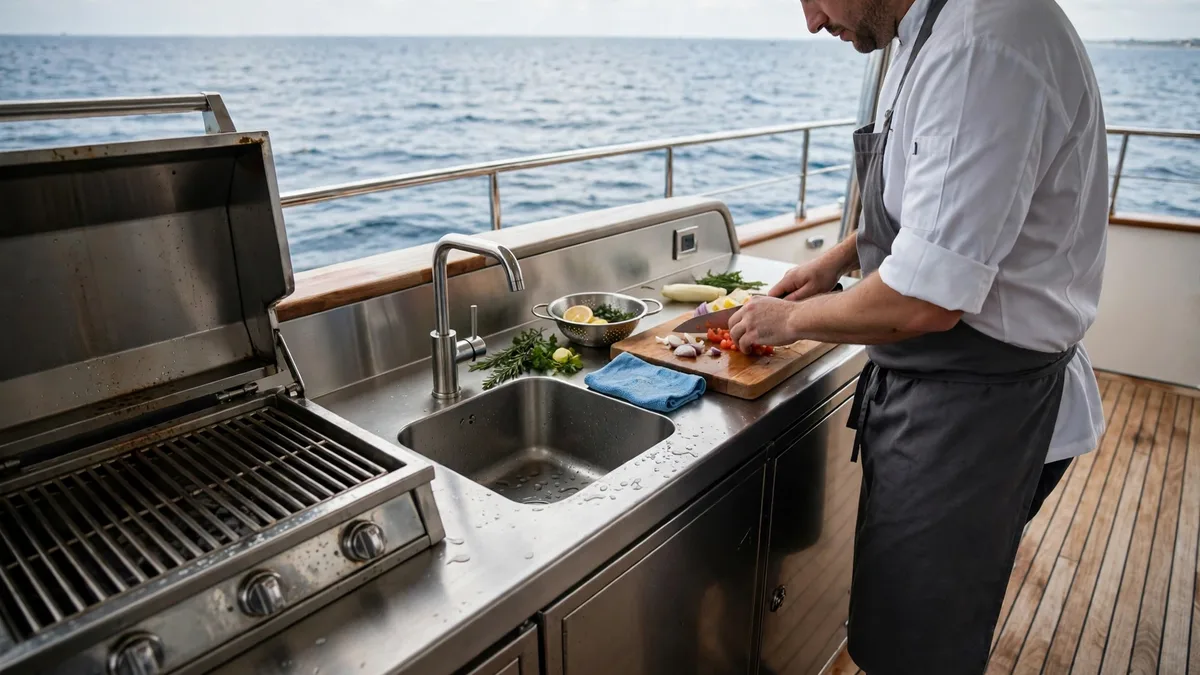
1. The steel counters, and metal that survives salt and sun
The counters are the first cost. A yacht outdoor kitchen is built from marine-grade 316 stainless steel, chosen because it will not rust, stain, or pit after years in salt air. The worktops are 3 to 5 millimetres thick, the cabinets are welded, not screwed alone, and every edge is folded and polished so no guest ever catches a finger on a sharp corner.
The steelwork is typically estimated at $25,000 to $60,000, rising with the length of the run. The cost comes from the material and the handwork: each counter is cut, folded, and welded to fit one deck, and one that is a millimetre out does not fit at all.
2. The grill and the appliances, and a kitchen without a roof
The appliances are the second cost. The outdoor kitchen usually carries a built-in gas grill, a sink with hot and cold water, an under-counter fridge, and often a small ice maker, all of them marine-grade.
The appliances are typically estimated at $20,000 to $50,000, including the grill, the fridge, and the ice maker. The cost comes from the marine standard: a land fridge would rust in a season, and a land grill would warp. The flat steel grill in the same family is covered in why a yacht teppanyaki grill costs so much, and the same marine markup applies to every appliance here.
3. Plumbing and drainage, and water that must go somewhere
The plumbing is the cost nobody sees. A yacht outdoor kitchen needs fresh water to the sink, grey water away from it, and a gas line to the grill, all of it running through a deck that moves, flexes, and gets wet. The pipes are stainless or copper, every joint is sealed against salt spray, and the drain runs to a tank below deck, never over the side.
The plumbing is typically estimated at $10,000 to $25,000, including the lines, the pumps, and the tank connections. The galley below it is described in how a luxury yacht galley works.
4. The marine build, and a kitchen bolted to a moving deck
The marine build is the cost that surprises people. The whole kitchen is bolted to a steel frame tied into the deck, with a raised lip around every worktop so plates and glasses stay put when the yacht rolls. The fridge is strapped in, the drawers lock shut, and the sink has a cover that turns it into extra counter space when it is not in use.
The marine build is typically estimated at $15,000 to $40,000, including the frame, the fixings, and the non-slip surfaces. The cost comes from the fitting: the kitchen is built into the yacht, not placed on it, and it must be removed and refitted at every major refit. The bar beside it is covered in why a yacht bar costs so much, and it is built the same way.
5. Power and refrigeration, and keeping food cold in the sun
The power is the fifth cost. The outdoor kitchen usually draws 3 to 6 kilowatts, with the fridge and ice maker on their own circuit so a fault at the grill does not take out the lights. The fridge is the hard part: it must hold 4 degrees Celsius in full sun, and it does it with thicker insulation and a bigger compressor than a land fridge of the same size.
The electrical work is typically estimated at $8,000 to $20,000, including the circuits, the breakers, and the refrigeration. The cost comes from the marine standard: the wiring runs through a deck that moves and gets wet, and every connection is sealed. A fridge that warms up in the sun is not a fridge, and on a yacht there is no shop to run to.

6. The finish, and a kitchen that looks like furniture
The last cost is the finish. A yacht outdoor kitchen is not meant to look like a kitchen. The steel is brushed or polished to match the deck furniture, the cabinets are faced in teak or lacquer, and the whole run is designed by the yacht’s interior designer, not by a kitchen supplier. Guests are meant to see a bar, not a galley.
The finish is typically estimated at $10,000 to $30,000, including the teak facing, the lighting, and the bar stools. The cost comes from the custom work: nothing in a yacht outdoor kitchen is off the shelf, because no two yachts have the same deck, the same party size, or the same owner.
The Specifications at a Glance
Here are the numbers that matter most on a luxury yacht outdoor kitchen.
| Specification | Typical Luxury Range |
|---|---|
| Counter length | 2 to 4 metres of worktop |
| Counter material | Marine-grade 316 stainless steel, 3 to 5 millimetres |
| Grill | Built-in gas grill, 10 to 20 kilowatts |
| Fridge capacity | 80 to 150 litres, marine-grade |
| Power draw | 3 to 6 kilowatts, own circuit |
| Sink | Fresh water in, grey water to tank |
| Worktop lip | 15 to 25 millimetres, raised |
| Build time | 4 to 8 weeks of hand work |
What Does a Luxury Yacht Outdoor Kitchen Cost?
A luxury yacht outdoor kitchen is estimated to cost roughly $100,000 to $300,000 installed, depending on size and finish. A compact run with a grill, sink, and fridge is estimated at roughly $100,000 to $180,000, while a full kitchen with a teppanyaki plate, ice maker, and teak facing is estimated at roughly $180,000 to $300,000. Annual maintenance is estimated at roughly $3,000 to $8,000.
A Rare Fact
A yacht outdoor kitchen is designed so the chef never turns their back on the guests. The grill, the sink, and the worktop are laid out in a line facing the seating, not facing the sea, because the chef is part of the evening, and a chef with their back to the party is a waiter. The kitchen is a stage, and the stage faces the audience.

Once you know where the money goes, the price makes sense. The steel is marine-grade and cut to fit one deck, the appliances are built to survive salt and sun, and the whole kitchen is designed to look like furniture while working like a galley.


