On a yacht, the most expensive cooking surface is not in the galley. It is on the open deck, in front of the guests, where a chef stands behind a flat steel plate and cooks dinner a metre from their plates. The grill looks simple: a slab of steel, a frame, and a row of seats. The invoice is not simple at all.
A luxury yacht teppanyaki grill is a flat steel hotplate, heated from below, on which a chef cooks meat, fish, and vegetables in front of seated guests, and it has to keep its plate at a steady, searing heat while the yacht moves. It is a restaurant and a show in one piece of equipment, and the price comes from the plate, the power, the marine build, and the chef it is built around. This is where the money goes.
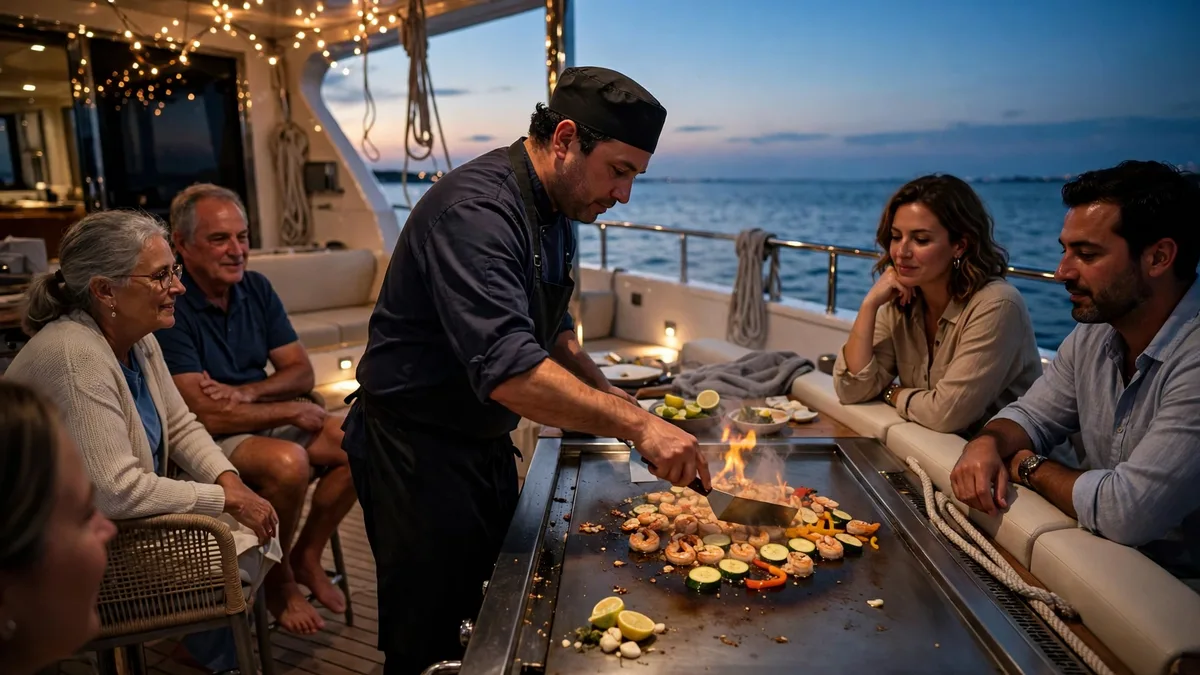
1. The steel plate, and a slab that stores heat like a stone
The plate is the first cost. A yacht teppanyaki plate is usually a slab of stainless steel 15 to 25 millimetres thick, 1.2 to 2.4 metres long, and it stores heat the way a stone stores heat in a pizza oven, so that when a cold load of steak lands, the surface does not drop and stall. The steel is ground flat to within a fraction of a millimetre, because a plate that is not flat cooks unevenly.
The plate is typically estimated at $15,000 to $40,000, rising with size and thickness. The cost comes from the steel and the machining: the slab is cut, ground, and polished by hand, and one that warps in its first season is replaced, not repaired. A restaurant plate indoors never faces wind, salt, and a rolling deck.
2. Heat and zones, and cooking a whole menu at once
The heating is the second cost. A yacht teppanyaki plate is usually held at 180 to 250 degrees Celsius, with two to four independently controlled zones across its length, so one zone sears steak, another cooks prawns, and a third keeps vegetables warm.
The heating system is typically estimated at $10,000 to $30,000, including the elements and the controls. The cost comes from the control: the plate must recover its temperature in under a minute after a cold load lands, or the whole seating stalls. How the grill works, from lighting to the last piece of the evening, is covered in how a yacht teppanyaki grill works.
3. Power and the yacht’s electrical load
The power is the cost nobody sees. A yacht teppanyaki plate usually draws 10 to 20 kilowatts, and the yacht’s generators are sized for it, with the grill on its own circuit so a fault at the plate does not take out the lights. The wiring runs through a deck that moves, flexes, and gets wet, and every connection is sealed against salt spray.
The electrical work is typically estimated at $8,000 to $20,000, including the circuit, the breakers, and the heat-up controls. The cost comes from the marine standard: the same power indoors would cost a fraction, because indoors nothing rolls, and nothing is washed down with a hose. The galley behind it is measured in the yacht galley spec sheet, explained.
4. The marine build, and a fixed grill on a rolling yacht
The marine build is the cost that surprises people. The plate is bolted to a steel frame tied into the deck, with a raised lip 15 to 25 millimetres high around each edge, so oil and food stay on the plate when the yacht rolls. The guest counter is fixed, the stools are fixed, and the chef’s floor is a non-slip surface that grips when wet.
The marine build is typically estimated at $20,000 to $50,000, including the frame, the lip, the counter, and the drainage. The cost comes from the fitting: the grill is built into the yacht, not placed on it, and it must be removed and refitted at every major refit. How the galley it serves is built is covered in how a luxury yacht galley works.
5. Ventilation and the air above the counter
The ventilation is the fifth cost. A teppanyaki grill on a yacht needs extraction that works outdoors, in the wind, without a roof to hang a hood from. The hoods pull 1,500 to 3,000 cubic metres of air per hour, enough to keep smoke and cooking smells from drifting into the cabins, and the ducting runs below deck to an outlet the guests never see.
The ventilation is typically estimated at $10,000 to $25,000, including the hoods, the fans, and the ducting. The cost comes from the design: the system must work when the yacht is at anchor and when it is under way, and it must be quiet enough that guests can hear the chef.
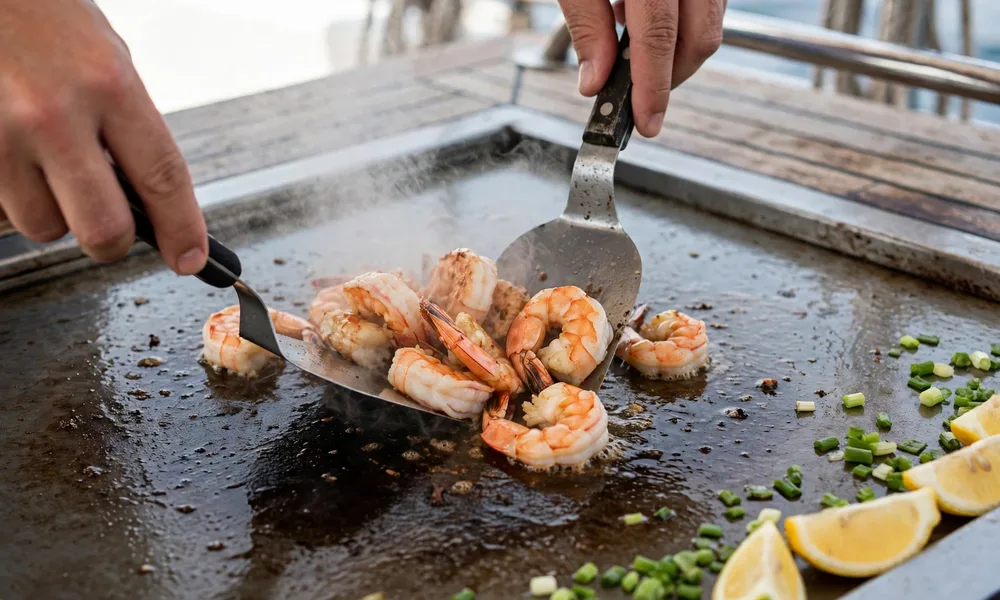
6. The chef, and a grill built around one person
The last cost is the chef. A yacht teppanyaki grill is built around the person who will cook on it: the plate height, the counter depth, and the seat positions are set for one chef and one party, and a guest chef who is taller or shorter works around it. The grill is a stage, and the stage is built for its performer.
The fitting is typically estimated at $5,000 to $15,000, including the counter, the stools, and the chef’s station. The cost comes from the custom work: nothing at a yacht teppanyaki counter is off the shelf, because no two yachts have the same deck, the same party size, or the same chef. A restaurant grill serves a schedule; a yacht grill serves one party at a time.
The Specifications at a Glance
Here are the numbers that matter most on a luxury yacht teppanyaki grill.
| Specification | Typical Luxury Range |
|---|---|
| Plate length | 1.2 to 2.4 metres |
| Plate thickness | 15 to 25 millimetres, stainless steel |
| Cooking temperature | 180 to 250 degrees Celsius |
| Heating zones | 2 to 4 independently controlled zones |
| Power draw | 10 to 20 kilowatts, electric |
| Heat-up time | 15 to 25 minutes from cold |
| Extraction airflow | 1,500 to 3,000 cubic metres per hour |
| Seating per plate | 6 to 10 guests |
What Does a Luxury Yacht Teppanyaki Grill Cost?
A luxury yacht teppanyaki grill is estimated to cost roughly $80,000 to $250,000 installed, depending on size and deck fit-out. A single plate with a hood and counter is estimated at roughly $80,000 to $150,000, while a larger grill with a full counter, extraction, and dining area is estimated at roughly $150,000 to $250,000. A replacement plate alone is estimated at roughly $15,000 to $40,000.
A Rare Fact
A yacht teppanyaki chef times the show to the swell, just like on a ship, but with fewer guests watching. On a rough evening the chef flips and tosses when the deck is level, and the guests, watching the steel plate, rarely notice that the whole deck is moving under them. The plate never moves, and that is the whole trick.

Once you know where the money goes, the price makes sense. The plate is a slab of steel ground flat by hand, the power is a circuit of its own, and the whole grill is built into the yacht around one chef, for one party at a time.


