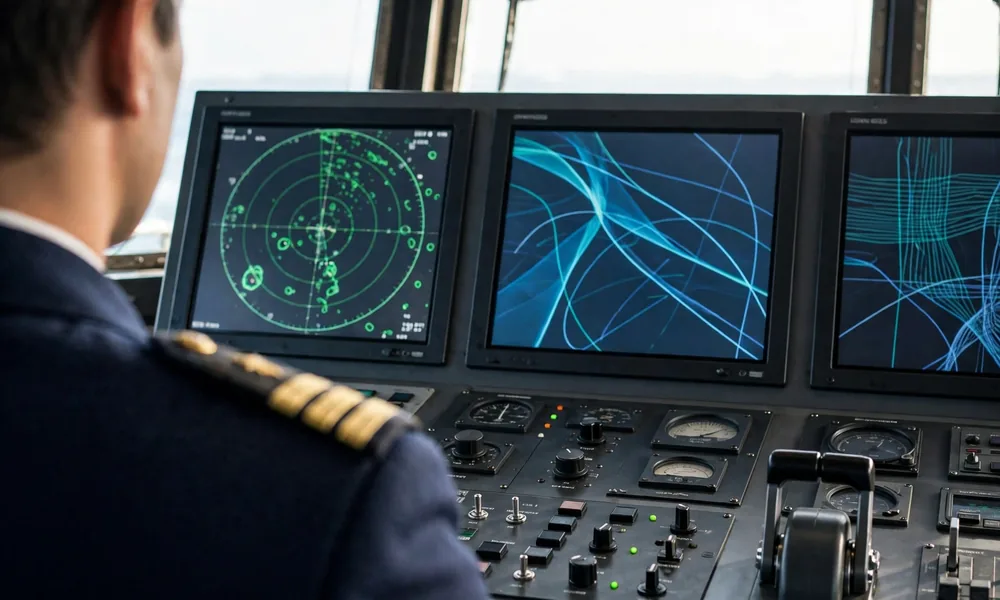
At three in the morning, in rain so thick the sea disappears, a container ship the length of four football fields is moving at twenty knots through a crowded shipping lane. On the bridge, two officers watch a wall of screens that show every vessel for miles around, every shallow patch, every current. The room they stand in is quiet, warm, and calm, and it is the most expensive room on the ship.
A ship’s bridge looks like a control room, but it is really a survival system. It has to keep working through storms, power failures, and fires. Its windows must survive green water crashing over the bow. Its electronics must keep talking to satellites, radar, and the engine room even when everything else goes wrong. And it has to be built so that a tired crew, in the dark, in bad weather, cannot easily make a fatal mistake. That combination of safety, redundancy, and human design is what makes a bridge cost so much.

Why It Costs So Much
The price of a bridge is not the price of its screens. It is the price of everything that keeps those screens alive and trustworthy when the ship is in trouble. A bridge on a large vessel is a sealed, armoured nerve centre, built to rules written in the aftermath of disasters. Every console is duplicated, every system has a backup, and every piece of glass is certified to take a blow that would shatter an ordinary window. The cost comes from that discipline, applied to a room that must never go dark.
The materials
The glass alone tells the story. Bridge windows are laminated, heated, and toughened, built in panes large enough to give a full view of the sea and strong enough to survive a wave breaking over the bow. Each pane is made to order, fitted into a steel frame that flexes with the ship, and heated so it never fogs or ices over.
The consoles are built from marine-grade steel and composites that will not burn, warp, or corrode in salt air. The chairs are designed for twelve-hour watches in heavy weather. Nothing on a bridge is domestic or off-the-shelf. Everything is specified for a room that must survive the worst night at sea and still look the same in the morning.
The labour
Fitting out a bridge is the work of several trades at once, and they have to work in a space no bigger than a large living room. Electricians run kilometres of cable through sealed conduits. Joiners fit the consoles and panelling to millimetre tolerances. Glaziers install windows that weigh hundreds of kilograms each. Instrument technicians calibrate radar, compasses, and steering systems that must agree with each other to the second decimal place.
The work is slow because it is tested as it goes. Every cable is checked, every screen is powered up and run for hours, and every alarm is triggered on purpose to prove it works. The bridge is one of the last parts of the ship to be finished. A bridge crew of specialists can spend months on a single room, and their time is the largest single cost after the electronics.
The rarity
Big-ship bridges are built in small numbers. A shipyard may launch a handful of large vessels a year, and each bridge is designed for one ship, one owner, and one trade. There is no standard bridge to buy in bulk.
The electronics are just as specialised. Marine radar, electronic charts, and dynamic positioning systems are made by a small number of companies, and each installation is configured for the ship it serves. The software is certified, the hardware is type-approved, and the whole package is sold in tiny volumes at prices that reflect years of development. When a bridge is one of a kind, everything in it is priced like a prototype.
The testing
A bridge is tested harder than any other room on the ship. Before the vessel leaves the yard, the bridge team runs failure drills: power cuts, steering failures, radar blackouts, and fires. Each drill must prove that the backup systems take over in seconds and that the crew can still steer the ship from an emergency station.
Then come the sea trials. The ship is taken into open water and put through manoeuvres while the bridge crew checks that every instrument agrees with reality. The radar is compared with what the officers can see. The compass is swung and corrected. The steering is tested at full speed and at a crawl. Sea trials take days and cost a fortune in fuel and crew time, but a bridge that has never been tested at sea is a guess, and no owner will bet a ship on a guess.
The low volumes
Everything about a bridge is low volume. The windows are made to order. The consoles are built one at a time. The software is licensed per ship. The yard cannot spread the cost of designing a bridge across a thousand identical units, because no two large ships are identical. Each bridge carries its full share of design, tooling, and certification, and that share is large.
Low volume also means the knowledge is scarce. The naval architects who lay out a bridge, the engineers who integrate its systems, and the surveyors who approve it are a small group, and their time is expensive. A bridge is not just a room with screens. It is the concentrated work of people who have spent careers learning how ships are actually driven, and that experience is part of the price.
Cost Breakdown
Exact prices are rarely published, so these figures are estimates showing where the money goes.
| Cost area | Estimated share | Estimated cost |
|---|---|---|
| Navigation and radar electronics | 30% | $600,000 – $1,500,000 (estimate) |
| Consoles, joinery, and fitting | 20% | $400,000 – $1,000,000 (estimate) |
| Bridge windows and steelwork | 15% | $300,000 – $750,000 (estimate) |
| Skilled labour and installation | 15% | $300,000 – $750,000 (estimate) |
| Design and systems integration | 12% | $240,000 – $600,000 (estimate) |
| Testing, trials, and certification | 8% | $160,000 – $400,000 (estimate) |
| Total | 100% | $2,000,000 – $5,000,000 (estimate) |
Specifications
| Feature | Typical detail |
|---|---|
| Location | Forward superstructure, highest working deck |
| Windows | Laminated, heated, toughened panoramic glass |
| Main systems | Radar, electronic charts, compass, steering, communications |
| View | Near 360 degrees on a full-width bridge |
| Redundancy | Duplicated power, steering, and navigation systems |
| Crew on watch | Two to three officers and lookouts |
| Build time | Several months of fitting and testing |

A Rare Fact
On a modern bridge, the ship can be steered by a joystick the size of a computer mouse, but the law still requires a traditional wheel as a backup. If every screen and every computer fails, the officer of the watch can still steer by hand, by compass, and by looking out of the window, exactly as sailors did a century ago. To see how the room is used, read how a giant ship is steered from the bridge, inside a superyacht bridge, and why a ship’s rudder costs so much.