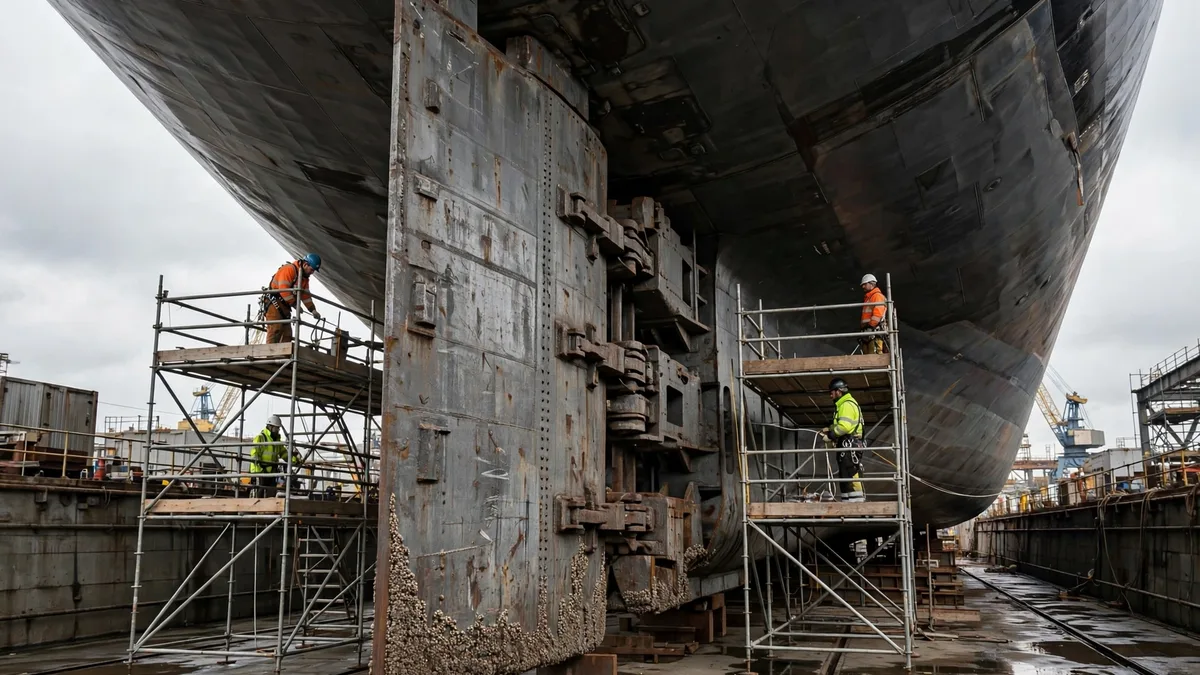
In the dry dock, the ship looks like a building that has been tipped on its side. Scaffolding climbs its hull, welders work in the shadow of its stern, and at the very back, half hidden behind a temporary shelter, hangs a shape that seems too simple for the fuss around it. It is the rudder, a flat steel blade the size of a house wall, and the team working on it treats it like the most important part of the ship. They are right. Without it, the largest vessel ever built is just a floating box that cannot steer.
A ship’s rudder looks simple because its job is simple: turn the water flowing past the hull and push the stern sideways, so the bow swings the other way. Doing that for a ship that weighs a hundred thousand tonnes, in seas that can throw it around, for twenty-five years without failing, is anything but simple. That is why a ship’s rudder is so expensive.
Why It Costs So Much
1. The sheer size of the thing
A rudder on a large container ship or tanker can be ten metres tall or more, with an area of tens of square metres, and it can weigh fifty tonnes or more. It is built from thick steel plate, welded into a hollow box with internal stiffeners, then filled or coated to resist corrosion. The steel alone costs a large sum, and the plate must be cut, rolled and welded to a precise curved shape, because a rudder that is not smooth creates drag and wastes fuel for the life of the ship. Size is the first reason for the price, and it is the most obvious one when you stand underneath it in a dry dock.
2. It carries enormous forces
When a ship turns, the water presses on the rudder with a force measured in hundreds of tonnes. That force is transmitted through the rudder stock, the thick shaft that runs up through the hull to the steering gear, and through the bearings that hold it. The stock is a forging, a single piece of high-strength steel machined to exact dimensions, and it must resist bending, twisting and fatigue for decades. The bearings, often made from specialist polymers or bronze, must allow the rudder to turn smoothly while carrying that load, and they must survive in seawater. Engineering a part that takes that punishment without wearing out is expensive work.
3. The shape is a science, not a guess
A modern rudder is not a flat plate. Its section is shaped like an aerofoil, with a curved profile that generates lift efficiently and a twisted shape that matches the flow coming off the propeller. Some rudders have a bulb on the leading edge, some have a flap on the trailing edge, and some are shaped to recover energy from the propeller slipstream. Each design is tested in a model basin and refined with computer simulations before the full-size rudder is built. Getting the shape wrong costs fuel on every voyage for twenty-five years, so shipowners pay for the research that gets it right.
4. It lives in the harshest place on the ship
The rudder sits behind the propeller, in turbulent, fast-moving water full of sand, debris and cavitation bubbles that can eat steel. It is also the part of the ship most likely to hit something, from a quay wall to floating debris, and the most difficult to inspect. To survive, it is coated with specialist paints, fitted with cathodic protection that sacrifices zinc anodes to save the steel, and inspected in dry dock every few years. The coatings and protection systems are expensive, and the cost of dry-docking a large ship just to reach the rudder adds to the lifetime bill.
5. The steering gear behind it costs as much as the rudder
A rudder is useless without the machinery that turns it. Large ships use hydraulic steering gear, with rams, pumps, motors and a control system that must work even if the main power fails. Regulations require a backup steering system, so there are two independent systems, and the whole installation must be able to turn the rudder from one side to the other in a set time. The steering gear room is a dense forest of hydraulics and electronics, and it is inspected and tested to classification society rules. The rudder and its steering gear are really one system, and they are priced as one.
6. Certification and the cost of failure
Every rudder on a seagoing ship must be approved by a classification society, which reviews the design, witnesses the welding and testing, and surveys the finished rudder in the dry dock. The rules cover the steel, the welding, the bearings, the steering gear and the testing, and they exist because a rudder failure at sea can be catastrophic. A ship that cannot steer in a storm, near a coast, is in grave danger. Owners and builders pay for the surveys, the documentation and the safety margins, because the alternative is a risk no insurer will accept.

Specifications
| Specification | Detail |
|---|---|
| Typical height | 5 to 12 metres on large merchant ships |
| Typical weight | 10 to 60 tonnes depending on ship size |
| Material | Welded steel plate with internal stiffeners |
| Rudder stock | Forged high-strength steel shaft |
| Steering system | Hydraulic rams with independent backup |
| Turn time | From 35 degrees one side to 30 degrees the other in under 28 seconds |
| Protection | Specialist coatings and sacrificial zinc anodes |
| Design life | Typically 25 years with dry-dock surveys |
Price
A ship’s rudder is always part of a larger new-build or repair contract, so there is no retail price, and any figure is an estimate. Industry sources indicate that a large rudder, with its stock, bearings and steering gear, can cost hundreds of thousands of dollars, and for the largest ships the figure can run into the millions once design, classification and dry-dock time are included. The cost is small compared with the price of the ship itself, but it is large for a single steel component, and it reflects the engineering, the materials and the safety systems behind a part that must never fail.

Rare Fact
Some modern rudders have a flap on their trailing edge, like the flap on an aircraft wing, which moves further than the main rudder and gives the ship far more turning power at low speed. These flap rudders, sometimes called Becker rudders, let a large ship manoeuvre in a tight harbour without tugboats, and they are so effective that they can cut the turning circle of a vessel dramatically. The flap is driven by its own linkage inside the rudder, a mechanism that must work perfectly in seawater for years.
The rudder is a reminder that the most important parts of a machine are not always the most glamorous. It is a steel blade in the water, out of sight for most of a ship’s life, and yet it is the part that decides whether a hundred thousand tonnes goes where its captain intends. That responsibility, and the engineering it demands, is what makes it so expensive.
The hull it steers is built as described in how a submarine pressure hull is made, the construction method follows the principles in modular ship construction, and the propeller it works behind is covered in how a ship propeller is produced.


