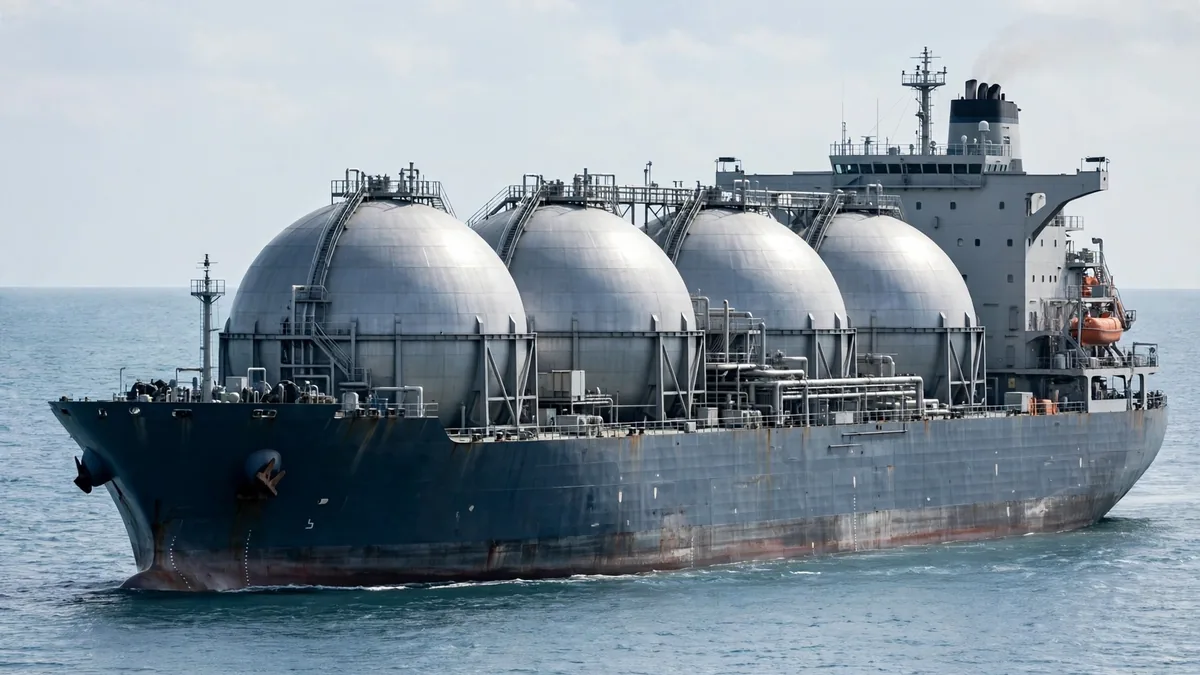
From the deck of a gas terminal, an LNG carrier looks like a floating science experiment. Four enormous silver spheres rise above its hull, each one bigger than a house, each one holding gas so cold it would freeze the air around it. The ship is not carrying ordinary cargo. It is carrying natural gas chilled to minus 162 degrees, shrunk to a six-hundredth of its normal volume, sealed inside tanks that must never, ever warm up.
Those tanks are the reason the ship exists, and they are also the reason it costs so much. A normal cargo hold is a steel box. An LNG tank is a precision cryogenic container the size of a building, built from metals that stay tough at temperatures colder than the Arctic winter, wrapped in insulation a metre thick, and tested until engineers are certain it will not crack, leak, or fail on a month-long ocean crossing.
Why It Costs So Much
An LNG tank is expensive for the same reason a spacecraft is expensive: it has to do something extreme, in a hostile environment, with no chance of repair while it is working. The gas inside is colder than anything the ship will ever meet at sea, and the steel around it is warm. Everything in the tank is a compromise between cold and warm, strong and flexible, sealed and serviceable. Getting that compromise right, four times over, on a ship that flexes in every wave, is one of the hardest jobs in shipbuilding.
The materials
Ordinary ship steel turns brittle at cryogenic temperatures. It would crack like glass if it touched liquid natural gas, so LNG tanks use metals that stay ductile in the deep cold. The most famous is Invar, a nickel-iron alloy that barely shrinks as it cools, used in thin membranes that line the inside of the tank. Other designs use nine-percent nickel steel, aluminium alloys, or stainless steel, each chosen for a different tank shape and each far more expensive than ordinary plate.
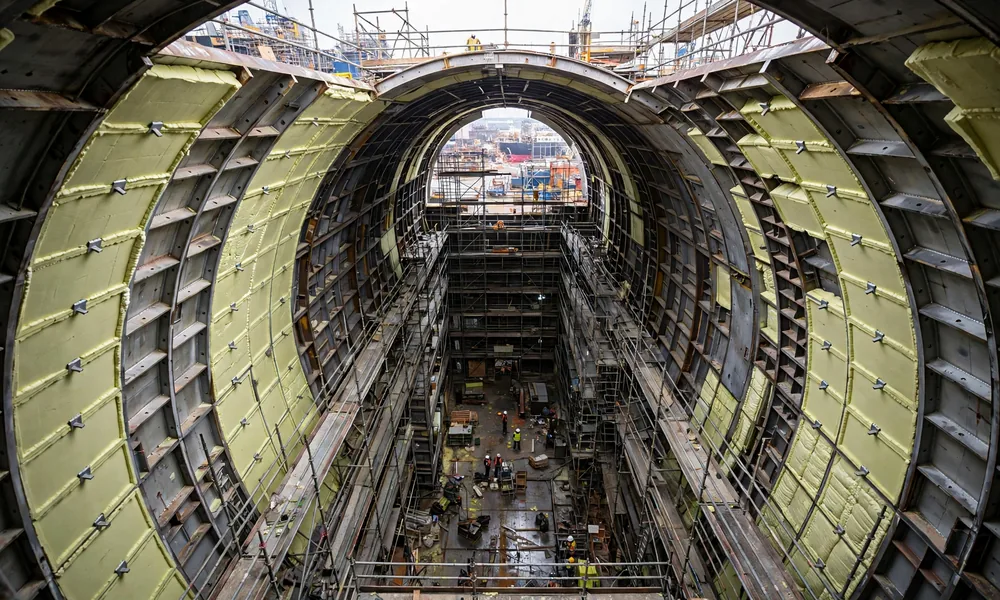
Then there is the insulation. Between the cold cargo and the warm hull sits layer upon layer of insulation, sometimes a metre thick, made from plywood boxes filled with perlite, foam panels, and glass wool. It has to keep the cold in for weeks at sea, because every degree of warming boils off cargo. A gap is a cold spot, and a cold spot is a crack waiting to happen.
The labour
Building an LNG tank is slow, exacting handwork. Welders who work on cryogenic tanks are among the most highly trained in any shipyard. Their welds are X-rayed and tested for leaks with helium, because a flaw the width of a hair can become a failure when the metal shrinks in the cold. Invar membranes are welded in thin sheets, sometimes less than a millimetre thick, by people who have spent years learning not to burn through them.
The insulation is fitted by hand too. Workers lay panel after panel inside a tank the size of a cathedral, checking each joint, sealing each seam, and working in conditions that are cramped, hot, and uncomfortable long before any gas arrives. A single tank can absorb tens of thousands of hours of labour, and the work cannot be rushed.
The rarity
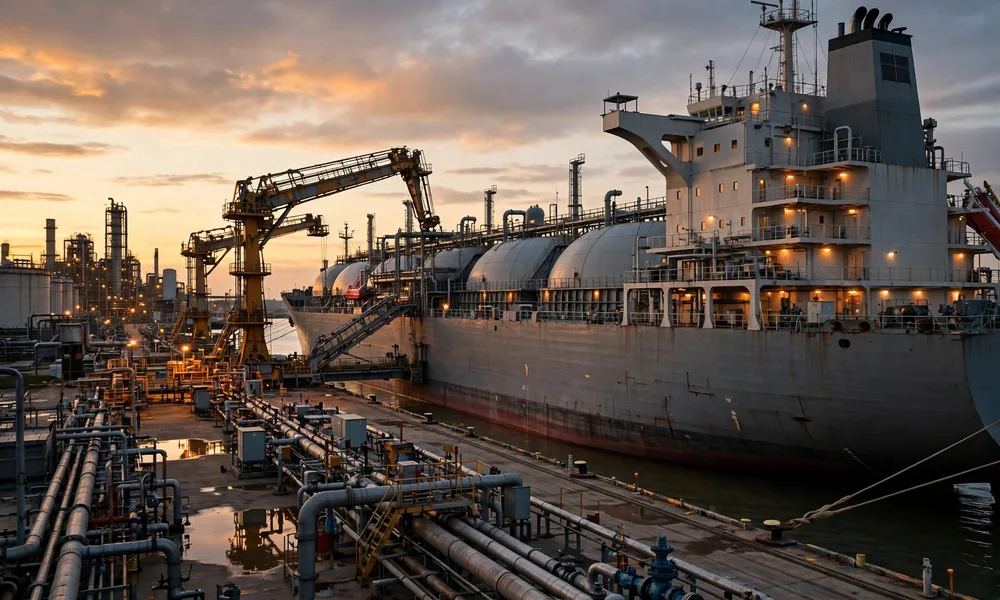
Very few shipyards can build LNG carriers at all. The work needs huge dry docks, cryogenic workshops, specialist welders, and a licence from the handful of companies that own the tank designs. A yard may build only a few LNG ships a year, and each ship carries four or five tanks, so the total number of tanks built worldwide in a year is counted in dozens, not thousands.
That scarcity shapes the price. The design of a membrane tank belongs to its licensor, who charges a fee for every ship. When an entire industry fits inside a few shipyards, there is no competition to push prices down, and no mass production to spread the cost of the design. Each tank pays its full share of a very small, very specialised world.
The testing
Before a tank ever sees gas, it is tested in stages that take months. Welds are inspected, chambers are pressure-tested, and the whole tank is cooled down slowly, degree by degree, while engineers watch for leaks and listen for the tiny pings of metal contracting. A fast cool-down would crack the tank, so the first chill takes days, with a team watching around the clock.
Then the ship goes to sea for trials, and the tanks are filled and emptied while the vessel rolls and pitches. Testing is slow and costly, but it is also the reason LNG carriers have such a strong safety record. Nobody who has watched a tank being cooled down for the first time would ever suggest skipping a step.
The low volumes
LNG tanks are built in low volumes, and low volumes make everything dearer. The nickel steel is ordered for one ship at a time. The insulation panels are cut to fit a single tank. The test equipment is used a few times a year. There is no production line to amortise, no warehouse of spare tanks, and no second-hand market to fall back on.
The low volume also means the knowledge stays concentrated. An LNG tank is not just metal and insulation. It is the accumulated knowledge of a few hundred people, applied to a handful of tanks a year, and that knowledge is billed accordingly.
Cost Breakdown
Exact prices are rarely published, so these figures are estimates showing where the money goes.
| Cost area | Estimated share | Estimated cost |
|---|---|---|
| Nickel steel, Invar, and alloys | 25% | $12,500,000 – $25,000,000 (estimate) |
| Insulation systems | 20% | $10,000,000 – $20,000,000 (estimate) |
| Skilled labour and welding | 20% | $10,000,000 – $20,000,000 (estimate) |
| Design, licensing, and engineering | 15% | $7,500,000 – $15,000,000 (estimate) |
| Testing and cool-down trials | 12% | $6,000,000 – $12,000,000 (estimate) |
| Pumps, piping, and safety systems | 8% | $4,000,000 – $8,000,000 (estimate) |
| Total per ship (4 tanks) | 100% | $50,000,000 – $100,000,000 (estimate) |
Specifications
| Feature | Typical detail |
|---|---|
| Cargo temperature | Minus 162 degrees Celsius |
| Tank types | Spherical Moss tanks or membrane tanks |
| Membrane material | Invar or stainless steel, under 1 mm thick |
| Insulation thickness | Up to 1 metre of layered panels |
| Capacity per ship | About 150,000 to 180,000 cubic metres |
| Boil-off rate | About 0.1% of cargo per day |
| Service life | 25 to 40 years |
A Rare Fact
An LNG tank is so well insulated that the gas inside stays liquid for weeks with no refrigeration at all. The only cooling comes from the cargo itself: a tiny amount boils off each day, and that escaping gas carries heat away, keeping the rest cold. It is a tank that refrigerates itself, built from metal that barely shrinks in the cold and insulation a metre thick, and it works so well that the ship’s biggest problem is not keeping the gas cold but finding a use for the gas that boils away. To see how the whole system fits together, read how LNG carrier tanks work, the hull beneath 20,000 containers, and how an icebreaker hull is made.