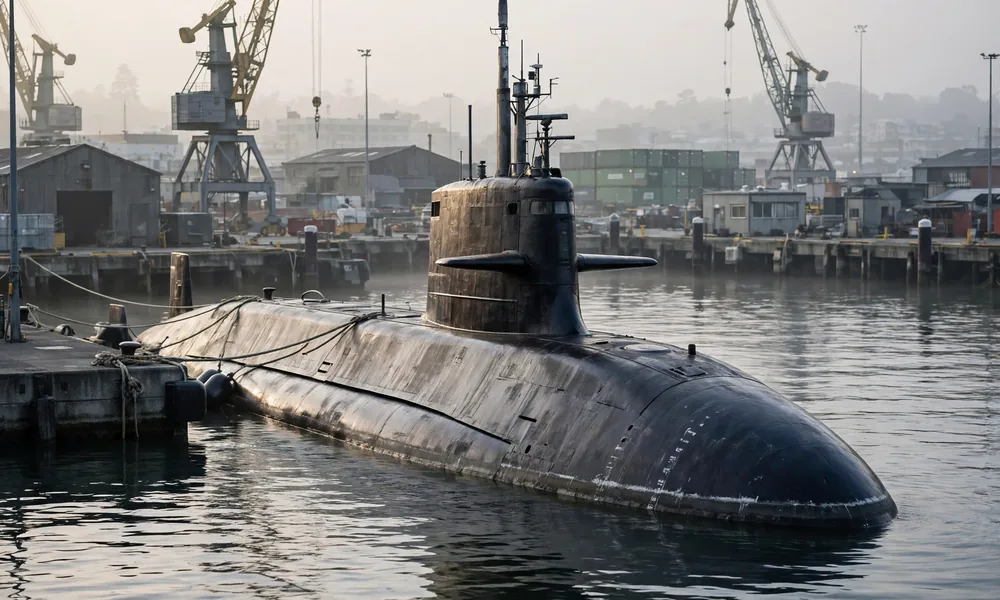
On a grey morning far from any shore, a submarine breaks the surface and a slim mast rises from its sail into the wind. There is no fanfare, no crowd, just a thin column of metal carrying the boat’s only link to the world above. For weeks the crew has lived in silence, cut off from news, from orders, from home. Everything they need to hear, and everything they need to say, must pass through that one mast. If it fails, the boat is deaf and mute in an ocean that does not forgive mistakes.
It looks simple from a distance, a pole with a few aerials on it. Up close it is one of the most demanding pieces of engineering ever put to sea. It must work perfectly while being dunked in salt water, slammed by waves, and pulled down to depths where the pressure would crush an ordinary mast flat. It is designed, built, and tested by a handful of workshops in the world, and its price reflects every one of those facts.

Why It Costs So Much
The price of a submarine communications mast is not set by the metal in it. It is set by everything the metal has to survive, and by how few people in the world know how to make it survive. A mast for a surface ship can be welded up in a week from ordinary steel. A submarine mast has to be watertight at depth, quiet in the water, invisible to detection, and reliable after months without maintenance. Each of those demands adds cost, and they multiply each other.
The materials
The mast itself is built from specialist alloys chosen for strength, corrosion resistance, and silence. Stainless steels and nickel alloys are common, because ordinary steel would rust through in months of salt-water service. Some parts use composites that let radio signals pass through while keeping water out, a trick that takes years of materials research to get right. The seals are just as important as the metal: a single rubber ring, no bigger than a dinner plate, has to hold back the full pressure of the deep sea every time the boat dives.
Inside the mast, the cables and aerials are built to military standards that commercial equipment never meets. Copper is silver-plated to resist corrosion. Connectors are sealed, potted, and pressure-tested. The materials bill alone runs far beyond anything a surface vessel would need, and most of it is ordered in tiny quantities from specialist suppliers who charge accordingly.
The labour
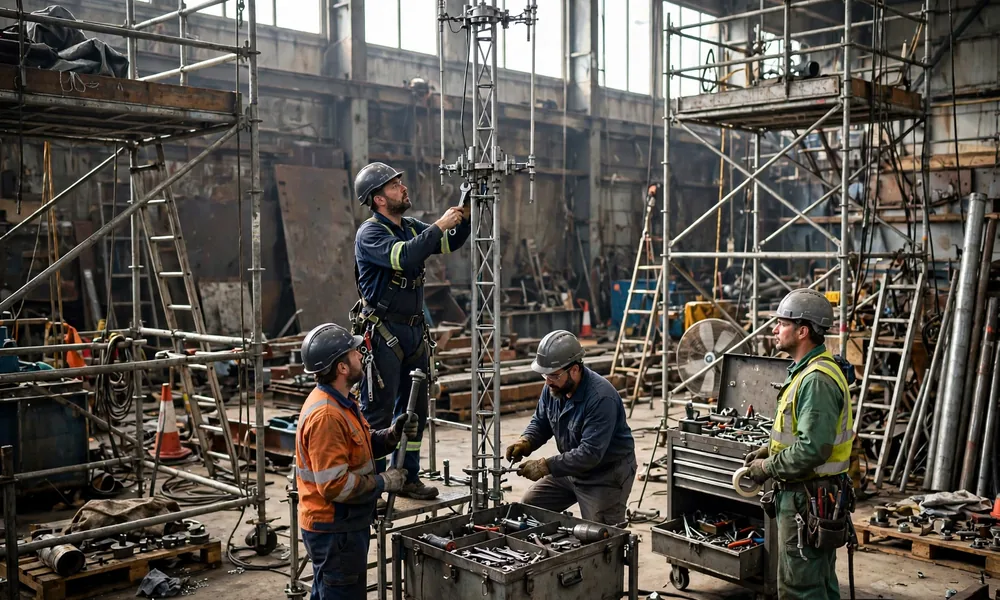
Building a mast like this is slow, skilled handwork. Fitters and welders who are cleared to work on submarine systems spend years learning the trade, and there are not many of them. The aerials are fitted by technicians who tune each one by hand, because a radio aerial that works in a laboratory may behave very differently inside a steel mast surrounded by salt water.
Assembly happens in clean, controlled conditions. That discipline costs time, and time is the most expensive ingredient of all. A single mast can absorb thousands of hours of skilled labour before it ever leaves the workshop, and every hour is charged at the rate of a scarce specialist.
The rarity
Very few masts of this kind are ever built. A country may order only a handful of submarines in a decade, and each boat carries one or two communications masts. There is no mass production to spread the cost of design, tooling, and testing.
The design itself is part of the price. Before any metal is cut, engineers spend years modelling how the mast will behave under pressure, how it will flex in a seaway, and how its aerials will perform when wet. When so few people can do the work, and so few units are ever made, rarity itself becomes the biggest line in the bill. The mast is expensive because almost nobody makes one, and almost nobody needs one.
The testing
Before a mast is fitted to a boat, it is tested harder than almost any other part of the ship. It is pressure-tested in a chamber that recreates the deep sea, cycled again and again to simulate years of diving. It is shaken on vibration rigs, soaked in salt spray, and frozen and baked to prove it will work in any ocean. The aerials are tested in anechoic chambers and then at sea, because a signal that looks fine on paper can vanish in real conditions.
Testing does not stop when the mast is installed. The whole boat goes through sea trials, and the mast is raised and lowered, extended and retracted, in every sea state the crew can find.
The low volumes
Everything about this mast is low volume, and low volume is expensive. There are no economies of scale to soften any of it, and the supplier cannot spread its overhead across a thousand units the way a car-parts maker can. Each mast carries its full share of the factory, the design office, and the test programme, and that share is large.
That is the real answer to the price. It is not one exotic material or one clever trick. It is a whole chain of rare skills, rare materials, and relentless testing, applied to a part that is built in tiny numbers and must never fail. The mast is cheap compared with the boat it serves, and ruinously expensive compared with anything else shaped like a pole.
Cost Breakdown
Exact prices are rarely published, so these figures are estimates showing where the money goes.
| Cost area | Estimated share | Estimated cost |
|---|---|---|
| Specialist alloys and composites | 15% | $150,000 – $400,000 (estimate) |
| Aerials, cables, and sealed electronics | 20% | $200,000 – $600,000 (estimate) |
| Skilled labour and assembly | 25% | $250,000 – $750,000 (estimate) |
| Design and engineering | 20% | $200,000 – $600,000 (estimate) |
| Pressure, vibration, and sea testing | 15% | $150,000 – $450,000 (estimate) |
| Seals, fittings, and spares | 5% | $50,000 – $150,000 (estimate) |
| Total | 100% | $1,000,000 – $2,950,000 (estimate) |
Specifications
| Feature | Typical detail |
|---|---|
| Purpose | Radio, satellite, and sensor links while surfaced or at periscope depth |
| Main structure | Specialist stainless and nickel-alloy mast, pressure-sealed |
| Height | Several metres above the sail when fully raised |
| Operation | Raised and lowered hydraulically from inside the boat |
| Sealing | Multiple pressure seals rated for full diving depth |
| Environment | Salt water, high pressure, vibration, and extreme temperatures |
| Service life | Decades, with periodic overhaul in dry dock |
A Rare Fact
A submarine’s communications mast is one of the few parts of the boat that must be both watertight and radio-transparent at the same time. Some sections are built from composites that are strong enough to hold back the sea yet let radio waves pass through as if the wall were not there. It is a wall that stops water and lets signals through, built by hand and trusted with the only voice a submarine has. To understand the wider boat it serves, read how a submarine communications mast works, the submarine sonar array specs, and how a submarine pressure hull is made.


