In the dark water beneath a submarine, sound is everything. There is no light to see by, no radar that works through seawater, and no window onto the ocean around the hull. A submarine listens its way through the world, and the ears it listens with are a sonar array: a curved wall of hundreds of sensitive ceramic elements mounted in the bow, wrapped around the hull, and trailed behind the boat on a cable. It is one of the most extraordinary listening devices ever built, and one of the most expensive pieces of equipment on any warship.
Ask what a sonar array costs and the answer is never simple, because a sonar array is not one thing. It is a system of hydrophones, amplifiers, cables, processors and software, all of which must work perfectly in crushing pressure, salt water and total silence. The price reflects that reality.

1. Thousands of Hydrophones, Each One Handmade
At the heart of the array are the hydrophones: ceramic discs that turn tiny pressure changes in the water into electrical signals. A modern bow array can hold hundreds or even thousands of them, arranged in precise patterns so the system can tell not just that a sound exists, but exactly where it came from. Each hydrophone is a piece of piezoelectric ceramic, cut, polished and wired by hand, then sealed against salt water for decades of service. The sheer number of precision parts, each one made in small batches, is the first reason the price climbs so high.
2. Silence Is Engineered In, at Great Cost
A sonar array is useless if the submarine itself is noisy, so the array and everything around it is designed to be silent. The elements sit behind a rubberised dome that lets sound in but keeps the flow of water smooth, and the array is mounted on rubber isolators that stop vibrations from the hull reaching the sensors. Even the cables are routed to avoid humming, buzzing and rattling. Building a machine that hears a whisper from miles away while sitting on top of a nuclear reactor, pumps and propellers is an engineering contradiction, and resolving it takes custom materials, endless testing and redesigns that cost a fortune. The silence is not a feature; it is the product.
3. The Dome: A Window That Must Not Break
Covering the bow array is the sonar dome, a huge curved shell that must be transparent to sound, strong enough to survive deep water pressure, and tough enough to take a collision with debris. It is made from special rubber and composite materials, shaped in moulds the size of a small house, and fitted to the hull with seals that must never leak. The materials are exotic, the moulds are one-off, and the fitting is done by specialists in a dry dock with the whole submarine out of the water. The dome alone can cost as much as a small ship, and it is only the cover.

4. Signal Processing: Hearing a Whisper in a Storm
Raw sound from the ocean is a mess: waves, rain, marine life, distant shipping and the submarine’s own machinery all arrive at once. Turning that noise into a clear picture takes powerful processors running beamforming software that combines the signals from hundreds of hydrophones, steering the array’s attention like a searchlight. The computers must work in real time, inside a steel tube, with limited power and cooling, and they must never crash. The software is written by small teams of specialists over years, tested at sea again and again, and updated for every new class of boat. It is bespoke code for a bespoke machine, and bespoke code is never cheap.
5. Testing Takes a Swimming Pool and a Sea Trial
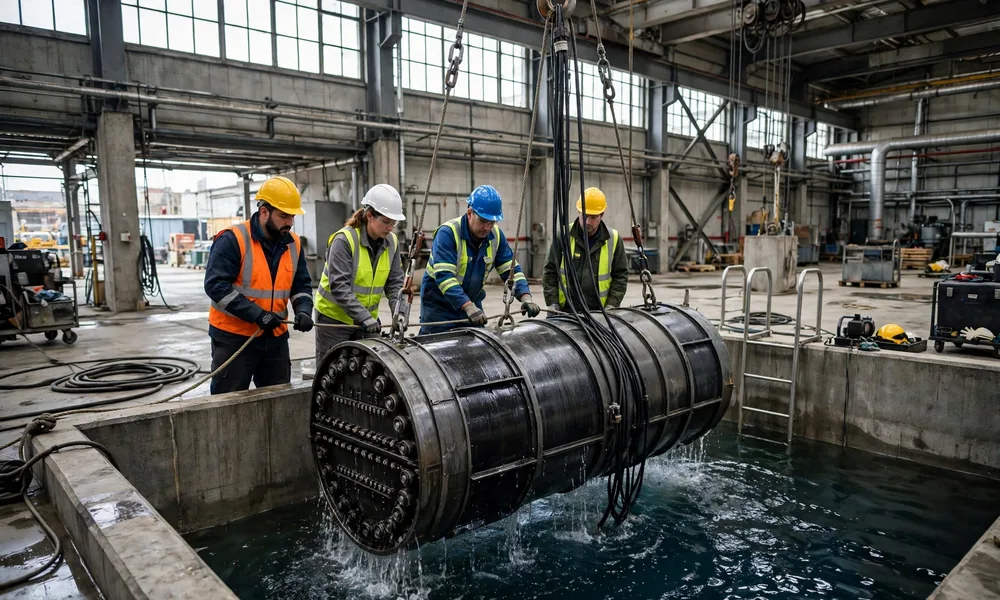
No sonar array is trusted until it has been tested, and testing is a production in itself. Individual elements are checked in acoustic test tanks, where calibrated sound sources measure their sensitivity. The assembled array is lowered into a water tank for full checks, then fitted to the submarine and taken to sea, where the boat runs trials against target vessels while engineers listen and adjust. The testing regime is one of the biggest hidden costs in the whole programme, and it is also the reason the arrays work when they are needed most.
6. Only a Handful of Yards Can Build One
There are very few shipyards in the world that can build a submarine sonar array, and even fewer that can build a good one. The skills — ceramic fabrication, acoustic engineering, deep-water sealing, quiet mounting — live in small teams that have worked together for decades, and the facilities, from the test tanks to the dry docks, cost billions to build and maintain. Each array is effectively a one-off, priced like a one-off, and the yards that build them charge accordingly. Rarity, in this case, is not a marketing word; it is a fact of the supply chain.
Submarine Sonar Array at a Glance
| Specification | Detail |
|---|---|
| Main sensor | Piezoelectric ceramic hydrophones, hundreds to thousands per array |
| Array locations | Bow sphere or cylinder, hull flanks, towed array behind the boat |
| Sonar dome | Rubber and composite shell, transparent to sound, pressure rated |
| Detection range | Tens of kilometres for loud targets, far less for quiet ones (estimate) |
| Operating depth | Rated for the submarine’s full test depth, typically hundreds of metres |
| Signal processing | Real-time beamforming across hundreds of channels |
| Service life | Designed to last the life of the submarine, often 30 years or more |
What Does It Cost?
There is no public price list for a submarine sonar array, and the cost is buried inside the price of the submarine itself, but the scale is clear from the programmes that build them. A modern attack submarine costs roughly 2 to 3 billion dollars (estimate), and its sonar suite is one of the most expensive systems aboard, with the array, dome, processors and software together running into the hundreds of millions of dollars (estimate). The price reflects thousands of handmade sensors, a one-off dome, years of software work and months of sea trials — plus the fact that only a handful of yards on Earth can do the job at all. For a closer look at the hardware itself, see the materials behind a submarine sonar array, and for the optics that work alongside it, the story of how a submarine periscope is made.
A Rare Fact
A submarine’s sonar can hear so well that its operators learn to recognise individual ships by sound alone, the way you might recognise a friend’s voice on the phone. Every propeller has its own rhythm, every engine its own hum, and experienced sonar operators keep mental libraries of the sounds they have heard, matching a distant contact to a ship they may have tracked years before. The most advanced listening device in the navy is, in the end, a very expensive pair of ears — and the people who use them listen for a living. The specifications of a submarine periscope show how much of a boat’s sensing is built around seeing and hearing without being seen.