Two hundred metres below the surface, a submarine runs silent in water so dark that no eye could see a thing. Yet the crew knows exactly what is around them: a freighter passing three miles to port, a whale calling somewhere below, the faint churn of another vessel’s propeller. They know because of the sonar array in the bow — a wall of listening devices that turns the faintest pressure waves in the water into a picture of the world outside.
A sonar array is not one material but a careful assembly of them, each solving a different problem. The hydrophones must turn the tiniest squeeze of water into an electrical signal. The dome in front of them must let sound pass through as if it were not there, while holding back the crushing pressure of the deep sea. The frame must hold hundreds of sensors in perfect position without passing the submarine’s own vibrations into them.
The Materials Behind the Submarine Sonar Array
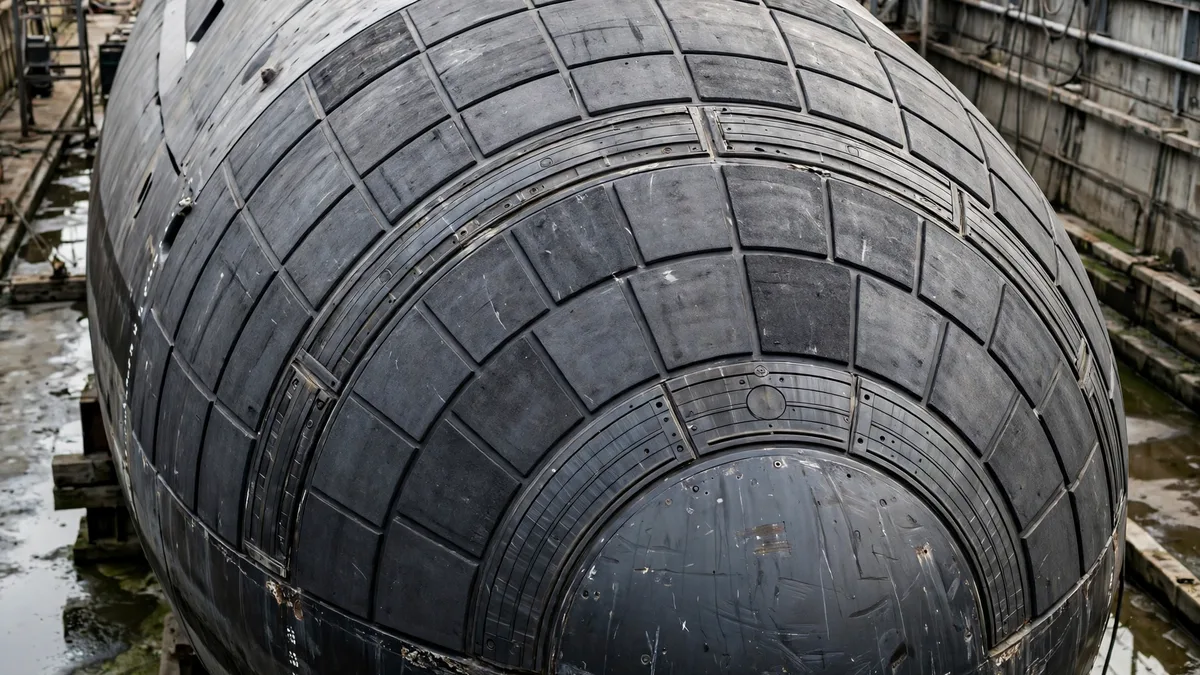
At the heart of the array are its hydrophones: small cylinders of piezoelectric ceramic that generate a voltage when squeezed by a sound wave. Around them sits the acoustic window, a thick dome of specially formulated rubber that is nearly transparent to sound. Behind them, the array structure is built from steel and composites, isolated on mounts that stop the submarine’s own machinery from deafening its sensors.
Step 1: Choosing a ceramic that listens
The first choice is the listening material itself. Most modern hydrophones use lead zirconate titanate, known as PZT — a ceramic that produces an electric charge when it is squeezed, and squeezes when a charge is applied. That two-way trick is what makes it useful: the same ceramic can listen for sounds and, in active sonar, send out a ping. Engineers choose PZT because it is sensitive, stable under pressure, and keeps its properties across the cold temperatures of deep water.
Step 2: Building the hydrophone
A hydrophone starts as a small cylinder or sphere of PZT, coated with silver electrodes on its inner and outer surfaces. When a sound wave presses on the ceramic, the electrodes pick up the tiny voltage it generates — often only millionths of a volt. The element is sealed in polyurethane, a tough rubbery plastic that keeps salt water out while letting sound pass through almost unchanged.
Step 3: The acoustic window
In front of the hydrophones sits the acoustic window: the dome at the very bow of the submarine. It is made from a specially compounded rubber, chosen because its density and stiffness closely match those of seawater, so sound waves pass from water into rubber and back again with almost no reflection. The dome is filled with water or oil to keep its pressure balanced with the sea outside, and it must stay flexible and watertight at depths where the pressure reaches dozens of times that at the surface. A dome that reflects sound, or that leaks, blinds the whole array.
Step 4: The frame, baffles and mounts
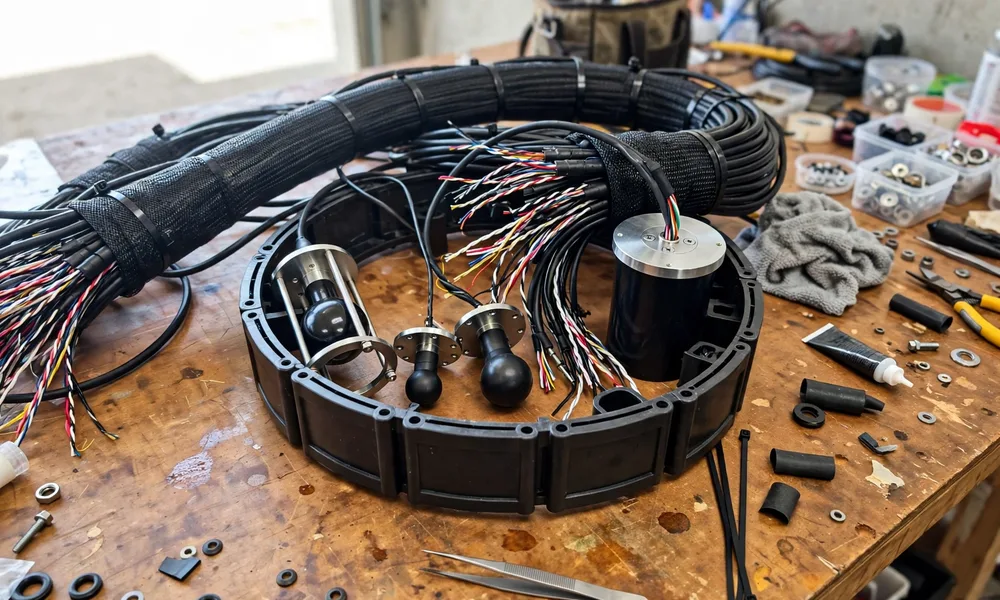
Behind the dome, the hydrophones are mounted on a rigid frame of steel and composite, arranged in precise rows so that the signals from hundreds of elements can be combined to work out the direction a sound came from. Baffles of sound-absorbing material sit behind the array to block noise coming from the submarine itself, and the entire assembly hangs on decoupling mounts — rubber and spring isolators that stop the rumble of pumps and motors reaching the sensors. Building it is slow, skilled work, and inside the submarine sonar array production line every element is positioned, wired and tested by hand.
Step 5: Cabling under pressure
Every hydrophone needs a cable, and those cables face the same hostile environment as the sensors. They are jacketed in polyurethane, which resists salt water, abrasion and the chemicals in the sea, and many are oil-filled so that pressure cannot crush them. Connectors are machined from stainless steel or titanium and sealed with multiple O-rings, because a single leak can short out a whole section of the array.
Step 6: Testing in the tank
Before an array goes anywhere near a submarine, it is tested in an acoustic tank — a large pool of still water where engineers can play known sounds at it and measure exactly what each hydrophone hears. Every element is calibrated for sensitivity and checked for dead spots, and the array is tested as a whole to confirm it can point at a sound source accurately. The testing is painstaking, because a fault found at sea cannot be fixed without dry-docking the boat. This is where the theory of how a submarine sonar array works meets the reality of hundreds of individual sensors that must agree with each other to within a fraction of a decibel.
Step 7: Fitting the array and sea trials
The finished array is installed in the bow during construction or refit, the dome sealed and flooded, and the whole system connected to the submarine’s sonar processing computers. Then come the sea trials: the boat dives, runs quiet, and listens. Engineers compare what the array hears against known targets — a support ship at a measured distance, a calibrated sound source lowered from the surface — and fine-tune the processing. Only when the array can pick out a faint contact from the background roar of the ocean is it signed off. The same care that goes into a submarine propeller applies here, because a sensor that cannot hear is as useless as a propeller that cannot push.
Submarine Sonar Array at a Glance
| Specification | Detail |
|---|---|
| Hydrophone material | Lead zirconate titanate (PZT) piezoelectric ceramic |
| Hydrophone sealing | Polyurethane encapsulation with silver electrodes |
| Acoustic window | Sound-transparent rubber dome, water or oil filled |
| Array structure | Steel and composite frame on decoupling mounts |
| Cable jacket | Oil-filled polyurethane, pressure-resistant |
| Number of elements | Hundreds of hydrophones in a bow array |
| Operating environment | Salt water at full submarine diving depth |
What Does It Cost?
A modern bow sonar array is one of the most expensive single systems on a submarine, costing tens of millions of dollars (estimate) as part of the boat’s sensor fit, while a single replacement hydrophone element can cost several thousand dollars (estimate). The price reflects hand assembly, precision calibration and weeks of tank testing, not the raw materials: the ceramic and rubber themselves are modest in cost, but turning them into an array that can hear across an ocean is not. A damaged dome or a flooded cable run can cost millions (estimate) to repair, which is why the array is protected, tested and handled like the delicate instrument it is.
A Rare Fact
A submarine’s sonar array is so sensitive that it can hear rain falling on the sea surface from far below — and experienced operators can tell a distant ship’s identity from the rhythm of its propeller alone, the way you might recognise a friend’s walk from down the hall. The array listens so well, in fact, that its own submarine is its worst enemy: the crew must run quiet, shutting down pumps and machinery, because the sensors will faithfully report every rattle and hum the boat itself makes. The most advanced listening device ever built spends much of its life trying not to hear its own home.