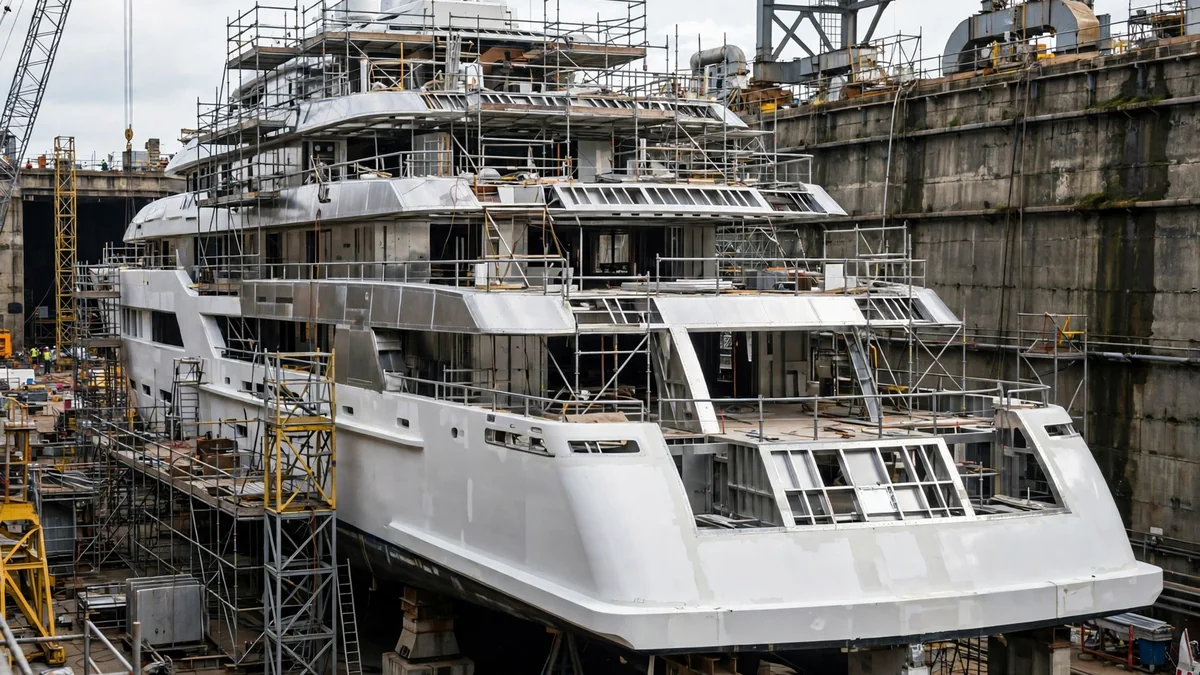
Stand on a shipyard quay and look up at a superyacht under construction, and the first thing you notice is how much of it is not hull. Rising above the waterline is the superstructure: the gleaming white tiers of decks, windows, and overhangs that hold the saloons, the cabins, the bridge, and the sun decks. On a modern superyacht, that whole upper world is usually made of aluminium, and building it is one of the most demanding metalworking jobs on earth.
Aluminium is chosen for a simple reason: it is light. A steel superstructure of the same size would weigh far more, raising the yacht’s centre of gravity and making it roll in a seaway. Aluminium keeps the weight up high to a minimum, which keeps the yacht stable, fast, and fuel-efficient. But aluminium is also unforgiving. It warps when welded, it cracks if it is worked wrong, and it demands a fairness — a smoothness of surface — that owners will judge with their fingertips.
The superstructure is built like a building and finished like a piece of furniture. Huge plates are cut, bent, welded, faired, and painted until a structure the size of a house looks like it was carved from a single block. This is how it is made.
How It Is Made
Step 1: Cutting the aluminium plate
It begins with plate: sheets of marine-grade aluminium alloy, usually 5083 or 5383, chosen because they resist seawater corrosion and weld well. The plates arrive in sizes up to several metres across and are cut by computer-controlled plasma or laser cutters following digital drawings, each piece numbered and marked for its place in the structure. Curved sections are rolled or pressed into shape, and every cut edge is cleaned and prepared for welding, because aluminium oxidises within minutes of being exposed to air, and welds made through that oxide layer are weak. The cutting is so precise that pieces fit together with gaps of a millimetre or less.
Step 2: Welding the structure
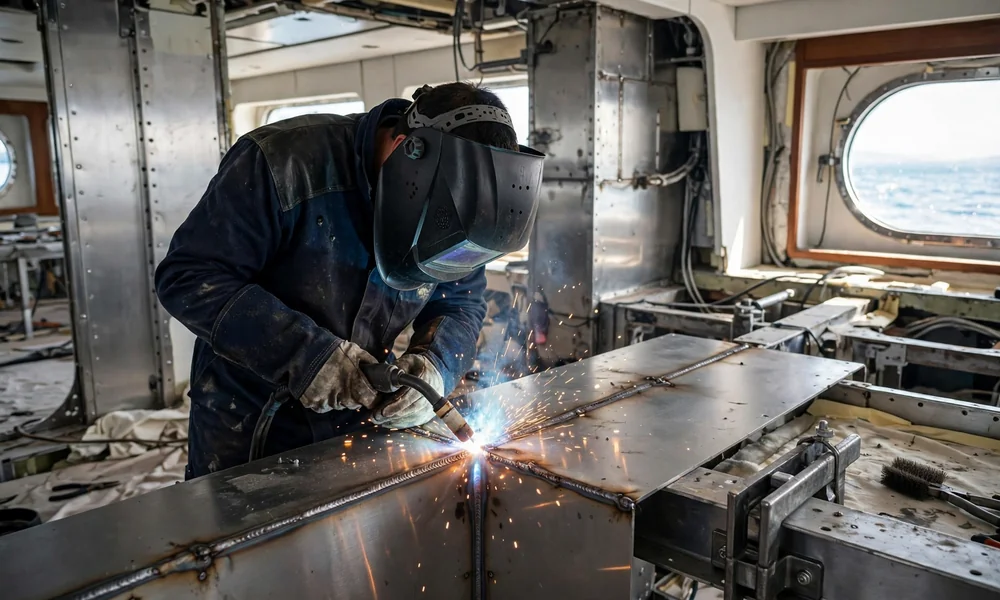
Welding aluminium is nothing like welding steel. The metal melts at a lower temperature but conducts heat away far faster, so welders use tungsten inert gas or metal inert gas welding with argon shielding to keep oxygen away from the molten metal. The superstructure is assembled in sections — deck by deck, bulkhead by bulkhead — on jigs that hold everything true while it is welded. Heat is the enemy: every weld shrinks as it cools, pulling the plate out of shape, so welders work in a planned sequence, balancing welds on opposite sides to keep the structure fair. The welders who do this work are among the most skilled in any industry, and their welds are tested by ultrasound and X-ray, because a flawed weld in a superstructure is a flaw in the yacht itself. The same battle against heat distortion shapes the hull below, as told in how a superyacht steel hull is made.
Step 3: Fitting the superstructure to the hull
Once the main sections are welded, the superstructure is lifted by crane and lowered onto the hull, where it is aligned and welded into place. This is one of the most dramatic moments in a yacht build: a structure weighing tens of tonnes, holding the bridge and the owner’s deck, hanging from a crane while fitters guide it onto its mounts. The join between hull and superstructure is critical, because the two flex differently at sea, and the connection must be strong enough to hold them together for decades of waves.
Step 4: Fairing the surfaces
A welded aluminium structure is strong, but it is not smooth. Every weld leaves a ripple, and every plate has a slight unevenness, so the next stage is fairing: the long, labour-intensive process of making the surface perfect. Fairing compound is applied by hand, sanded back, applied again, and sanded again, in a cycle that can take weeks for a large yacht. Long straightedges and raking lights reveal every hollow and bump, and the fairers chase them until the surface is flawless. The deck spaces the superstructure shelters are finished with equal care, including the open-air areas described in how a superyacht beach club is made.
Step 5: Painting and glazing
With the surface fair, the superstructure is painted — usually in multiple coats of primer, colour, and clear coat, each one sanded between coats, until the finish has the depth of a mirror. Superyacht paint is applied in climate-controlled halls, because dust in the air becomes a flaw in the finish. Then comes the glazing: huge panels of laminated glass, some curved, some flat, are bonded into the window openings with structural adhesive and sealed against the sea. The result is the yacht’s face: long bands of dark glass set into white aluminium.
Step 6: Fitting out the interior
The last stage is fitting out. Inside the aluminium shell, insulation, wiring, plumbing, and air conditioning are installed, then the joinery — the wood-panelled saloons and cabins that define a superyacht’s luxury — is fitted piece by piece. The bridge, with its navigation systems, is installed at the top of the superstructure, and the exterior decks are finished with teak or synthetic decking. By now the superstructure is no longer a metal shell but a floating home, and the final weeks are spent on sea trials, where the yacht is tested for speed, stability, and noise. What the superstructure does for the people on board is explored in how a superyacht aluminium superstructure works, where the design choices behind the shape are explained.
Specs
| Specification | Typical value |
|---|---|
| Alloy | Marine-grade aluminium 5083 / 5383 |
| Typical plate thickness | About 5–12 mm |
| Welding methods | TIG and MIG with argon shielding |
| Weight saving vs steel | About 60 percent lighter for the same structure |
| Typical superstructure weight | Tens of tonnes on a 50 m yacht |
| Paint system | Primer, colour, clear coat, sanded between coats |
| Glazing | Laminated structural glass, bonded |
| Build time for the structure | Several months |
What Does It Cost?
A superyacht aluminium superstructure is never priced on its own, because it is part of a yacht that costs tens of millions. A 50-metre superyacht typically costs an estimated $30–$60 million, and a 100-metre yacht can exceed $200 million, and those are approximate prices for the whole vessel. The superstructure accounts for a meaningful share: the aluminium itself, the skilled welding, the weeks of fairing, and the mirror paint finish all add up, and the labour alone runs into thousands of hours. Refit work gives a sense of scale — repainting a large superstructure is estimated at roughly $500,000–$2 million, an estimate that varies by yacht size and paint system. The structure is expensive because it is, quite literally, the face of the yacht.

A Rare Fact
Here is the detail most people miss: aluminium and steel expand at different rates as they warm up, and a superyacht’s aluminium superstructure sits on a steel hull that moves differently in the sun. The joint between them has to absorb that movement for the yacht’s whole life, which is why it is engineered with flexible connections and careful detailing rather than a simple rigid weld. On a hot day in the Mediterranean, the superstructure can grow several millimetres longer than the hull beneath it — and the yacht is designed to let it, silently, without a crack or a creak.


