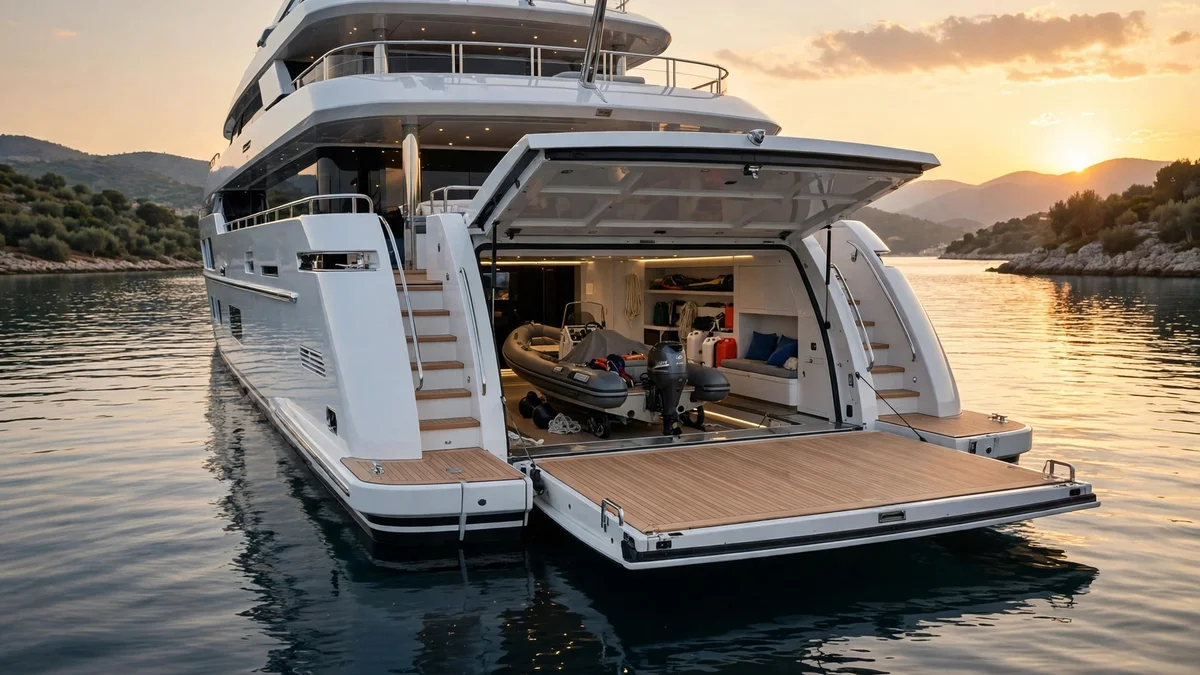
Picture a superyacht anchored off a quiet island, the sun low and the water flat. From the stern, a section of the hull opens like a secret door, and a small boat slides out on rails, floats free and speeds away toward the beach. That small boat is the tender, the yacht’s car, and the garage it lives in is one of the most expensive rooms on the whole ship — a watertight compartment inside a moving vessel that must open to the sea, swallow a boat whole, and close again without letting a drop of water into the yacht.
A tender garage sounds like a luxury, and it is, but it is also a feat of engineering that would defeat most shipyards. It has to hold a boat weighing several tonnes, launch it in rough water, dry it, refuel it and store it safely while the yacht crosses oceans. Owners rarely see the garage working; they only notice when it fails, and the bill for building one that never fails is enormous.
Why It Costs So Much
A garage on land is a box with a door. A tender garage is a box inside a ship that must survive the sea trying to get in, the yacht rolling in a swell, and a heavy boat moving around inside it. Every part of the design answers a problem that a normal garage never faces.
Reason 1: The door opens to the ocean
The garage door is a section of the hull itself, and it must seal perfectly when closed yet swing or slide open at sea to launch the tender. Its seals, hinges and hydraulics are built to withstand waves slamming against them at speed, and a failure would flood the stern of the yacht. The door alone is a piece of marine engineering that costs as much as a small house, and it is tested again and again before the yacht is delivered.
Reason 2: Launching a boat from a moving ship
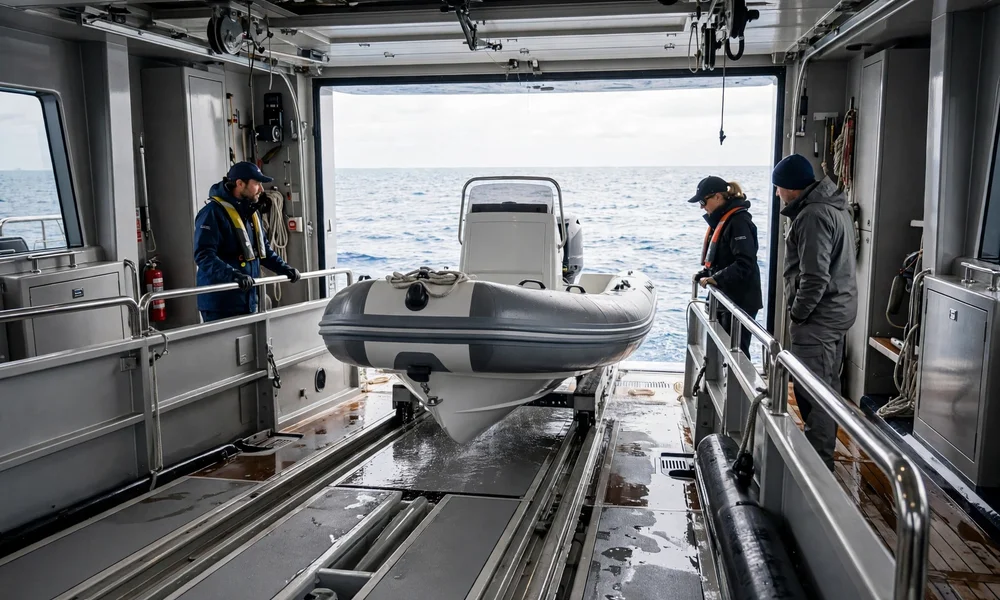
Getting the tender out is a choreographed operation. The boat sits on a cradle or rails, and a hydraulic system slides it out over the water, lowers it, and releases it — all while the yacht may be rolling in a swell. Some garages flood partially to float the tender out; others use a davit or a submersible platform. Every mechanism must work flawlessly with a multi-tonne boat swinging above open water, and the crew operating it are standing on a wet deck at the stern of a moving ship.
Reason 3: Everything inside is waterproof, including the yacht
The garage is a watertight compartment, separated from the rest of the yacht by bulkheads and doors that can be sealed in an emergency. Its floor drains to the sea, its electrics are sealed against spray, and its ventilation must clear exhaust fumes from the tender’s engine without letting seawater in. Building a room that is both part of the ship and isolated from it takes careful naval architecture, and the steel or aluminium structure around it is heavier and more complex than an ordinary hull section. The hull itself is already a marvel, as the journey from steel plate to superyacht hull shows, and the garage is the most complicated part of it.
Reason 4: The tender itself is a small yacht
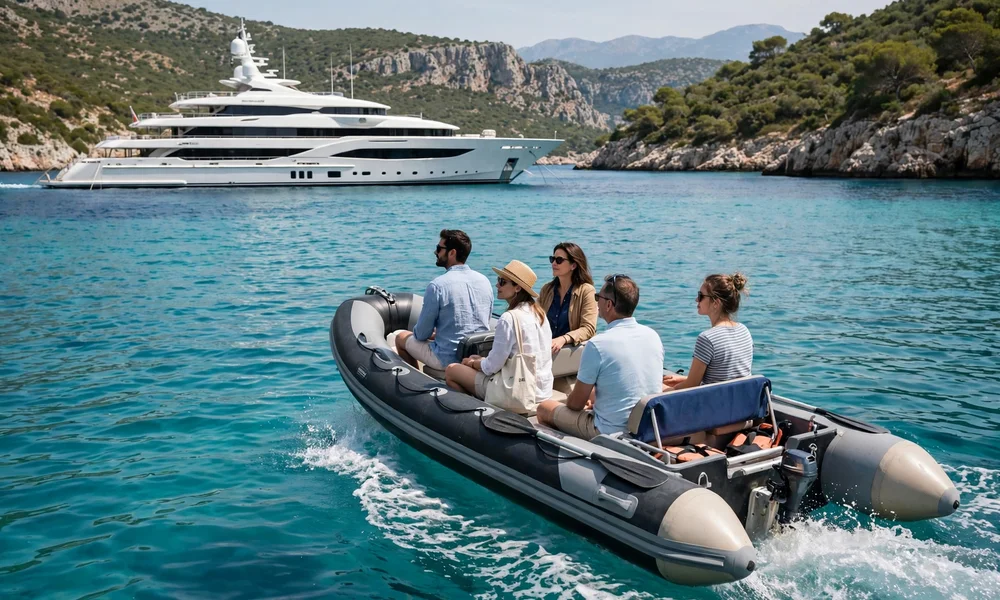
A superyacht tender is no dinghy. It is often a custom-built boat, six to ten metres long, with a powerful engine, seating for a dozen guests, and a price that can reach hundreds of thousands of dollars. Some owners carry two tenders, plus jet skis and diving gear, all of which must fit, be secured and be launched from the same garage. The garage is therefore designed around the tender, not the other way around, and changing the tender later can mean rebuilding the garage.
Reason 5: Storage for everything the tender needs
Fuel, spare parts, fenders, lines, diving tanks, water toys — the garage stores all of it, in a space that is already tight. Fuel must be stored safely away from ignition sources, with ventilation and fire suppression. Everything must be lashed down so it cannot move in heavy weather, and the crew must be able to reach it all in a space barely taller than a person. Fitting that much function into a compartment inside a hull is a puzzle that takes months of design.
Reason 6: It must work in heavy weather
A tender garage that only works in a flat calm is useless. The systems are designed to launch and recover the tender in a swell, with the yacht rolling and pitching, which means stronger hydraulics, wider tolerances and more powerful winches than a fair-weather design would need. Keeping a yacht steady while all of this happens is its own discipline, and gyroscopic stabilizers are part of why modern yachts can launch tenders in conditions that would have been impossible a generation ago.
Reason 7: The space costs the yacht somewhere else
Every cubic metre given to the tender garage is a cubic metre taken from cabins, the engine room or storage. On a yacht, space is the most valuable thing there is, and the garage competes with guest suites for it. Designing the stern so that the garage, the beach club and the engine room all fit together without compromising any of them is a three-dimensional puzzle, and the solution is always a compromise that costs money to make work. The yacht’s own hull construction sets the limits, as superyacht hull construction explains.
Specifications
| Specification | Detail |
|---|---|
| Tender length | Typically 6 to 10 metres |
| Tender weight | Several tonnes, depending on size and engine |
| Garage door | Hydraulic hull section, watertight when closed |
| Launch system | Rails and cradle, or floodable dock, or submersible platform |
| Compartment | Watertight, with sealed bulkheads and drainage to sea |
| Storage | Fuel, spares, fenders, diving gear, water toys |
| Fire protection | Suppression system and sealed fuel storage |
| Operation | Designed to launch and recover in a swell |
Price
A custom tender alone can cost $200,000 to $1 million or more (estimate), and the garage that houses it — the hull door, hydraulics, rails, watertight compartment and fire systems — adds a substantial sum on top, often estimated at several hundred thousand dollars as part of a new-build yacht (estimate). On a large superyacht the combined cost of tender, garage and launch systems can comfortably exceed $1 million (estimate). It is a price owners pay without hesitation, because a yacht that cannot put its guests ashore is a yacht that cannot do its job.
Rare Fact
Some of the largest superyachts carry tenders so big that the garage has its own side door for loading them, and the tender itself can be larger than the yacht that many people first learn to sail on. A few yachts even carry a second, smaller tender inside the first one’s garage, like a set of Russian dolls built for the sea.
That is why a superyacht tender garage costs so much: it is a dry dock, a boat lift, a fuel store and a watertight vault, all hidden inside the stern of a ship, expected to open to the ocean and close again without a leak. The tender slides out, the guests step ashore, and nobody sees the engineering that made it look easy. That is the point.


