Stand behind a supercar at a track day and you will notice the exhaust tips before anything else. They are not chrome, and they are not painted. They shimmer blue, gold and violet, like oil on water, and they look like something from a laboratory rather than a car part. That is a titanium exhaust system, and it can cost as much as a small used car — ten or twenty times the price of a steel one that does the same basic job.
The difference is not the shape. A titanium exhaust follows the same path under the car, carries the same gases and makes a similar sound. The difference is the metal itself and what it takes to turn that metal into pipes. Titanium is light, strong and stubborn: it resists heat that would destroy steel, and it resists every attempt to cut, bend and weld it. The workshops that can work it well are rare, and they charge for the privilege.
Once you know what goes into one, the price stops looking like a fashion tax. A titanium exhaust is a hand-built object made from one of the most difficult metals in common use, welded in an atmosphere of pure argon, finished by hand, and tuned by ear. It is jewellery that happens to carry exhaust gas.

Why It Costs So Much
Reason 1: The metal itself is expensive
Titanium costs far more than steel before anyone touches it. It is abundant in the Earth’s crust, but extracting pure titanium from its ore is a slow, energy-hungry process, and turning it into the thin-walled tubing an exhaust needs adds more cost still. Only certain grades are suitable, and each batch must be certified. A single exhaust system uses several metres of tubing, and the raw material alone can cost hundreds of dollars.
Reason 2: Welding it needs pure argon and rare skill
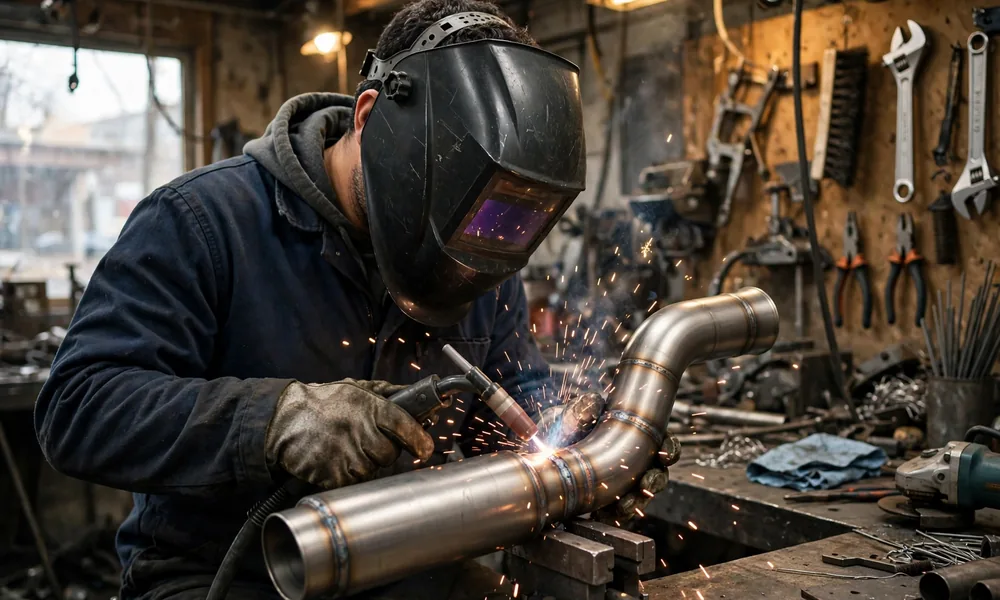
Titanium cannot be welded in open air. Above a certain temperature it reacts with oxygen and nitrogen, turning brittle and weak, so every weld must be shielded with pure argon — on the outside and on the inside of the pipe, a technique called back-purging. The welder works slowly, with a tungsten electrode and a filler rod, watching the molten pool through a dark lens. One lapse in gas coverage ruins the joint. The welders who can do this to motorsport standard are few, and they are paid like the specialists they are. Learning how a titanium exhaust system is made is mostly learning how much of its cost is welding.
Reason 3: Bending it without cracking is an art
Exhaust pipes are full of tight bends, and titanium does not bend like steel. It springs back, it work-hardens, and it cracks if it is forced. Each bend is made on a mandrel bender that supports the inside of the tube so it does not collapse, and the bend radius, wall thickness and alloy must all be matched. A bend that goes wrong wastes a length of expensive tubing, and complex systems need dozens of bends. The jigs and tooling are made for one car model, and the time spent setting them up is charged to a small production run.
Reason 4: The walls are paper-thin on purpose
The whole point of titanium is weight saving, so the walls are made as thin as they can safely be — often under a millimetre. Thin walls save kilograms, but they dent if a tool slips, they are harder to weld without burning through, and they transmit more vibration. Every handling step, from cutting to fitting, has to be gentler than with steel. The weight saved is real — a titanium system can be half the weight of a steel one — but the thinness that delivers it makes every stage of the work slower and more delicate.
Reason 5: The finish is done by hand
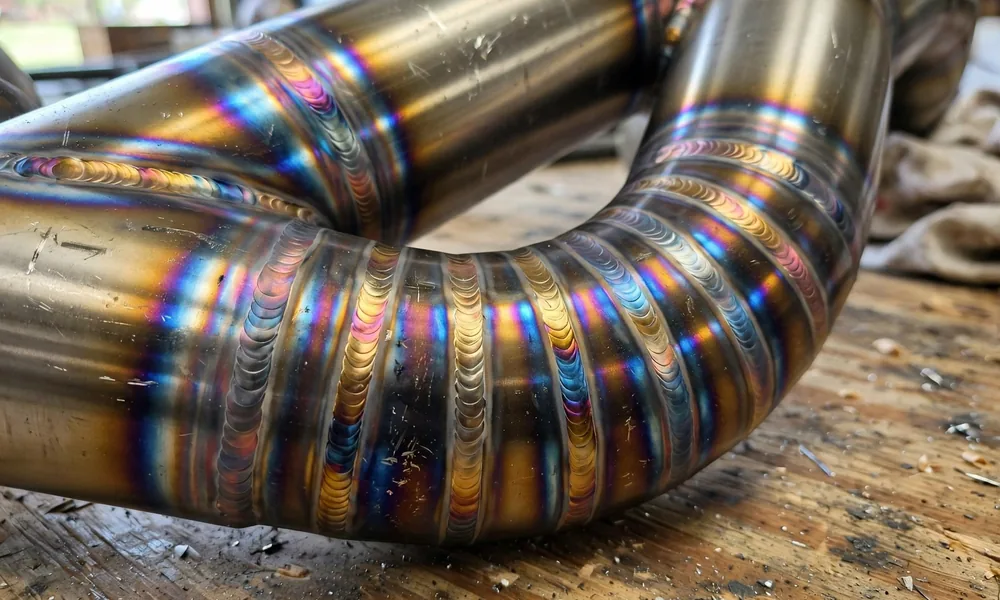
Those blue and gold colours are not paint. They are a thin oxide layer that forms on the titanium as it heats, and the exact shade depends on the temperature. Makers polish the pipes by hand to a finish that shows the colours off, and some systems are deliberately heat-treated to bring the colours out evenly. Hand polishing a full exhaust takes hours, and the result is a finish that no machine can reproduce. Buyers pay for it because it is the visible proof of what the system is made of — the colours only appear on real titanium.
Reason 6: Each system is tuned, not just fitted
A performance exhaust is not only plumbing; it is an acoustic instrument. The pipe diameters, the lengths and the silencer design are tuned to shape the engine’s sound and to keep the back pressure right, and the finished system is tested on a dynamometer. That development work — prototypes, test sessions, revisions — is spread over a small number of cars. A system made for a rare hypercar may sell only a few hundred units, so each one carries a large share of the development cost. The figures in a titanium exhaust system specifications guide are the result of that tuning, not just a list of dimensions.
Specifications
| Material | Titanium, commercially pure grades and Ti-6Al-4V alloy |
| Wall thickness | 0.8 to 1.2 mm, against 1.5 mm or more for steel |
| Weight saving | 40 to 60 percent lighter than an equivalent steel system |
| Max gas temperature | Up to 600 degrees Celsius at the headers |
| Typical system weight | 5 to 9 kg, against 12 to 20 kg in steel |
| Welding | TIG welding under argon shielding with back-purging |
| Finish | Hand-polished, with natural blue and gold heat tint |
| Corrosion | Highly resistant; no coating or rust protection needed |
| Sound | Sharper and higher-pitched than steel, tuned per model |
| Main drawback | Very expensive, thin walls dent easily, repairs need a specialist |
What Does It Cost?
As rough estimates, an aftermarket titanium exhaust for a sports car costs around $2,000 to $8,000, and a factory-fitted titanium system on a hypercar can cost $10,000 to $25,000 or more as an option. Those figures are estimates, not quotes, and they vary with the car, the system length and the maker. The raw titanium is only a fraction of the price; most of it is welding, finishing and the small production run. Understanding how a titanium exhaust system works helps explain why the steel equivalent is so much cheaper — steel is forgiving, titanium is not.
A Rare Fact
Titanium exhausts change colour because of heat, not paint. The blue, gold and violet tints are a thin layer of titanium oxide that grows on the surface as the metal heats, and the colour depends on the exact temperature the metal reached. That is why the tips near the engine are often blue while cooler sections stay silver: the exhaust is wearing a permanent record of its own heat. The effect is so distinctive that some steel exhausts are painted to imitate it — but the paint never changes with temperature the way real titanium does.
A titanium exhaust costs so much because the metal is dear, the welding demands pure argon and rare skill, the walls are thin enough to dent, and every system is tuned for one car. It saves weight no other material can match, it never rusts, and it wears colours that cannot be faked. For the drivers who buy one, that combination is worth the price.