The invoice for the submarine’s hull arrived as a single line, and the yard manager read it twice. The steel for a hull of the same size would have cost a fraction of the figure in front of him, and the difference was not a rounding error. It was the price of a metal turned from ordinary ore into a sponge, melted in a vacuum, forged under enormous pressure, and welded in argon gas, all to build a tube that can dive deeper than steel ever could. The titanium submarine hull is one of the most expensive structures ever put to sea, and its price is not a mystery. It is the sum of every difficult thing titanium demands.
A titanium submarine hull is the pressure hull of a submarine built from titanium alloy instead of steel. The pressure hull is the inner tube that carries the crew and resists the crushing pressure of deep water, and titanium is chosen because it is roughly as strong as steel at about half the weight, and it does not corrode in seawater. The metal buys depth and silence, and it charges for both.

Why a Titanium Submarine Hull Is So Expensive
Titanium is expensive at every stage of its life, from the mine to the sea trials, and a submarine hull concentrates all of those costs into one enormous structure. The raw metal is costly, the shaping is slow, the welding is painstaking, and the testing is unforgiving.
The metal itself: sponge, vacuum, and a price set by difficulty
Titanium starts as ore, usually rutile or ilmenite, and the journey from ore to usable metal is long. The ore is converted to titanium tetrachloride, then reduced with magnesium in the Kroll process, a batch operation that produces a porous grey mass called titanium sponge. The sponge is then melted, often twice, in a vacuum arc furnace, because molten titanium reacts with almost everything it touches, including air. What a titanium alloy is explains the grades that result, most often mixed with small amounts of aluminium and vanadium for strength. Titanium sponge costs many times more per tonne than steel, and a hull needs hundreds of tonnes of it.
Forging and rolling: a metal that fights back
Shaping titanium is slow, hot, expensive work. The metal is strong even at the temperatures used for forging, so the presses must be enormous, the dies wear quickly, and the work must be done in a narrow temperature window, because titanium that is worked too cold can crack and titanium that is worked too hot can lose its strength. Rolling a curved hull plate is worse: titanium springs back after every pass through the rollers, so the plate must be rolled, measured, and rolled again until the curve is right. Each plate is checked against a template, because a hull that is out of round will bend unevenly under pressure. The labour is specialist work, done by a small number of yards and craftsmen, and specialist labour at that scale is priced accordingly.
Welding: argon tents, slow passes, and no second chances
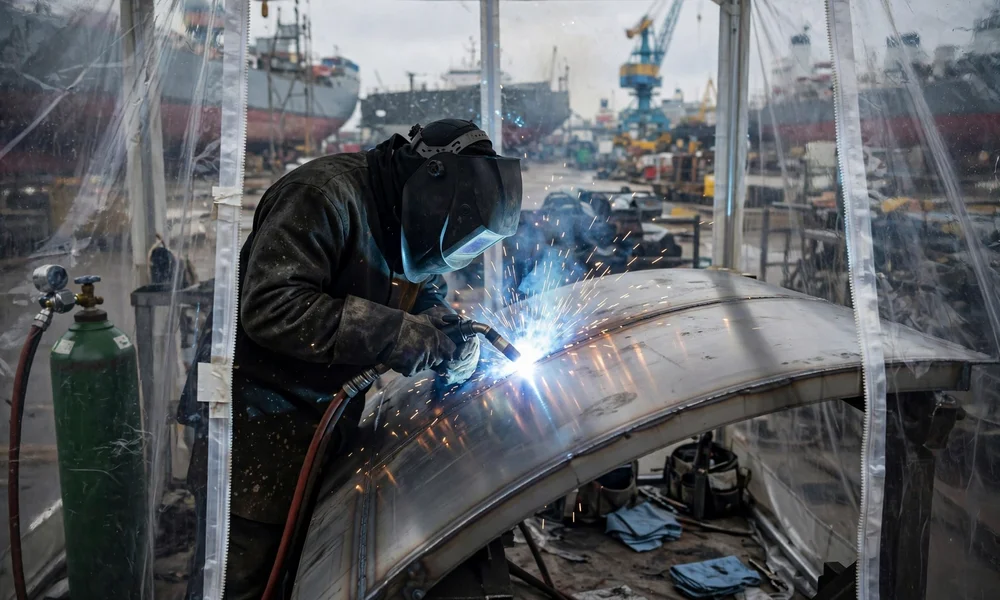
Welding is where the cost climbs fastest. Hot titanium grabs oxygen and nitrogen from the air and turns brittle, so every weld must be made inside a shield of argon gas, with welders working in sealed tents or behind trailing gas shields that keep air away until the metal has cooled. A single hull contains kilometres of weld, and each metre is laid slowly, in short passes, by welders who are among the most highly trained in shipbuilding. How a submarine titanium hull works describes the structure those welds hold together, and the welding is the reason the structure costs what it does. Every weld is inspected with ultrasound and X-rays, and a weld that fails is cut out and redone at full cost.
Scrap, testing, and the cost of getting it wrong
Titanium machining produces large amounts of swarf, the metal chips cut away to bring a part to size, and although the swarf can be recycled, it is worth far less than the plate it came from. Yields are low: a significant share of the metal bought never reaches the finished hull. Then comes testing. The empty hull is pressure-tested in stages, filled with water and raised to pressures beyond any depth it will ever reach, while sensors listen for leaks or movement. Certification adds more: every plate, weld, and test must be documented and signed off, because the hull will carry a crew into water that would crush a lesser structure in seconds.
Small numbers: a hull with no production line
Only a handful of titanium submarine hulls have ever been built, and each one is effectively a prototype. There is no production line to spread the cost across, no learning curve that brings the tenth hull down to half the price of the first, and no supplier who stocks titanium hull plates off the shelf. Why titanium is worth its price makes the general case, and the submarine hull is the extreme version of it: the metal earns its keep in exactly the places where failure is not an option, and it is priced for exactly that.
Titanium Submarine Hull Specifications
| Specification | Typical figure |
|---|---|
| Material | Titanium alloy, aluminium and vanadium grades |
| Weight vs steel | About 40 percent lighter for equal strength |
| Corrosion | Highly resistant to seawater, minimal maintenance |
| Plate thickness | Thick curved plates, rolled to hull diameter |
| Welding | Argon-shielded, ultrasound and X-ray inspected |
| Testing | Full pressure test beyond maximum operating depth |
| Hulls built | Only a handful, each effectively a prototype |
What a Titanium Submarine Hull Costs
A titanium submarine hull adds an estimated $100 million to $300 million to the cost of a submarine, compared with a steel hull of the same size, depending on the boat’s dimensions and the yard’s experience. The premium comes from the raw metal, the forging and rolling, the argon welding and inspection, and the low production volume, in roughly that order. The whole submarine can cost an estimated $1 billion or more, so the hull is a large share of a very large bill. Navies accept it because the hull buys greater depth and a hull that does not rust, which means less time in dry dock and a longer life at sea. Over a service life of thirty years or more, the maintenance saved narrows the gap, but it never closes it.
A Rare Fact About the Titanium Submarine Hull
The most famous titanium submarines were built in the Soviet Union, and their hulls were so expensive that the programme built only a handful of boats before the cost ended it. One class could dive deeper than any other submarine of its era, and its titanium hull was part of the reason. The lesson was clear: titanium can take a submarine deeper than steel, and the price of that depth is a hull that costs as much as a small fleet of ordinary ships.

The titanium submarine hull is expensive because every step of making it is hard, slow, and unforgiving, and because only a few have ever been made. It is the price of depth, paid in sponge, argon, and patience, and no navy has yet found a cheaper way to buy it.