On a calm evening in a crowded anchorage, the most important piece of equipment on a superyacht is the one nobody is looking at. The anchor is down, the chain is out, and a vessel worth tens of millions is held in place by a few hundred kilos of steel and the grip of a fluke buried in the seabed. When the wind rises at three in the morning, that grip is the difference between a quiet night and a disaster. Nobody on board thinks about the anchor system until the moment it matters most — and by then, it had better be the best money can buy.
A yacht anchor system is not a single object. It is a chain of parts — anchor, chain, windlass, bow roller, chain locker, controls — that must work together under loads that would snap ordinary hardware like string.
The cost comes from the size, the materials, and the engineering needed to make it all reliable in the worst conditions a yacht will ever meet. Here is where the money goes.

Why the Yacht Anchor System Costs So Much
1. An anchor forged to hold a floating hotel
A superyacht anchor is a serious piece of steel, often weighing 300 to 500 kilograms, shaped so that it digs in and holds under a pull many times the weight of the yacht itself. The best anchors are forged from high-tensile steel, not cast, because forging lines up the grain of the metal and makes it far stronger for its weight. A cheap anchor drags. A good one holds through a gale, and the difference is in the steel and the shape.
2. Chain measured in tonnes, not metres
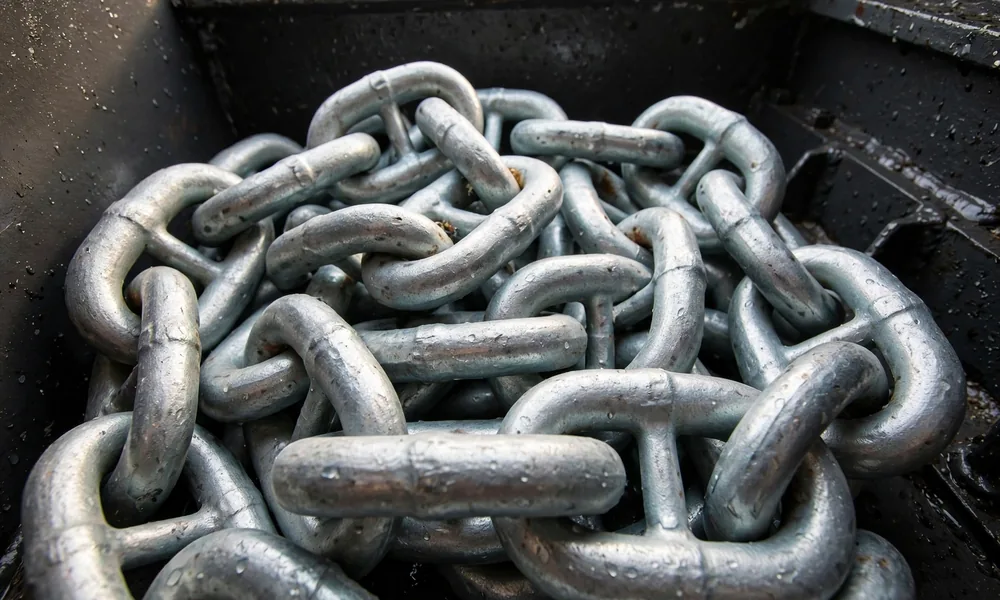
The chain on a large yacht is not a decorative extra. It is the part that does most of the holding, its weight lying along the seabed and keeping the pull on the anchor horizontal, which is how an anchor grips best. Superyacht chain is high-tensile, calibrated link by link so it runs smoothly through the windlass, and hot-dip galvanised against corrosion. A full set can weigh several tonnes and cost as much as a family car, and it must be replaced on a schedule, because a single corroded link is a weak point in the whole system.
3. A windlass that lifts tonnes without complaint
The windlass is the powered winch that hauls the anchor and chain back aboard, and on a superyacht it must lift several tonnes of steel while the yacht is pitching in a swell. It is built from bronze, stainless steel and marine-grade alloys, driven by a hydraulic motor or a heavy electric motor, and sealed against salt water. A windlass failure leaves the crew hauling by hand, which on a large yacht is not a real option. The windlass is engineered to work first time, every time, for decades, and that reliability is expensive to build in.
4. Built for salt water, which attacks everything
Salt water is one of the most corrosive environments on Earth, and an anchor system lives in it permanently. Every part is chosen or treated to survive: stainless steel where it can be afforded, hot-dip galvanising where it cannot, bronze for the parts that move, and sacrificial anodes that corrode first to protect the rest.
5. Controls, sensors and the crew’s safety
A modern superyacht anchor system is operated from the bridge, from the bow, and sometimes from a remote control on deck, with chain counters, load sensors and alarms that tell the crew exactly what is happening below. The system must be fail-safe: if power is lost, the anchor can still be released, and the brake must hold the chain even if everything else fails. All of that electronics and safety engineering sits on top of the steel, and it all has to work after months at sea in salt air. The same thinking runs through every system below the waterline, as our guide to yacht keel specs shows.
6. Custom fitted to one bow, and one bow only
No two superyacht bows are alike, and the anchor system is designed around the shape of the hull it serves. The anchor pocket, the bow roller, the chain locker and the windlass mount are all shaped to fit a particular yacht, so the anchor stows flush, deploys cleanly, and never touches the hull. That custom fit is why the system works so quietly and reliably — and why it cannot be bought off a shelf. The propeller below the stern gets the same bespoke treatment, as our look at yacht propeller specs explains, and the stabiliser fins that keep the yacht steady share the same philosophy, covered in our guide to yacht stabiliser fins.
Yacht Anchor System Specifications
| Specification | Typical superyacht system |
|---|---|
| Anchor weight | 300–500 kg |
| Anchor material | Forged high-tensile steel, galvanised or stainless |
| Chain diameter | 16–22 mm, high-tensile calibrated |
| Chain length | 200–300 metres |
| Chain weight | Several tonnes |
| Windlass pull | Several tonnes, hydraulic or electric |
| Controls | Bridge, bow and remote, with chain counter |
| Service life | Decades, with scheduled chain replacement |
How Much Does a Yacht Anchor System Cost?
Prices are estimates, because every system is custom fitted to its yacht and builders rarely publish a price list. A complete anchor system for a large yacht — anchor, chain, windlass, bow roller and controls — is generally estimated at $80,000 to $250,000, with the biggest superyachts going higher. The anchor alone can cost $15,000 to $40,000, a full set of high-tensile chain can cost $30,000 to $80,000, and the windlass and installation make up the rest. It is a large sum for equipment that spends most of its life out of sight, but it is the equipment that keeps the yacht where the crew put it.

A Rare Fact About Yacht Anchor Systems
The anchor chain on a large yacht is so heavy that it does most of the holding all by itself. When a yacht is anchored in deep water, the weight of the chain lying on the seabed acts like a giant spring, absorbing gusts and keeping the pull on the anchor flat along the bottom. In a strong blow, the chain lifts link by link off the seabed, and only when the very last links start to rise does the anchor itself take the full force of the wind — which is why experienced captains let out far more chain than seems necessary.
That is the real answer to why a yacht anchor system costs so much. It is a chain of parts — anchor, chain, windlass, controls — each built to survive salt water and to hold a floating hotel in a gale, fitted to one bow and expected to work first time, every time, for decades. The price is the cost of that certainty, paid once so that nobody on board ever has to worry about it at three in the morning.