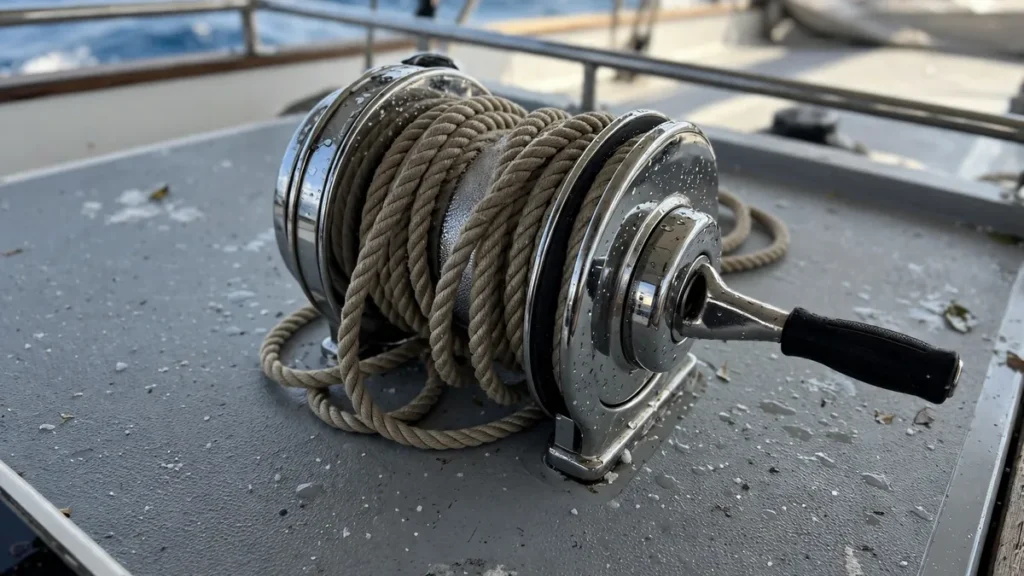
The wind has come up overnight, and the anchorage that was calm at sunset is now a different place: white horses on the water, the yacht swinging on her chain, the anchor somewhere down below in the dark holding everything. On deck, the crew checks the chain, checks the windlass, and looks at the shore to see if the boat has moved. It has not.
An anchor system is the most old-fashioned thing on a modern yacht, and also one of the most important. It is a heavy piece of shaped steel, a length of chain, and a machine to haul it back up. And yet the whole system — anchor, chain, windlass, and the way they work together — is as deliberate as anything else on the boat. The numbers that describe it are the numbers that describe holding power: the anchor’s weight and fluke area, the chain’s diameter and length, the windlass’s pulling power. They decide how much wind the yacht can ride out. Here is what those numbers mean.
How It Works
Step 1: The anchor itself
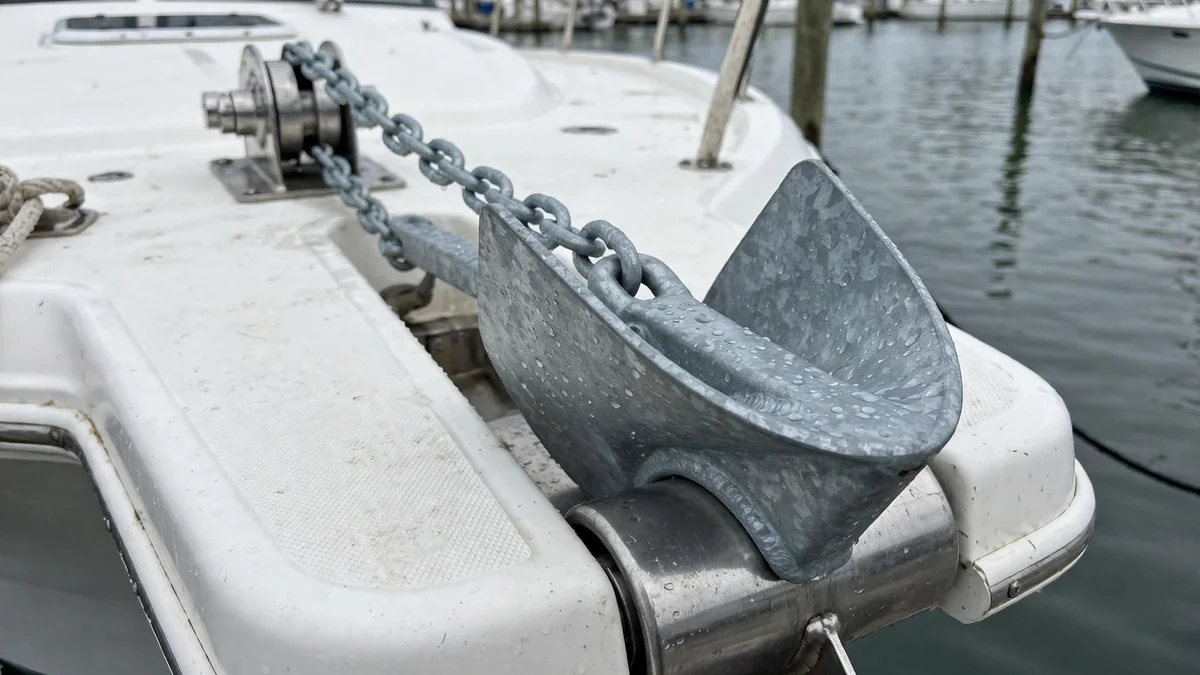
A modern yacht anchor is usually a scoop or spade design — a single curved fluke with a sharp toe and a weighted tip, like a ploughshare — which digs itself deeper the harder it is pulled. Shape matters more than weight: a well-designed 15-kilogram anchor can hold better than a poorly designed 25-kilogram one. The anchor is stowed on a bow roller, a fitting on the stem that lets it drop and return without banging the hull. The bow is planned around it, as described in how a yacht anchor system works.
Step 2: The chain and the catenary
Behind the anchor comes the chain, and the chain does as much of the holding as the anchor itself. Anchor chain is short-link galvanised steel, usually 8 to 13 millimetres in diameter, and its weight is the secret: when the yacht pulls, the chain lifts off the seabed in a curve called a catenary, and the weight of the hanging chain absorbs the shock of waves and gusts before they reach the anchor. That is why scope matters — the ratio of chain let out to water depth. The rule is five to seven times the depth in normal conditions, more in bad weather. Too little chain and the pull comes from above, yanking the anchor out; enough chain and the pull stays horizontal, where the anchor is strongest. Chain materials and protection are covered in yacht anchor system materials engineering.
Step 3: Setting the anchor
Setting an anchor is a skill, not a drop. The crew lowers the anchor until it touches the bottom, then lets the yacht drift back slowly, paying out chain, until the anchor bites and the chain comes taut. Then the engine is put gently into reverse to test it. A well-set anchor in sand or mud will bury itself completely, fluke and shank, and the harder the wind blows the deeper it digs. A set anchor holds many times its own weight, because the seabed, not the anchor, does most of the holding.
Step 4: The windlass
Getting the anchor back up is the windlass’s job, and it is one of the hardest-working machines on the yacht. The windlass is an electric or hydraulic winch on the foredeck, with a gypsy — a toothed wheel shaped to grip the chain links — that hauls the chain in link by link, and a drum for rope. A windlass for a 50-foot yacht might pull with 700 to 1,500 kilograms of force, even while the anchor is buried and the chain is under load. The windlass also has a manual override, because an anchor that cannot be raised is a yacht that cannot leave. Costs are explained in why a yacht anchor system is so expensive.
Step 5: The chain locker and the bitter end
The chain disappears down a hawse pipe into the chain locker, a compartment in the forepeak where it piles up in a pyramid as it comes in. The locker has to be deep enough for the chain to fall freely, and it has to drain, because the chain brings seawater with it. At the very end of the chain is the bitter end, the last link, attached to the boat with a rope strop that can be cut in an emergency. That is the final safety: if the anchor snags and the yacht must leave in a hurry, the crew can cut the bitter end and abandon the anchor.
Step 6: Holding in bad weather
In a gale, the anchor system is tested properly. The windage of the yacht — the force of the wind on the hull, rig, and superstructure — can reach several tonnes in 40 knots, and the chain and anchor have to hold it hour after hour while the boat surges and swings. The chain absorbs the shocks, the anchor digs deeper with every gust, and the crew watches for dragging. If the anchor drags, the crew gets it up, motors clear, and sets again — before the shore gets close.

Yacht Anchor System Specs
| Specification | Typical range |
|---|---|
| Anchor weight | About 10 to 40 kg for yachts of 30 to 60 feet |
| Anchor type | Scoop or spade design, steel, often galvanised |
| Chain diameter | About 8 to 13 mm short-link galvanised steel |
| Chain length | About 50 to 100 metres, sometimes more |
| Scope ratio | 5 to 7 times water depth, more in bad weather |
| Windlass pull | About 500 to 2,000 kg depending on yacht size |
| Windlass power | About 500 to 2,000 W electric, or hydraulic |
| Holding power | Many times the anchor’s own weight when well set |
What Does a Yacht Anchor System Cost?
A complete anchor system for a 40-foot yacht — anchor, chain, and windlass — is estimated to cost roughly $2,000 to $6,000, while a system for a 55 to 60-foot yacht is estimated to cost roughly $6,000 to $15,000, and a superyacht system with a large anchor, heavy chain, and hydraulic windlass is estimated to cost $30,000 to $100,000 or more. The anchor itself is estimated at roughly $300 to $2,000 depending on size and design, the chain at roughly $5 to $15 per metre, and the windlass at roughly $1,500 to $8,000.
A Rare Fact
The anchor is one of the oldest pieces of technology still in use, and its shape has barely changed in three thousand years. Stone anchors were used in the Bronze Age, and the Admiralty pattern anchor was standard from the 19th century until the middle of the 20th. The modern scoop anchor, which looks nothing like the classic Admiralty shape, was only invented in the 1930s — the CQR, designed by the mathematician Geoffrey Ingram Taylor, was the first to use a hinged plough shape that dug itself in. And yet the word itself is older than all of them: anchor comes from the Greek ankura, meaning a hook or a bend, and it has meant the same thing for as long as ships have existed.
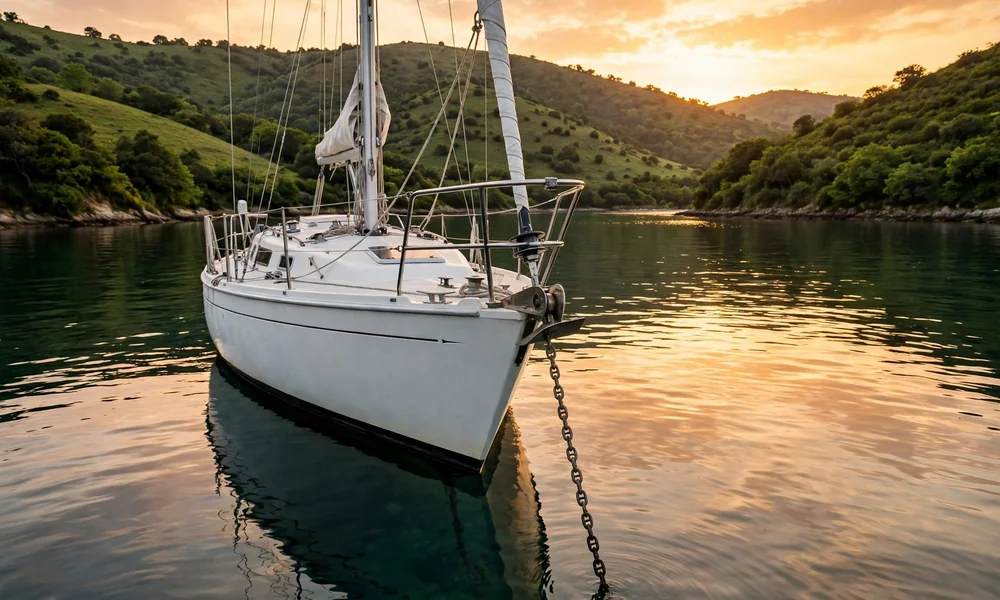
Next time you see a yacht sitting peacefully at anchor, remember what is holding her there: a piece of steel the size of a shovel, buried in the mud, with a chain doing the quiet work of a shock absorber.